Tuesday, 14 April 2009

April 8th: The Guns


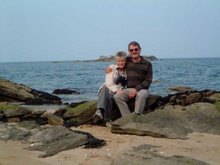
In 1926 Spain decided to modernise its’ coastal defences. The armaments for this were largely contracted to the British firm of Vickers, and one such battery was located on a headland 10 miles from the campsite to defend Cartagena harbour, headquarters of the Spanish Mediterranean Fleet. The site was abandoned in 1993, leaving the hardware mostly intact (but no live ammo!), and some serious hardware it was, the biggest being the 15-inch guns, which Jane and a friend are propping up.

There are some lovely views from the headland, which I’m sure the Spanish servicemen stationed there hated with a vengeance as it’s located miles from anywhere.

Sunday, 12 April 2009

April 6th: Mazarron Mines


The ores here bear mainly lead, zinc and silver, and have been worked since pre-Roman times, right up to 1966. Peak production was during the 1860 to 1940 period with more than 2,000 people employed.

In 2005 the mining area was designated a historical site, which doesn’t mean they’ve done any conservation or safety work: it’s perfectly possible to fall down an unfenced mineshaft or fall off crumbling steps. The ramshackle nature of the site makes it all the more interesting though, and reminds you that ultimately you are responsible for your own safety rather than assuming it’s always guaranteed by some official umbrella.

p.s. I thought the winding gear photo seemed more dramatic in black & white.

April 1st to April 5th:Spain Again

Stayed at Granada en route from Morocco to our favourite site near Mazarron, in the province of Murcia. From Granada to Mazarron is about 4 hours drive, through some lovely mountain scenery.

Los Madriles campsite has about 200 pitches in terraced rows, so most have good sea and mountain views. The pitches are individual and separated by shrubs or trees, so are fairly private, with gravel surfaces. That’s much better than the other medium used here – beaten earth- that turns into mud after heavy rain. Grass, commonly used in the UK, doesn’t survive the summer heat. The photo shows evening sun on the hill along one of the terraces.

Tuesday, 31 March 2009

March 27th to 31st: Moulay Bousselham


We moved today from Marrakech 300 miles north to our last port of call in Morocco. The campsite is by a lagoon that connects with the sea at the village of Moulay Bousselham, where there is a fine sandy beach. The village takes its’ name from a 10th century holy man and is a place of pilgrimage as well as being a weekend resort favoured by wealthier Moroccans.

We did, by the way, solve the mystery of the half-finished buildings, mostly dwellings. It seems that Moroccans typically build their own houses by saving up and doing it a bit at a time, and it might take 10 or 15 years to complete. They don’t have a mortgage system as borrowing and interest are frowned on for religious reasons.

Had to include this last shot of an unfinished house, only to show the scaffolding system generally used. They obviously need to get through this stage of construction fairly quickly, at least before woodworm sets in!

Thanks, Morocco, it was wonderful!

Sunday, 29 March 2009

26 March; Operation Overload

These photos show just some of the overloads and dangerous loads we saw, certainly not the most extreme examples, as you rarely have the camera ready at the right moment.


The most dangerous load that we saw was carried by a moped, weaving at high speed through the souks. The moped passenger was a youth holding a large sheet of glass (4ft by 3ft ish), flat face forward, with his bare hands. The most burdensome load was a woman carrying a 15kg gas bottle on her head.

24 March: Tourist Marrakech.


The large central square in the Medina (old town) comes alive after dusk with a host of performers: African bands, snake charmers, acrobats, storytellers, food stalls etc. They all collect money for watching the performance or taking photos and all ask for ridiculous amounts initially. The group here wanted the equivalent of £4 for a few snaps, but we only gave what we thought was reasonable, so they got £1 (10 dirhams).

The picture above is of the interior of a madersa, a Koran school. This one was refurbished in the 1560’s and is covered with intricate designs and, overall, gives the impression of great peace and harmony. Experts think that the same craftsmen worked on this building as worked on the Alhambra Palace in Granada, Spain.

The El Badi Palace (was there an el Goodi?) dates from the same period as the madersa, but is now a ruin. Above, Jane takes the part of the ghost doomed to perpetually wander the crumbling subterranean passages. The photo below is of the icon of Marrakech, the Koutoubia Minaret, completed in the 12th century, and visible for miles, given the absence of tall buildings here.

23 March: The High Atlas

These are the highest mountains in North Africa and rise steeply from the plain, 30 miles south of Marrakech. On this particular route into the High Atlas, the road runs out at the village of Imlil (alt. 5,700 ft.). It’s a trekking centre so you can continue on good tracks by mule, on foot, or 4X4.

We carried on walking a short way up the path toward Djebel Toubcal, the highest peak at 13,681 ft., avoiding the guides touting for hire and even guides who’ll find you guides!