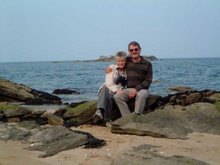
Saturday, 17 October 2009

Oct 10th-14th: Small Towns in Tuscany


Sometimes smaller places give you a better atmosphere of past times than the showcase cities.
San Gimignano is an example. The whole town is 14th C and is all the more authentic for being a little patched up here and there.


Each building is also so different.


These worn steps are from the town of San Miniato. You can picture the medieval townsfolk strolling up and down them of an evening & maybe the odd medieval drunk falling in a heap at the bottom.
Not much has changed!

Wednesday, 14 October 2009

Oct 11th: Pisa

Couldn’t go to Pisa and not include THE photo. We did resist the tourist’ favourite snapshot: the photo showing the hands of child/partner/friend stretched out supporting the toppling tower. Immense pains were being taken, “in a bit”…”out a bit”…to snap the hands in the precise position to save the precious monument.

This is the actual brass light fitting that Galileo saw swinging back and fore, and deduced that it appeared to take the same time to swing each arc, even as it was slowing down. He turned these observations into formal calculations for the time-swing of the pendulum, the principles of which were applied to create pendulum clocks, the most accurate timepieces in general use until modern times.


Wondrously lifelike, intricate carved figures support the pulpit in Pisa cathedral. The lady’s hand in covering her nakedness shows a very proper modesty. You aren’t allowed to speculate on any other interpretation.

Monday, 12 October 2009

Oct 9th: Florence


Any city that’s named after a character in the Magic Roundabout has to hold high expectations, and Florence didn’t disappoint. Here we have the Ponte Vecchio, and then us in front of a copy of Michelangelo’s David in the Piazza della Signoria. The Piazza itself was full of wonderful statues and palaces. Far too much to do in a day, so further trips on the cards.


We took the train to Florence. Italian trains seem to run reasonably to time but all look in need of tlc and are covered in graffiti- see sad example below. While waiting for the stopping train to take us to Florence, an express thundered through the station, which is on a curve. The express was able to take the bend at such a high speed because the railway lines are set at different heights, so creating a banked track. What a brilliant idea! Our train pulls up a few minutes later. We are now presented with getting into a train with an upward slope of 30 degrees. So much for the banked track! It does hasten the departure of alighting passengers, however, by rolling them straight onto the platform as soon as the doors open.

Friday, 9 October 2009

Oct 4th to Oct 7th: Ciao Italy!

We arrived yesterday at Montopoli where the site is almost empty, as can be seen from the photo. You won’t be able to see that the caravan aerial is missing, replaced by a small silver lump. That’s half a coke bottle secured by elephant tape. The aerial snapped somewhere en route but, fortunately, was prevented from falling off by the cable, so simply rolled around on the roof. Elephant tape is the most wonderful instant repair solution and secures anything including, presumably, defective elephants.

The weather today was sunny and warm (26º). We spent a lazy day on site followed by a pleasant evening walk up to the picturesque small town of Montopoli (nearly the board game!). We are conveniently located 25 miles from Pisa or Florence and well placed to visit most parts of the region.

Saturday, 20 June 2009

June 10th- 16th: France, The Lot Valley


One days drive from Barcelona takes us to Vers. This is a village near Cahors with a municipal campsite on the banks of the river Lot. The photo is taken from the end of the camp where we were pitched. It is a beautiful setting and very peaceful – apart from Friday night when a gang of noisy campers partied until the early hours. They left on Saturday morning after consultation with the warden!

The village above is St Cirq Lapopie, a short drive away from Vers. It clings to the cliffs above the river Lot and is mostly medieval. The houses below are typical. It did have a number of expensive boutique clothes shops, souvenir stores and restaurants, but did not come across as too touristy.

Had to really include the photo below of Cahor’s famous bridge, the Pont Valentré. It dates from the 13th Century and, when we walked over it, we were impressed by how sturdy and well repaired it still was. Half expected a troupe of Knights to come clopping across, but had to make do with a party of schoolchildren.

The weather was a comfortable 25 to 28 degrees maximum. To sum up, this area’s got the Lot! Now, sitting in Calais car ferry port writing this, two days after leaving Vers, temperature 15 degrees, reminds us we’re now back to real Summer weather.

Friday, 19 June 2009

June 9th: Barcelona Part 2


We wanted to get an overall feel of Barcelona, so where better to start than with Gaudi’s architecture, and the city’s no.1 attraction the unfinished cathedral Sagrada Familia. Gaudi worked on this, on and off, for 43 years until his death in 1926 (run over by a tram). He based his designs on natural forms- trees & plants, crystals, shell patterns etc. and work is currently proceeding towards completing the cathedral using these principles. It is planned to finish it by 2030. The next photo shows some tree-like main support pillars that are of the recent construction.


Gaudi’s own work is much more ornate, and presumably accounts for the 43 years he put into it. The photo below illustrates the wealth of detail above the entrance doors in the main facade that is part of the original structure.


More Gaudi below – a block of apartments in the centre of the city. Note the flowing lines and organic appearance. It is remarkable to think this building was constructed in the early 1900’s.


This one below, again, is all curves, but more highly decorated with tiles.


As we said in the previous blog, Barcelona is an elegant city and the final pic of the fountains, and Jane, in the Placa de Catalunya sort of sums it up. Pity about the yellow barrier, but this is a “warts and all “ show, folks.

Monday, 8 June 2009

June 7th: Barcelona


All major ports in Spain seem to claim theirs was the departure point for Christopher Columbus’ discovery of America. Barcelona is no exception and has a huge commemoration column to prove it!

Starting at Christopher Columbus on the waterfront, we walked up the most famous street, which is called the Rambla. There are stalls, artists and street performers everywhere, most quite unusual and amusing, but what a way to earn a living! The clown below roamed around making a nuisance of himself by e.g. putting his wig on bald passers-by and startling women with a whistle. We watched him while having coffee at a pavement café and were much tickled. If not for the clown’s gear, he would surely have been arrested.

The Rambla itself is full of elegant buildings, like the Opera house. The picture below is of a house decorated with classical style figures and objects.

We walked from the Rambla a short way into the Gothic Quarter, the oldest part of the city that houses the cathedral and many lovely squares. The lovely square in the photo below is Jane.

One more for the road: a medieval courtyard with a classical guitarist who was very good. It’s a sad comment that he was getting fewer donations than the clown!

Picasso Museum next stop, but obviously no photos allowed. The museum was laid out in the chronological order of Picasso’s life (1881-1973), from his early roots as a portrait painter through his blue period and on to cubism. Apart from the portraits, we were generally rather baffled by his work, but it was a really interesting experience.
Barcelona came across as a clean, stylish and vibrant city, with plenty to see. We only scratched the surface but we’ll report more after our next visit tomorrow.