Tuesday, 23 February 2010

Feb 20th: Farragudo

In between showers we take a trip along the coast to Ferragudo, originally a fishing village, and walk from there.
There are still some fishermen around as evidenced by the jumble of fishermen’s huts showing signs of occupation. There were also stacks of lobster pots on the quay we had just walked past. The rest of the town is devoted to tourism.


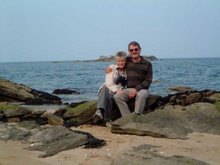
But we quickly get to some small pretty bays and enjoy the sheltered sunshine.
Just after taking the photo, the surf rushed in and soaked Jane’s trousers.


We nearly manage to get back before a sharp shower, but there followed an interesting mixture of clouds and sunshine, resulting in an unusual picture.

Monday, 22 February 2010

Feb 17th to 19th

Camping Albufeira is a large site, part of which is block-booked each year by the Camping and Caravanning Club of the UK to hold a rally. As members of the club, we booked our pitch through them to get the discounted site fees. We’ve never been on a rally before, but know all about them through the Club magazine: lots of social events like line dancing, quiz nights, bingo, whist drives, walks etc. Well, we are keen on the walking. Checking in with the rally steward, he said, “There’s lots of activities, but no pressure.” We breathe a sigh of relief. He continues, “But unless all members support these functions we’ll lose the use of the hall.” Gulp.


The weather is mild but unsettled. Long-stay rallyists tell us it’s been raining since December. If your pitch becomes waterlogged, the campsite has a rapid response gravel service. A lorry appears and two men Feb 17th to 19th furiously shovel gravel onto your pitch and then rake it into the mud and puddles. We requested this facility on day 2 and were impressed by its’ efficiency. The Portuguese are clearly less mañana than the Spanish. You can see all our lovely effective gravel on the photo, and how our pitch would be un–gravelled by looking at the vacant plot adjacent. It is water, about 6 inches deep

Friday, 19 February 2010

Feb 15th & 16th: from Merida to Albufeira


We arrive at Merida on Sunday night, Feb 14th, and will stay an extra day here. Merida is a pleasant town with a big Roman history. The photo shows a Roman bridge 720 metres long in excellent condition. The biggest threat to the survival of Roman structures wasn’t decay, but the pirating of the beautifully trimmed stones to be reused in other building work.

The Moorish fort in the town is an example of this, built entirely of “re-cycled” Roman building blocks. The bridge itself was preserved intact presumably because it continued to be needed to cross the river.

This is the bullring, built in the Moorish style. It looks like most people’s nightmare of a package holiday hotel.
Merida to Albufeira is around 5 hours drive and, after about half way, warmish and sunny (18 degrees). We arrive late afternoon and book in to the site.

Thursday, 18 February 2010

Feb 2010 Going To Blogging Portugal!

Feb 10th to Feb 14th

We left home in light snow and a bitter wind. Through the tunnel and into France it was the same. Usually French Aires (the picnic areas) look good enough to spend your whole holiday in, but the weather changes one’s perceptions, as the photo shows, and the functional toilet block takes on the appearance of a Russian H-bomb shelter.


So on to Arcachon, just south of Bordeaux, where we stayed for a couple of days. Arcachon overlooks a large lagoon famous for its farmed oysters. The must-see visit here is what the French claim is the highest sand dune in Europe. We climbed it, puffing and panting, and were rewarded with an impressive view from the top even on such a grey (and bitterly cold) day. However, all Welshmen believe that the dunes at Merthyr Mawr, near Bridgend in South Wales, are higher. Clearly, only a game of rugby between the two countries can ultimately settle this dispute.
Driving the short distance from the dune back to the campsite, an oncoming car impacted with one of the towing mirrors. These project an extra foot beyond the normal mirror so you can see around the caravan when towing. They should be removed when you’re not towing, but hey, we’re only here for a day, so I didn’t bother. A salutory lesson! But apart from a loud bang and the total disintegration of the mirror, no other damage was done- and the other vehicle didn’t even stop.


Saturday 13th saw us crossing into Spain near Biarritz, with more sprinklings of snow and biting winds. Lots of snow on the Pyrenees and other mountains as we proceed inland, all very picturesque.


Sunday, today: stopping for coffee at a roadside café, I noticed a rack labelled “gifts”. It was composed entirely of catapults! Do let us know if there’s any nice little lad you want to send a little prezzie to: anything to get his head out of the computer.

By early afternoon we passed around Salamanca, continually heading south, although you’d hardly believe it because at no time since we started from England has the temperature risen above 3 degrees.

Monday, 2 November 2009

30th Oct: The Isle of Capri

Well, Sorrento drew us back sooner than we thought, if only to catch the ferry to Capri! A flat calm day was essential as we are not good sea travellers even for the 25 minutes on the hydrofoil. This is the pretty little harbour from where we ascended by funicular to the main town, also called Capri. Capri is a classy, attractive town of small squares and narrow alleyways

The island is 4 miles by 2, so any elevated position gives stunning coastal views. This one, from the edge of Capri town, shows a deep blue sea and, if you can spot it, a turret near the shore was part of the villa where singer Gracie Fields used to live. That won’t mean much if you’re not in our age group, but she became Britain’s highest paid pre-war performer. Husband no.2 died in 1950, so she lived there alone until 1952 when she married a Rumanian-born local who had come to repair her radio!

Then we walked from Capri town, up 1,000 ft to Emperor Tiberius’ palace overlooking the mainland. Tiberius ruled the empire from here for the last 10 years of his life, from AD27 to 37, and it was here that he received the news of Christ’s execution.

This next photo doesn’t look at lot different from one earlier. It would have had great significance had you been one of Tiberius’ victims: they were cast off these vertical cliffs near the palace. Wringing a positive comment from this severe type of justice, it was probably somewhat more effective than ASBOs.


Parts of the island are quite populated, but there are just a few full size roads e.g. between the port and Capri town. The main communication arteries are lanes too narrow for cars. These have good pavement surfaces and take special narrow electrically powered vehicles, as in the example below. As with the APE 50’s, are we looking at the future?


Capri did have a certain magic but we needed more time to savour the quieter parts of the island.

Saturday, 31 October 2009

27th Oct: Come Back to Sorrento!


Yes, beautiful climate, lovely cliff-top views, handsome town etc., but not exactly dragging us back. Did we miss something?

Now this below is much more interesting. Jane’s really taken with it. These small 50cc transports are to be found all over Italy. It’s called an APE 50, steered with motorbike handlebars, and designed for driver only but frequently accommodates two Italians. So, scrap our fancy cars & let’s all have one of these. At a stroke, it’s the energy crisis solved, speeding offences solved, junk transportation problems solved. It’s also the ultimate social leveller. (Metallic paint, turbo, 3 wheel drive versions, all not allowed, but perhaps a covered wagon version to transport the family would be permissible).

Wednesday, 28 October 2009

25th Oct: Up Pompeii!

We’re now staying near Sorrento and today visited Pompeii: 20 minutes on the train.

The scale of Pompeii was far greater than we expected, as was the state of preservation, all due to being covered by 6 metres of volcanic ash. The culprit was Mt. Vesuvius, shown in the background and me in the forum. Doesn’t look very threatening, does it? (The volcano, not me!)

The town was laid out on a grid system and what you see here is the main shopping street, complete with traffic calming measures! These big stones were actually stepping stones for pedestrians to cross the street in wet weather leaving gaps sufficient for cartwheels to pass.

This is an example of a shop selling food. The food was stored in jars sunk into the counter top and could, if necessary, be kept warm by heating the jar from underneath. Fast food Pompeii style. We weren’t able to determine where the Clarks shoes agency was.

The houses & gardens of the wealthy were lavishly decorated. These are some examples of the murals.


Can't decide if this guy is having a sly fag or picking his nose.


Building Methods. What looked to be solid stone usually wasn’t. They built most structures in brick, or a mixture of brick and stone, and then faced that over with mortar and/ or plaster. The decaying wall photo shows how these layers are built up.


Entertainment: the Coliseum. This is the oldest one known, and you can see its’ interior scale with reference to the two modern-day posers.

The exterior of the building should be even more awe-inspiring, but actually looks like a disused victorian railway viaduct.

Finale: an atmospheric temple, jazzed up a bit by the photo-programme.


In summary, Pompeii was a most impressive place.