Thursday, 10 June 2010

June 5th: The Rance Estuary


We’ve already described the walk along the estuary into Dinan. There was no evidence of it being tidal, but walking the other way explains why: a barrage and lock gates. So, on one side of the lock is a marina permanently full of water, on the other a tidal river.

A road runs across the barrage so when a tall-masted yacht wants to go through the lock, the lockkeeper has to move the road out of the way. It swivels, as the photo shows. We were actually stood on the swivelling section before it moved, and couldn’t understand why the lockkeeper kept waving at us. “What a nice chap”, we thought, only reflecting afterwards on what he might have been muttering under his breath!

We kept going along the path along the tidal stretch and noticed numerous fishing huts on stilts, mostly like the one in the photo, in a ramshackle condition. They are evidently in current use and must be more robust than they look.
Farther on down the estuary, at Dinard near the sea, is another barrage. This one is 330 metres wide and contains the largest batch of tidal electricity generators in the world. The cost per unit is now less than nuclear, which supplies more than 60% of France’s electricity. Has the UK missed a much bigger opportunity with a 10- mile wide Severn barrage?

Monday, 7 June 2010

June 2nd: Mont Saint Michel

We’re on a family outing to Mont Saint Michel today, and it’s cool with rain and low cloud.

The abbey is magnificent, with its’ multitude of buildings that sit atop the island of Mont St. Michel. They mainly date between the 12th and 16th centuries although the first record of a religious building was of an oratory in the 8th century, built by Aubert, Bishop of nearby Avranches, following a vision he had of the Archangel Michael. St. Michael gave Aubert a straight choice- found either an abbey, or M & S Stores.

Today a 2k causeway links the island, but in the Middle Ages it was truly an island except at low tide. The tide here goes out as much as 15k, the farthest in the world, and comes in very rapidly, reputedly (and exaggeratedly) at the speed of galloping horses. You can see the extent of the bay in the photo and how far away the tide line is. Pilgrims who visited the abbey had to judge it just right or get caught in the tide or quicksand. There were many tragedies.

The massive construction, of which the above picture shows but a small part, is all stone blocks. These were quarried from the nearby Chausey Islands or Brittany, and brought by boat or across the sand by dodging the tides, and then hauled up to the top of this precipitous rock. That’s before building could begin! It was an amazing achievement, and the construction work is of a quality comparable with the great cathedrals of Europe. The cloisters below show the harmony of the design.

The next two pictures are just two examples of beautiful and atmospheric parts of the abbey.


But we’re not going into raptures about everything. Leading up to the abbey is the main street, full of tourist shops, restaurants and hotels. This is serious rip-off territory. It’s interesting how these places like to produce a character from the past with some kind of provenance so as to justify premium prices. In this case they’ve raked up a Mère Poulard, her on the hanging sign on the left in the photo. Mère Poulard, we are told, produced the most delicious omelettes here over 100 years ago, so you can sample its like in numerous restaurants, or buy MP cookbooks, cooking pans, biscuits, aprons, mugs, plaster of Paris figures etc.

Anyway, as the weather was pretty awful, a consolation was needed and a round of ice creams was thought to precisely fit the bill. However, the setting does make it look like the prisoners’ last request (we were sheltering)!

Saturday, 5 June 2010

May 28/29th: St Malo


St Malo’s old town is a walled citadel. It is, however, an accurate reconstruction as 80% of it was destroyed during the last war. It was originally a fortified island occupied by pirates who used its’ commanding position to control this section of the coast and extract tribute from passing ships. These pirate adventurers travelled far and wide, exploring and settling such places as the Falkland Islands, which they called Les Malouines (a St Malo inhabitant is a Malouin), and hence the Spanish name Las Malvinas. So really Brittany should be claiming the Falklands.

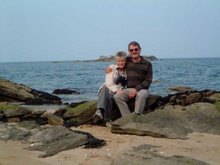
This week we’re tying up with Adam, Alison and Gemma who have a cottage not far from our campsite, and here we are having drinks in the warm sunshine. There are numerous islands in St Malo bay making it very picturesque, and if you carried on straight over Jane’s head for 30 miles, you’d arrive at Jersey.

The whole coastal region is prolific in oyster and mussel beds. I think they hide the oysters away as they command a premium price- one euro each- but mussels are more accessible. The photo shows a dense bed on the causeway to one of the nearest islands. Moules marinières feature on practically every restaurant menu in the area, always with chips. In Scotland the equivalent would be haggis and chips.

Thursday, 3 June 2010

May 26th: The Dordogne to Brittany

We left Brantôme for Dinan in Brittany, a distance of 350 miles and do-able in a day as it’s mainly motorway. The site at Dinan is two miles outside the town, near the river Rance estuary, and you can walk along the river path (see photo) to the Port of Dinan and then up into the town.

Dinan is on the high ground overlooking the river, so it’s a steep climb up a cobbled street to what is reputedly the best-preserved medieval town in Brittany. This is part of the ascent.

There are superb views from the ramparts because of the town’s elevation, and looking down over the river is one of the best. The river is tidal up to here although about 15 miles from the open sea, and the quays have an interesting mix of sea, river and canal boats.

The difference in building styles from the Dordogne, that we’ve just left, is very noticeable. Here it’s steep pitched slate roofs as opposed to terracotta tiles, and more angular buildings. That style applies to old and new structures alike, although the ancient buildings take a better photo so that’s what we’ve got below as an example.

The Place du Guesclin commemorates the town’s hero Bertrand du Guesclin who fought a single combat with an English knight in 1364. By winning the duel, Bertrand lifted the siege of the town. He later became Constable of France. Seems a big patch for just one constable, but we are talking medieval heroes here not today’s Dixon of Dock Green burdened with modern technology.

Monday, 31 May 2010

May 22nd-25th: Here and There

Not far from Brantôme is the village of St Jean de Côle. The centre still retains a medieval appearance and atmosphere. You feel you are stepping back in time. The old bridge has the original cobblestone surface as you can see from the photo, but look carefully at the stones and see how lumpy they are. This makes them quite uncomfortable to walk over, even wearing modern footwear: a small reminder of the realities of life long ago that it’s easy to overlook when visiting these idyllic places.

The whole area is just countryside, at its most lush at this time of the year. Occasionally you discover something that you haven’t seen for years or even since childhood. The next picture is one of these- a clump of wild strawberries, with one nearly ripe.

Our rambles around also included one very sobering moment. We came across the monument shown below in a clearing, beautifully tended. It commemorates, on the 26th March 1944, the execution by SS firing squad of 26 local men as a reprisal for an attack by the Resistance on a German general’s car. The obelisk lists each name on the pillar. The setting exudes tranquillity but at the same time is a powerful inducement to reflect on that awful scene of March 1944. It would be comforting to think that the collective effect of memorials to such atrocities would influence future conduct, but history, past and recent, appears to indicate otherwise.

Saturday, 29 May 2010

May 22-25th: Good Bugs and Bad Bugs

This is a handsome unidentified beetle about an inch long highlighted by the bright white limestone.

We are seeing many dragonflies, hatched by the sudden warmth. This one has an iridescent blue body and brown wings.

Now for the villains. Superficially the bush looks quite attractive, a kind of hoar- frosty look with all those “cobwebs” spun in the branches. They aren’t cobwebs, but caterpillar cocoons, and the bush is dead. The caterpillars hatch out and simply eat the bush. The caterpillars themselves are to be avoided as they can eject fine hairs when agitated which, if inhaled, cause a lung reaction that can be debilitating in humans and fatal in dogs. Apparently there’s an epidemic of these creatures in parts of Europe- and we saw lots of these cocoons in Spain, particularly in pine trees. There’s no real remedy unless you spray all the trees in Europe.

Having built up these creatures into nightmare proportions, here’s a (carefully taken) photo of one of the hatched-out cocoons. That’s Jane’s finger, and you can send her get-well-soon cards and flowers to Brantôme hospital. Joking, of course!

Friday, 28 May 2010

May 22nd: A Strange Wedding

We decided to visit Perigueux, the main town in the area via the scenic route. One stop was Bourdeilles, a picturesque village astride Brantôme’s river, the Dronne. We parked the car and walked towards the Mairie (Town Hall), where the ancient bridge crossed river. In front of the Mairie, a wedding party was assembling and, as you do, we stopped to do some rubbernecking.

On closer inspection, this appeared to be no ordinary wedding. Lots of hippy style outfits, and men in dresses. Next photo sums up our tentative conclusions- were we witnessing an all-male ceremony?

Disappointment really, because a conventional bride and groom have now appeared, alighting from the red Citroen Diane in the background. Bride kisses everyone in sight; intended spouse looks bored, hands on hips; and official with sash (Registrar?) beams good-naturedly but smile turning into grimace by the minute. Perhaps we were witnessing the norm for weddings in France these days. Qui sait?

We did actually come to see the village- so here it is. One photo of the river and one of the castle. Very pretty.


We drove through some beautiful rolling countryside on the way to Perigueux, and photos couldn’t do it justice, so you haven’t got any. The centre of Perigueux is elegant, with narrow alleys, lovely stone buildings and expensive, designer clothes shops. Par for the course. The town’s most unusual feature is the cathedral, dedicated to St. Front (was there also a St. Back?). It’s large, very white and features many domes, and is quite bare inside. It would have been a 12th century wonder, but has been remodelled so many times that there’s not much left of the original 12th century structure, apart from keeping roughly to the original concept. The final reconstruction, started in 1852, was directed by an architect called Abadie. He was so taken with the general appearance that he used the same format to design the Sacré Coeur church in Paris. My photo is taken from the wrong side to see all the domes, but you can get the definitive image from any guidebook on the region or the internet.