Tuesday, 15 February 2011

Feb 8th Onwards: Camping Atlantica d’Imourane

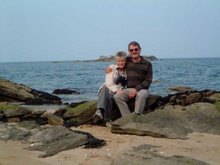
We have arrived at our first long-stay destination, near Agadir. It is a brand-new site by the seashore, and faces west giving us some lovely sunsets. As nice as the site is- seen one and you’ve seen ‘em all- a sunset makes a much prettier picture.

Imourane is next to Aourir, better known as banana village from the local crops of tiny, sweet bananas that every shop seems to sell. Many sell only bananas. How is it possible to make a living from selling only bananas? They aren’t even expensive at 60p a kilo.

Any large gathering in Morocco results in what, at first glance, appears to be chaos. The local market is no exception. At the bottom end of the market, so great was the press of people, vehicles and animals that it wasn’t possible to take a photo with enough depth of field to show it the way it was. But it all seems to work because nobody hassles, you just flow with the crowd like a river current and peel off or stop where you want to.

We had an evening meal in the village, with entertainment thrown in. Moroccan music and dancing isn’t perhaps the most riveting spectacle because it’s very repetitive, but it’s different. One of the dances is particularly odd where they form a line and shuffle along shaking their shoulders like they are doing a Ted Heath laugh. I’d like to report that the tajines we had were delicious, but the consensus was that the chickens were roadrunners i.e. spare and meatless. I suppose at £4.20 a head, which included the floorshow, we couldn’t really complain.

Sunday, 13 February 2011

Feb 6th: Essaouira

We arrived at Essaouira to find the campsite full. Fortunately there was a motor caravan parking area nearby but with no water, electrics or toilets. That’s not a problem for a couple of nights as we carry spare water, have on-board loo, battery for lights and gas for cooking. We paid a charge of £3 per night that included 24- hour security by a guardian and dog. Dunes at the back leading to the beach. So here we are, all looking pretty happy: from left to right, Derick, Helen, Paul, Jane and Trish. I'm holding the camera.

Essaouira is another lovely old walled town like El Jadida, and looks older than its 1770 completion date. It was designed by a French military architect, on the orders of the local Sultan. The photo is a typical example of the style, complete with typical tourist shop and shopkeeper.

In fact, the town is full of tourist shops but still manages to retain an authentic Moroccan feel. The atmosphere is relaxed which is maybe why the area was a focus for hippy communities back in the 60s and 70s, with famous names like Jimi Hendrix spending time there.

Morocco is a blend of old and new in no particular order. It has an excellent mobile phone network and internet connections but we are observing many tasks carried out in the traditional way, for instance the boat repair in the photo below. Derick is an ex-naval man and commented that they would have repaired boats in this way since time immemorial, slowly bending the spar to shape, nailing it in and caulking it with pitch, although he was sure that they were using a more high-tech modern sealant than pitch.

Wednesday, 9 February 2011

Feb5th: El Jadida


We spent an extra day at El Jadida in order to visit the old town, a World Heritage site. It was built by the Portuguese in the 16th century with surviving fortified walls, and was subsequently modified by the French and Arabs. An important part of the defences was securing a water supply, and a huge cistern was constructed in the centre of the old town for this purpose. It’s open for visiting and a shallow depth of water has been left inside to produce amazing reflections from the sunlight entering through the circular roof opening. The cistern was used as a film location for Orson Welles production of Othello, which I gather was a box office flop, but which has since acquired critical acclaim due to its age. There’s hope for the Carry-On films yet. Shame they didn’t make a “Carry On Cistern”.

Continuing with the frivolity theme, I couldn’t help recording the café sign below. Could this have been Jacque’s dream when he retired, to run a little café in a run- down street in El Jadida?

There also appears to be a thriving ship building industry, for traditional large fishing boats. There were several in various stages of construction, and the one in the picture is in the early stages with just the wooden skeleton. The basic designs are all the same and must go back centuries. Anyone notice a similarity to Noah’s Ark?


Walking back to the campsite from town in the early evening we saw a huge roost of eagrets within a large walled enclosure not open to the public. The photo only captures a small part of it and as dusk was falling hundreds more were flocking in, so there were eventually many thousands of them. It was interesting that within this mass of eagrets was a group of half a dozen crows that were determined not to be intimidated by the influx so stayed firmly put- we’ve got as much right here as you have, mate.

Monday, 7 February 2011

Feb 2nd: into Morocco


The fast ferry from Tarifa to Tangier really is fast, as you can see from its wake. It covers the 20 miles in 45 minutes. By contrast, the customs control at Tangier port proceeded at snails pace. It took about an hour and a half to process 20 vehicles, none of which were lorries. So what took all the time, considering all our group’s documents were in order? Simple inefficiency: one official in a splendid uniform vetting all the papers, surrounded by countless sub-officials and non-officials doing very little. But this is why we’re here- to look through a window into another culture.

First overnight stop is at Moulay Busselham, only 80 miles from Tangier. This pleasant town is just off the motorway and has a convenient campsite, with an unexpected visitor appearing on the doorstep. We fed it, of course. It would be fair to say that the magnificent cockerel looked in much better condition than the average Moroccan male.

Moulay is named after a 10th century Egyptian holy man whose shrine is nearby. His speciality miracle is to cure psychological problems by the sufferer being locked in his shrine for 48 hours. Statistics are not available for the proportion of those who are cured as opposed to those who emerge stark, raving bonkers.

Tuesday, 1 February 2011

Sat 29th to Tue 1st Feb: At the Gates of Africa

We have joined up with the two sets of friends who are travelling with us to Morocco, Paul & Trish, and Derick and Helen. The meet-up campsitesite is at Conil, 40miles from Tarifa from where our ferry will depart tomorrow for Tangiers. We went to the port yesterday to book the crossing and have a day out.

Apart from being our port of departure, Tarifa is an historic and interesting place where the main architectural influence is Moorish, as this entrance gate to the old town shows. Some of the streets are so narrow that you could shake hands with the neighbours opposite from the balcony.

The buildings are mainly white and cube shaped, very much like old Moroccan towns, and the faded, peeling paint in this square adds to the impression of being in North Africa. Notice the balcony on the left is held up by two yellow jacks. Do we need to go to all the way to Morocco?

The square was so full of character, our group decided to have lunch at the café in the far corner. We’d got the ferry tickets at a much better price than expected, had a fascinating walk around Tarifa, and it was sunny and warm. So we were in excellent spirits. And this is a good example of where the camera does lie. Just look at the expressions on our party’s faces- we could have all just had our wallets pinched!

Here’s the top of the old town walls- but what do you see: a forest of TV aerials, about a dozen in that one apartment block. A fair guess would be one for each dwelling in poorer areas or even whole countries.

So, here's a thought. To carry out a quick and cheap population census:
1.establish the average family size
2.total population = average family size times number of TV aerials (or sat. dishes).

A final piece of folklore information. The town of Tarifa gave us the word tariff because it was the first town in history to charge a levy on goods landed through its port.

Sunday, 30 January 2011

Sunday Jan 23: Beating the Barcelona Bandits.

Last autumn, friends of ours were towing their caravan on the motorway skirting Barcelona when they heard a loud bang appearing to come from their caravan front/ car rear area. A car then pulled alongside them, one of the passengers leaning out of the window and pointing to the caravan tyre. Instinctive reaction: pull in and deal with an obvious emergency.

If you did stop, you would find that the car containing the helpful, gesticulating passenger would also stop, you would presume, to offer further assistance. However, the occupants of the car would rob you. It might be a straightforward hold-up or a distraction theft, that is, one of them would take you to point out the damage while the others rifled through the car. Afterwards, you would also notice a dent in your caravan or car where the thieves had thrown an object to create the bang you heard that was meant to authenticate the fictitious crisis.

That’s the background. So, it’s 11.00 am on a sunny Sunday morning and here we are going around Barcelona on the motorway. Bang, there’s a thump from low down on the rear of our car. A car pulls past us with passenger pointing animatedly to the car wheel, as if to indicate a deflating tyre. The car signals us to pull over: they clearly aim to help us. There’s a moment of indecision on our part before the penny drops. Our vehicle is handling fine, no evidence of a flat type or any other problem.

The advice is: keep driving- fairly obvious really- and that is what we did. The Good Samaritan bandits shot off at the next exit. We pulled in to the next services, i.e. plenty of folks around, to see what damage their missile had caused. Thankfully, none we could detect: it must have hit the tough plastic skirt running round the bottom sill of the car. Our friends also carried on driving, but did discover some damage to the tailgate of their car.

Shame we didn’t get any pictures: they didn’t stay around long enough. On the other hand, if we had stopped, they would have pinched the camera, so no pix either way!

Thursday, 27 January 2011

2011 The Blog Stops Here

Jan 19th to 22nd : Alconbury to The Pyrenees

We left home on 19th Jan, grateful for the return of reasonable weather. A good run of 430 miles through France took us to an overnighter at motorway services 40 miles beyond Troyes. Our thoughts of heading towards ever improving weather were somewhat shattered on looking out next morning….

Keep travelling south, it’s bound to improve! And it did: we ran out of the snow in about an hour. So now let’s stop for coffee & croissants: even on motorways, we said, in France you still get freshly made coffee.
But times move on, and the motorway services presented us with banks of drinks machines. I counted them: there were an amazing 18 machines scattered around in groups, not all the same, most able to dispense a huge variety of drinks. We had an acceptable chocolate drink each, but I wondered how the economics of this high-tech set-up compares with a couple of café girls. We needed the services of a person anyway as the machine delivered only one drink instead of the two we’d paid for!

That evening we arrive at a pleasant site on the banks of the river Rhone. There’s a biting wind making it feel very cold, but wrapping up warm we take an evening walk into the pleasant town of Tournon-sur-Rhone. There are a number of huge barges plying the river and it’s a shame we don’t have navigable rivers of this size in the UK to slightly ease our road congestion.

Pyrenees next stop, just into Spain. We’ve stayed at this site before and it’s beautifully located in pine and cork oak hills. Still cold and even windier but sunny, so we togged up as on the day before and had a splendid hour’s brisk walk. It’s a wonder the site is open in winter as we were the only touring folks there, but there is a residential section so it presumably takes no more manpower to run the whole lot.