Friday, 6 May 2011

Another Blog, at Last!

We left El Rocio on 10th April for Los Madriles, in the province of Murcia, where we have stayed for the last 4 years at around this time of the year. We broke the 400 mile journey with an overnight stop at Granada, and arrived at Los Madriles in the early afternoon of the following day. Setting up was delayed by bumping into numerous friends from previous visits, but eventually we were installed on a pitch with a nice sea view. Now it's April and there are plenty of pitches free as the over-winterers leave by the end of March before which time the site is totally full.

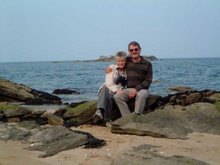
We arrived on a Monday and were booked into the Tuesday walk. We’ve done most of them before, but are all worth doing again, and the photo above from this first walk shows just how picturesque this area is.

Also a nice example of local scenery: the beach framed by the background mountains and featuring the shorewalkers, our companions from a birthday lunch, heartily enjoyed and celebrated- see below!

Last week a new walk was proposed, in the Espuna National Park- so I’m not repeating previous years’ blogs. Firstly it’s all up and up, but following a good waymarked trail through pines, scrub and rocks of which the photo is a good example.

But as we plodded upwards on the long ascent the crocodile of walkers became more and more spread out as some of the walkers tired. And it was hot. However, the walk leaders are quite fit and not wanting to slow down because we may be late for lunch. “Walk, don’t talk,” was the message passed back. Some disgruntled muttering about this. Walking, for most of us, is a social activity and chatting to other trekkers is part of it. Also, pausing to admire the scenery, maybe take a photo, or look at the flora & fauna. A comfort stop. A brief rest.

Anyway, we did eventually reach the crest, and the view was superb. (I took the photo while walking- didn’t slacken my pace, honest.) From here on it was downhill, so no fatigue issues, but a cracking pace was still being set in the “walk, don’t talk” style. It was nevertheless a lovely walk and perhaps illustrates the difficulty of coordinating a group of individuals with differing objectives and physical constraints.
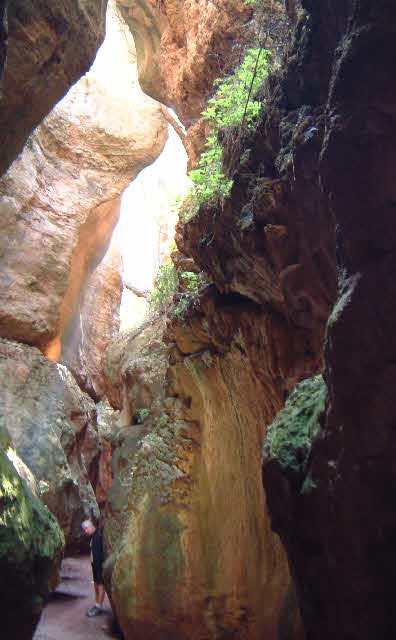
After lunch we visited this dramatic gorge that ran for several hundred metres and was invisible on the approaches. You can judge the scale by Jane’s figure in the bottom left hand corner. The colours and shapes of the rocks were particularly outstanding due to algae and limestone accumulations.

Saturday, 9 April 2011

Apr 1st to 10th: El Rocio


El Rocio looks and feels like a cowboy film set. All the pavements- sorry, sidewalks- have hitchrails, and the streets are wide and dusty. No tarmac, just compacted sand. It’s also mainly closed up, a little livelier at the weekend in the commercial area, but not many of the dwellings are inhabited, street after street of empty, shuttered houses. A few ridden horses and carriages occasionally appear. The photo below has that same Tex-Mex feel: it’s like they’re waiting for Billy the Kid to ride into town.

So what’s going on? It all goes back to the 13th century, so the story goes, when a hunter found a statue of the Virgin Mary in a hollow tree. The location of this hollow tree is now marked by the church in El Rocio, which features the statue in a magnificent gold alterpiece setting, See below:

The virgin is a source of individual pilgrimage, which accounts for most of the visitors at weekends, but there are also some special pilgrimages that go back hundreds of years organised by brotherhoods based in the local towns. There are now around 90 brotherhoods who all own houses and stables in El Rocio that are only occupied when these events occur. Hence the empty buildings. The biggest gathering is at Whitsun with around a million participants and spectators. A few too many for us!

This is El Rocio from across the lagoon, showing the pilgrimage church on the left. The flamingos in the foreground also reveal another aspect of the area: the DoƱana National Park. It is one of the most important wetlands in Europe, with eagles, lynx and a host of smaller birds, mammals and reptiles. Entry is restricted to marked trails, but these are well laid out and cross the wetlands on raised walkways.

This particular area of marshland was full of nightingales, difficult to spot but entrancing to listen to. The habitat was more varied than expected, as the cork oak glade beneath shows. Cork stripping was a main source of income in the past, but sadly most of the oaks are gone, leaving the stripping exclusively to the beaches 10 miles away.

The visitor centre is a former Palace, really a magnificent hunting lodge. It contained an exhibition detailing the former way of life in the park that has practically disappeared. It was all very well laid out and organised, so we were impressed. The walks were especially beautiful with lots of birds- but no lynx (should have taken a tin of cat food with us).

Tuesday, 5 April 2011

March 27th to 31st: Chefchaouen


From Fes to Chefchaouen took us about 5 hours, including a lunch stop. After leaving Fes we soon entered the Rif Mountains, a Berber area, and drove the rest of the way through green, lush scenery. There is clearly more rain here which, with the warm climate, may well account for Chefchaouen being the country’s marijuana growing centre. It is called kif locally and the guy in the top photo is sat on a rock having a smoke. This is tolerated here at least for the locals but it is not permissible to deal in or export the drug, so tourists beware: no pot plant for aunty from here!

Above is the medina, the original Chefchaouen, hidden in a fold of the mountains. So hidden, in fact, that before 1920 when the Spanish army arrived, it had been visited by only three Westerners. This is remarkable as the town is only 70 miles from manic, international Tangier, but even these days the villagers in the hills seem reluctant to talk to strangers and many are unable to understand much Spanish or French, the official second language of Morocco. This is in stark contrast to remote Berber areas elsewhere in the country where the locals seek you out for conversation in French or English. Maybe elements of the region’s fiercely independent past insularity still persist. In Chefchaouen itself visitors are very welcome and delight in the quaint alleys and squares washed in blue lime, as per example below.

The campsite is located above the town and leads onto mountain tracks with splendid walks looking down on the town. The photo two above was taken from one of these walks, as was the photo below.

We did a day trip to Tetouan near the coast, a city of 400,000 inhabitants, and the Spanish administrative capital of the part of Morocco they ruled over during the years 1912 to 1956. With some small exceptions, France administered the rest of the country, by far the majority, and thereby French continues as the country’s second language after Arabic, in the same way that English functions in India as their second language.

This is one of the plazas in Tetouan and could be part of a square on the Spanish mainland. And then from Spain, straight back to Morocco: the doorway with the old ladies sitting on the step could be from any part of Morocco.

The mix of Spanish and Moroccan is everywhere in the city, unsurprisingly. Look below at the king’s palace (remember, a palace in each city!): Spanish building, Moroccan pillars. Spain itself often has a similar mixture as a result of decades of occupation by the Moors (the Moroccans) with many original Moorish structures remaining but also this same influence in later architecture.

We came back from Tetouan by a tortuous route, firstly 30 miles of roadworks, then 20 miles of the worst potholes (like bomb craters) so far encountered. But an experience! One more day of packing, and then back to Spain.

Our two months here have been an excellent adventure, thanks not only to the fascinating variety of Morocco and the weather, but also to our travelling companions who all strived to get along together as part of a team, and succeeded: we were friends at the start and at the finish.

Sunday, 3 April 2011

Monkey Business

A day trip out from Fes takes you to the cedar forests of Azrou in the Middle Atlas range. There is wonderful scenery and the highest points on the route still had snow patches when we went. But the main purpose of the trip was to see the only area in Morocco with wild monkeys. These are the Barbary apes, which supplied the original stock for Gibraltar. The English university student we met doing a study on them told us they are not apes at all but macaque monkeys. We found them easily enough: or rather they found us, in a picnic area. Simple really, picnic spot = food, and we soon discovered that they’d die for a Pringle, in this case from Jane.

And now the “see no evil” monkey on the roof of the car (remember the three wise monkey) with a glum companion.

Finishing up with a monkey, again on the car roof, who started scratching and bending lower and lower until his head was on the roof. For modesty’s sake, I moved from the rear of the car around to the side to take the photo!

The troupes of monkeys don’t all congregate around the picnic areas to scrounge food; some stay deep in the forest and are quite shy. We fleetingly saw one of these groups later, driving through an isolated area: they were gone in an instant when they spotted us. We ended up at the town of Azrou that lends its name to the forest. It is a pleasant, bustling town, remarkable for its green roofs as the photo shows. From here we drove in a loop back through the Middle Atlas, this part completely bare of trees but with huge panoramas, until we dropped down onto the plain and 30 miles back to Fes. Brilliant day out.

Saturday, 2 April 2011

March 21st to 28th: Fez


This is the medina in Fez, famous for being the largest functioning medieval city in the world, and giving its name to Tommy Cooper’s hat. Sadly we only saw one being worn, and that without the tassel. We did see many beautiful doorways, though, and the example below is from the King’s palace. It’s not open to visitors. The King, Mohammed IV, has a palace in every major city in Morocco and seems to be universally loved as champion of the people against corrupt government bodies. How does he manage that: I though he was the government, or at least a major part of it?


On from the palace, through the Jewish quarter. Most of the Jews left Morocco between the Last War and 1956 to set up in the new state of Israel. The Jews originally arrived here from Spain as a result of religious persecution, so the buildings are in the Andalusian style. The area has decayed quite badly but where premises are being patched up it’s usually good for a photo, as here where a workman is perched high up on a set of rickety planks. Allah decides on Health and Safety matters so you don’t need Risk Assessments.

These are the tanneries. The skins are firstly cured, by being steeped in a mixture of pigeon droppings and cow urine, for many weeks. So there is quite a pong. The vats above contain vegetable dyes that the cured skins are soaked in for about a week, up to 120 skins per vat. In that week, the skins are individually washed through the dye by hand many times, the dyers standing barelegged in the dye vats to accomplish the task. The photo beneath shows one of the dyers working. The process is basically unchanged since its establishment 1,000 years ago. I wonder if the dyers suffer in later life from any ailments as a result of the work, e.g. pickled red-leg syndrome?

The potteries were also rooted in the past, the potter kicking the wheel around with his foot and at the same time managing to make remarkably consistent beakers. The pottery we visited specialised in making mosaic tables. The mosaic pieces are chipped out from fired tiles by hand, glued in a pattern in a frame and then polished up to give the examples shown in the photo below the potter. They ship to anywhere in the world, so there’s no excuse for not buying. Have the answer ready, off pat. “Yes, they are beautiful, but I’m allergic to ceramics: everything’s plastic where we live”. That’s true- it is, in the caravan!


Fes was most interesting with a beautiful wide, landscaped boulevard in the new part of town, and surrounded by high green hills, less touristy than Marrakech but lacking the charisma.

Wednesday, 30 March 2011

Majorelle Gardens


Located in a suburb of Marrakech, these gardens were designed by the French painter Jacques Majorelle in the 20s and 30s, and owned by Yves St Laurent until he died in 2008. They are now owned by a Trust. Visually the gardens are very different from any others we’ve seen. Colours are used to blend in with the tropical plants, particularly the blue in the photo above that was supposed to be based on the colour of French agricultural workers overalls. It sounds naff, but is effective.

There are groups of wonderful specimens and here we are looking at cacti (without speculating on the unusual shapes). The next group below is palm trees with oleanders and the usual, unusual blue pots. The tending of the gardens is immaculate, not a leaf out of place, which is in striking contrast to the maintenance of other exhibits in Marrakech.

Altogether a most stimulating experience.

Tuesday, 29 March 2011

Day Trip to Imlil


Imlil is a Berber village in the High Atlas 90 minutes drive from Marrakech. It is a trekking and climbing base, even skiing at this time of the year, being at the foot of the highest mountain in North Africa, Djebel Toubcal. In the photo above, Toubcal is the peak on the horizon, just to the right of centre, behind Jane and me. Many of the trekkers and skiers have their luggage taken up higher by mule, and trains of these animals plodded past all the time we were there, some also bearing trippers, the mountain equivalent of our camel ride. The mules have the same air of resignation to their fate as the camels.


Berber villages in this region seem to blend into the countryside, being made of the local mud mix and stone. The buildings are flat topped with a final covering of turf. They are eco-dwellings without the builders even realising it (or caring, probably).

We walked a little way up from the village to the waterfall, coming across patches of snow the biggest of which covered this flat area. Trish and Jane are carefully making their way across it. The waterfall was difficult to get close to and not spectacular but the setting was beautiful.