Wednesday, 6 June 2012

30th May: The Zumberak

This was our last trip out before leaving Croatia, to a region located between the campsite and the Slovenian border. It comprises remote villages and steep green hills. Buildings like this old mill were typical.
There were also some beautifully simple small country churches as shown in the photo below.
None of our maps covered the area in enough detail to navigate the small country roads, so we used the sat-nav. Just put the name of the next village in and let the device do the work. We stopped at a lovely spot for lunch, in a valley by a stream, en route to the next destination. It was from there on that the trouble began. The road started to deteriorate and soon became a rubble-strewn, narrow, grass covered track that ascended steeply through dense forest. At one point the trees fell away down a steep ravine to reveal this lovely view.
Why do we have such blind faith in these gadgets? After 20 miles of crawling along the dirt track at no more than 10 miles per hour, the sat-nav voice cheerfully announced: “Welcome to Slovenia.” It had taken us into another country! We were expecting customs officers to appear through the trees at any minute, and of course we had no passports with us. Was this an ancient smuggling trail perhaps?
But plod on, having come so far we didn’t want to retrace our steps on such an awful road. A sigh of relief- in a few miles, the sat-nav welcomed us back to Croatia. Soon after, at a crossroads in the track, I was able to reset a route to another and nearer village, still 6 miles away, but here was a proper tarmac road, with lines on. It was like driving on a motorway.
Off-roading adventure not withstanding, we found the Zumberak a lovely area. Just as we were running out of the hills, we passed another unusual small church, complete with reflection, that could have been transported straight from Russia. With love.

Tuesday, 5 June 2012

Karlovac


Karlovac’ was built as a fortress town in 1579 by the Austrian Empire and contained many elegant buildings. A lot of these are now in a poor condition following the town’s decline after the Homeland War. This is a good example.
Some dwellings are also in a state of decay. We’ve seen very few occupied properties in this condition in Croatia in general. We know this one is being lived in from the lady hanging out washing, and the sky dishes.
In my childhood it was not unusual to see bombsites left from World War II, and similarly here we are seeing the aftermath of a war. The main difference is the type of damage: here it’s often the bullet holes of hand to hand fighting in the streets.
But let’s not portray a worse picture than it is. It’s not all falling to pieces, so to prove it here’s a church tower and town roofs all in good condition. Well, maybe a lick of paint on the bottom right hand tower.
There was also a medieval pageant held at the castle overlooking the town on the last weekend in May. The participants went to great trouble to dress the part and provided all sorts of re-enactments, like this dancing.
We found the most authentic presentation to be the weapons fighting. A man and woman demonstrated their skills with swords, daggers and pikes. They were highly accomplished. The photo shows the pike fight. I imagine the combatants were in fact man and wife as she looks like she really wants to kill him.
The Turk with his turned up toes and beard looks the part, as do the children and the man in black and white picking his nose! Most realistic, as they must have had bad (or worse) habits back in those days!  


Saturday, 2 June 2012

The Homeland War Museum

Zagreb received little damage in the war, but the town of Karlovac near the campsite was at the front line. The Serbian advance was halted in the village of Turanje just outside Karlovac and then the tide turned in Croatia’s favour. So what better place to put a museum?
There is a considerable display of hardware, some of it showing how desperate and innovative the Croats were, for example this Sherman tank. The tank is World War Two vintage so had languished for 50 years before being refurbished and brought into the service. It must have acquitted itself well as it’s all in one piece.


Another vehicle, an armoured troop carrier, looked homemade. It turned out from the information leaflet that it actually was, by a workshop in our campsite village.
From home made to very high-tech. This is a Croatian Air Force Mig-21 fighter.  The info brochure didn’t explain how the Croatians managed to get hold of such a powerful and expensive aeroplane, but it was presumably seized from a Yugoslav Air Force base in Croatia. It’s supported on a steel girder at the rear although in the photo it looks as if I’ve snapped it flying around the museum.
And now the mystery pic. The leaflet describes it as an amphibious ferry. Is it even the right way up? It’s very large, as you can see from comparison to Jane, and is hinged horizontally at about the level of Jane’s head, like a giant sandwich toaster. Perhaps it’s the Catering Corp’s secret weapon.
There were many more exhibits, and as impressive as the museum was, it related to war paraphernalia rather than people. However, there were still houses in Turanj showing evidence of war damage. This house in particular, where the bullet holes in the main wall must have been left as a memento, made us reflect on the dreadful reality of war for the inhabitants.


Thursday, 31 May 2012

25th May: Zagreb

Zagreb as a settlement has been around for 1,000 years when the king of Hungary established a town and cathedral. Today most of the old buildings have been rebuilt or restored as a result of earthquakes or fire, or just been restored for the sake of it. Nevertheless, the old centre is full of character and atmosphere.
The cathedral was virtually rebuilt in 1880 following an earthquake and is very elegant, but doesn’t take a nice photo at the moment as it’s covered in scaffolding- because it’s being restored!
So this is St Mark’s church instead. It has a roof featuring the coats of arms of Zagreb and Croatia. These could be mistaken for the local football teams’ crests put there by celebrating fans. It’s in a lovely cobbled square that also contains the Croatian Parliament building.
Opposite the cathedral is a set of statues in gold leaf of the Madonna and four angels. The gold is so bright it looks like the photo’s been touched up. Sculptures are from the mid 1800’s by an Austrian called Fenkhorn. 
The market is a huge affair and deals in the usual range of fresh veg and clothes. Around the market are numerous cafes containing many characters who are much more interesting to photograph than the onions and cabbage. The next photo is of a true Father Christmas face, but the chap behind is worth a look as he seems to be practicing for his next gurning competition.
The Croatian National Theatre is an example of the many splendid buildings dating from the 19th and early 20th centuries. It was opened in 1895, and as we walked along the far side we could hear some opera singers practicing. The mustard colour was quite popular in the city but maybe makes it look too much like a concert hall at the end of the pier.
There are many areas of green space, usually with a feature of some sort, perhaps a bandstand, a public building or a sculpture as in the next photo. It’s a modern work, and by the figure’s dimensions is clearly a warning to all against too much junk food.
Being the capital, there are numerous museums, one of which we had never encountered before: the Museum of Broken Relationships. We didn’t go in as time was limited, but I couldn’t help Googling it later to find out what it contained. Apparently anything from garden gnomes to underpants! “This is the vase she threw at Henry before she walked out” type of thing. Notice the sign is in English, so maybe they're targeting the UK divorce rate.

Zagreb feels like a city coming out of a recession (whilst the rest of us are heading into one!). The Homeland War is well behind them and Croatia joins the European Community next year. However, the legacy of the communist regime is still visible in this typical scene of Zagreb’s pretty rooftops from the high town. If you look along the skyline there are masses of utilitarian highrise flats. We passed them on the train into the city. The closer you get, the grimmer they look. But if you’ve nowhere to go, or live in some hovel, then they’d look great, so perhaps we shouldn’t be so quick to pass judgement.
The train journey mentioned above was comfortable and cheap. The station was a 10 minute walk from the campsite, so very convenient and much less stressful than driving the 40 miles to Zagreb. It was a corridor train with compartments, so have a look at the photo and try to recall when you last rode in one of these. Remember the luggage racks you could sleep on?


Monday, 28 May 2012

May 20th: Plitvice National Park

The park was a pleasant 50 mile drive from the campsite and is Croatia’s premier National Park. From the start it seemed well organised, with different walks pre-planned so you just follow the letter for your chosen walk. We picked walk B. Pathways were either gravel, or wooden boards where the walk crossed water or swamp, so no muddy feet. Right at the start we viewed the highest waterfall in the country, and most spectacular it was too.
The park comprises 16 connected lakes, all at different levels. There is an average of about 10 metres between each lake so there are some incredible falls, rapids and rushing torrents where water flows down to the next level.
At several point in the walk park transport is provided as part of the planned route. We took a boat along the longest lake after eating at the fast-food point near the jetty. The boats are electrically driven so as not to disturb the wildlife, and provide a half-hourly service.
Speaking of wildlife, most of the big stuff makes itself scarce when visitors are around. In the northern part there are bears, wolves, lynx and boar. However, birds and fish are abundant, also some more unusual water-dwellers like this crayfish. But sorry, nothing for the barbie. Fishing is forbidden.
A road train forms part of the transport system so you can walk a lot further and then take the train back. It does seem an excessively rugged conveyance for ferrying walkers along a few miles of level tarmac road, and put us in mind of the vehicles we came across in Morocco that had crossed the Sahara!
The high level walk back gave us another angle on the park, looking down on the lakes. The waterfalls are less impressive at this height, but you can see how well the walkways are designed to take you right along the face of the falls and rapids. The visit is more memorable if you’re drenched in spray.
So another splendid day out, even though it took us a long time to figure out how to persuade the barrier to let us out of the car park. As usual, there were instructions nearby. In English. Don’t you feel a fool….


Sunday, 27 May 2012

18th May: On to Zagreb

We’ve moved on to the Zagreb region, to a lovely, quiet riverside site 40 miles from the city of Zagreb, the Croatian capital. The nearest town is Karlovac 8 miles away.
The campsite pitches are generous, as shown in the photo. Pitches can be quite small in many foreign sites so neighbours end up being too close, and it also doesn’t allow the sensible UK fire protection gap of 6 metres.
Another odd phenomenon is known as the “herd instinct”, where some campers pitch as close as possible to your unit regardless of available space. It might make a good subject for a medical book: “The Psychology of Camping”.
The river really is this turquoise colour. It’s about 50 metres away from our caravan, just far enough should the heavy showers of the last few days cause a sudden rise in level. We were nearly flooded in Alconbury in 1998- many of our friends were- so we’re a bit wary of rivers and heavy rain.
The site used to be approached by crossing the longest wooden bridge in Croatia. This is currently being replaced by a super new concrete road bridge. A welcome local improvement to be sure, but the photo shows another, sadder angle; the last bits of the ancient old structure being engulfed by the concrete juggernaut. I’m certainly not against progress, but there is a price to pay.
For comparison, you might like to see the complete old bridge a few years ago before the “modernisation” (photo from the internet).

Wednesday, 23 May 2012

15th May: Primosten and Trogir

Today we decided to make a tour of the coast south of Šibenik. First stop, for morning coffee, was the island town of Primosten, now joined by a short causeway. Cafés with decent coffee, cakes and ice cream are available everywhere in Croatia at reasonable prices, so we quickly found one on the quay and sat in the sunshine. It’s a very pleasant place, but not that old. The best general view was from a lay-by after leaving the town.
In 30 minutes of driving along the lovely Dalmatian coastline we arrived at Trogir. It is also an island town, joined by a bridge to the mainland, but this one has a long history going back to its founding by the Greeks in the 3rd century BC.
The main square is particularly pleasing and dominated on one side by the Venetian-towered cathedral dating from 1213. A master mason called Radovan carved many fine figures on the frontage, and also an inscription in which he describes himself as “most excellent in his art”. Talented, yes: modest, no. This is the building.

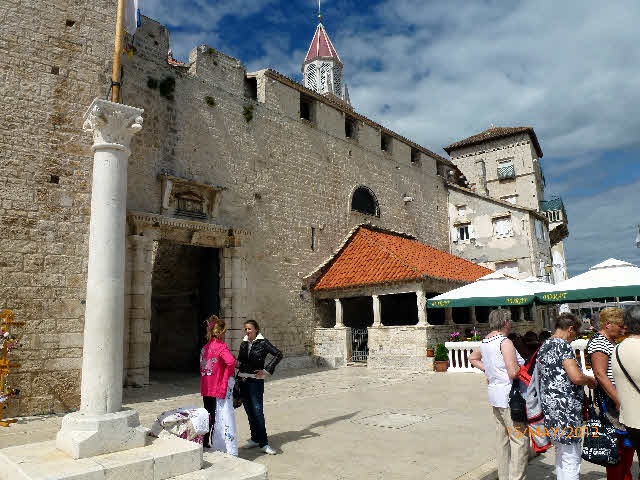
Facing the cathedral is the town clock and loggia, an open-air gallery containing an intricately carved 15th century frieze  (not by Mr Bighead this time). We went in to see the carvings and to take photos of the cathedral.
The loggia was quite crowded, and the reason was soon apparent: a choir was about to sing. This was a klapa choir, an ensemble of between 5 and 10 men singing traditional Croatian songs. Almost every town or village has such a group.
The choir struck up, performing as klapa choirs do, without musical accompaniment. The singing was most professional and the harmonies exquisite. So impressed were we that we bought their CD afterwards. This is the choir, Klapa Tragos, in front of the frieze. Out of curiosity you may like to hear them on You Tube: if so, click the following link:  www.youtube.com/watch?v=NE-vRRB72_4
The town still has some of its defensive walls standing, but most were demolished by Napoleon’s men in the belief that allowing the sea breezes to waft through the town would blow away the endemic malaria. Simple logic often works, a pity not this time. Anyway, here’s the Town Gate in a part of the wall that has survived.
We had been expecting Croatia to be poorer than it has turned out to be. Maybe we will see a different side later, when we go inland away from the tourist areas.  We did however see a beggar today, but this had more to do with the presence of tourists than poverty. She was quite well dressed and had a bowl in her left hand that she shoved under diners’ noses as she darted in and out of the restaurant clientele. Deserving or not?
We had already eaten by this time, in the narrowest alley possible that still had room for passers-by. Again, beautifully cooked pizzas, and great value.
So we trogged back from Trogir to Camp Marina via the more direct inland route, passing through lush green hill country. It was odd that we didn’t see any cattle, sheep or goats grazing, but there weren’t many houses either.