The gorge is 4 miles from the campsite. It was discovered
in 1891 by the local mayor and his surveyor friend. By 1893 they had organised
a trail through the gorge, which was no mean feat as you can see from the
photo. These wooden walkways cover practically the whole mile length of the
canyon as the rock walls are too sheer for conventional paths.
The river drops quite quickly so there are many
rapids, as can be seen from the photo above. The walls almost touch at a few
points, with the wooden walkway edging around, faithfully attached to the rock
face. Let’s hope they’ve used plenty of creosote on the wood.
It’s full of fish and birds, which generally move
too fast to be photographed. But here’s one who posed for us. It’s a dipper.
These bob up and down under the water looking for food, and are to be found
only in this sort of fast flowing river. It’s looking a bit cheesed off, but
then maybe we would be too, if we had to eat our roast beef or big Mac with
our heads under the water.
The gorge finishes with a lovely, tumbling
waterfall. Those are people on the bridge above the falls, so as you can see it’s
a good size. They obviously sorted out their problems as they didn’t jump.
The return route was either retracing one’s
steps, or a footpath through the woods. We went the footpath way; it turned out
to be a muddy track, having been churned up by forestry machinery. But onwards
and upwards, literally, passing this interesting refreshment arrangement on the
way. Some kind soul had placed a glass tankard on the branch (upper right) for
use at the spring. Clean water maybe, but not so sure about the tankard!
Finally we surfaced from the forest by a small
church, St Catherine’s, in the middle of nowhere but apparently a venue for
pilgrims and certainly a venue for walkers.
From the church back to our starting point,
where we had left the car, was an easy stroll on a meadow footpath with super open
views down to Bled and into the mountains.
Wednesday, 13 June 2012
Sunday, 10 June 2012
June 7th: Ljubljana
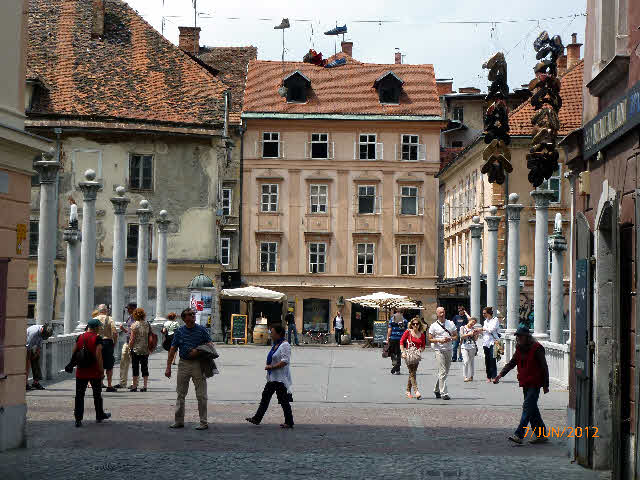
This is the capital of Slovenia, located about
40 miles from Bled. It is one of the smallest European capitals, and its
medieval core is delightful. In many showcase cites, the streets are wide and
full of imposing edifices, or narrow winding and quaint. Here the thoroughfares
are wide and gently curving with varied, elegant old buildings of quality. See
below as an example
There’s been habitation here since 2,000 BC, with Roman, Slav and German/Austrian influences being the most important. It has suffered two large earthquakes, in 1511 and 1895. The old centre is almost encircled by the River Ljubljanica with the castle on a hill at the back. River frontages usually look appealing and this is no exception.
Many of the bridges have a long history. The
shoemakers bridge shown next was occupied by shoemakers following the eviction
of the butchers by popular petition to the ruling Emperor Maximilian 1st because
of the smell. Max was a depressive and used to take his coffin with him on his
travels. There are no shoemakers left, but the pile of shoes hanging up in the
top right hand corner represents their past glories.
However, another reason for being in the city
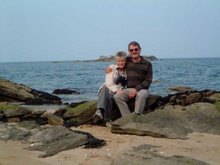
was to meet up with Jane’s nephew David who is doing research at Ljubljana University.
Here’s Jane and David in Prešernov Trg, one of the principal squares.
With a local guide, how could we fail to properly
check out the city? It’s not the guidebook stuff; anyone can get hold of that,
but the hidden corners. So now guess what this is.
A graffitied, derelict building? It’s certainly covered in
graffiti; in fact it’s a non-profitmaking cultural and social centre, a huge
7,000 square metre squat of the former premises of the State owned ROG bicycle
factory, closed in 1994. The organisers and users see this enterprise as
providing extensive cultural opportunities from an unused building, and you
have to ask the question, why not?
Bring your own bottle and fill it with
milk from the dispensing machine. It’s in the market square: fresh milk every
day, and cheap. What a great idea, but would it be too much bother for us back in
the UK?
We liked Ljubljana very much. It had a great
atmosphere and vibrancy. And not just the old quarter; the post 1895 earthquake
buildings are quality designs, like this department store, completed in 1905 in
the art nouveau style.
Saturday, 9 June 2012
To Slovenia 1st June: Lake Bled
Camping Bled is right on the Lake. It’s a large campsite, so our actual pitch is a few hundred metres from the lake, but you walk out of the site entrance onto the path that circles the lake. The town of Bled is at the opposite end to the campsite. It’s not a large lake, about 4 miles all round, but very picturesque. Here’s a view from the path with a tourist boat being rowed gondola-style, at gondola-style prices.
The other distinguishing feature of the lake is the island. This appears on every tourist ad for Bled and often for Slovenia itself. Can’t manage the usual helicopter shot, but this is it, the clump of green trees where the church is.
Something always seems to be going on. This weekend it’s the European Junior Rowing competition. The lake was sectioned into lanes along its total length for races. It was great to see all the youngsters keenly competing, and here are three boats speeding neck and neck for the finishing line. We decided not to take out a pedalo and show them what real speed was.
On the walk around the lake there is a long garden containing many unusual sculptures, the most bizarre of which is in the next photo. It’s a pyramid of fish-heads. You always look for some deep meaning in these sorts of works, but maybe it’s nothing more than a hint to the wife that he’s fed up with fish for dinner four times a week.
The other distinguishing feature of the lake is the island. This appears on every tourist ad for Bled and often for Slovenia itself. Can’t manage the usual helicopter shot, but this is it, the clump of green trees where the church is.
Something always seems to be going on. This weekend it’s the European Junior Rowing competition. The lake was sectioned into lanes along its total length for races. It was great to see all the youngsters keenly competing, and here are three boats speeding neck and neck for the finishing line. We decided not to take out a pedalo and show them what real speed was.
On the walk around the lake there is a long garden containing many unusual sculptures, the most bizarre of which is in the next photo. It’s a pyramid of fish-heads. You always look for some deep meaning in these sorts of works, but maybe it’s nothing more than a hint to the wife that he’s fed up with fish for dinner four times a week.
Wednesday, 6 June 2012
30th May: The Zumberak
This was our last trip out before leaving
Croatia, to a region located between the campsite and the Slovenian border. It
comprises remote villages and steep green hills. Buildings like this old mill
were typical.
There were also some beautifully simple small country churches as shown in the photo below.
None of our maps covered the area in enough detail to navigate the small country roads, so we used the sat-nav. Just put the name of the next village in and let the device do the work. We stopped at a lovely spot for lunch, in a valley by a stream, en route to the next destination. It was from there on that the trouble began. The road started to deteriorate and soon became a rubble-strewn, narrow, grass covered track that ascended steeply through dense forest. At one point the trees fell away down a steep ravine to reveal this lovely view.
There were also some beautifully simple small country churches as shown in the photo below.
None of our maps covered the area in enough detail to navigate the small country roads, so we used the sat-nav. Just put the name of the next village in and let the device do the work. We stopped at a lovely spot for lunch, in a valley by a stream, en route to the next destination. It was from there on that the trouble began. The road started to deteriorate and soon became a rubble-strewn, narrow, grass covered track that ascended steeply through dense forest. At one point the trees fell away down a steep ravine to reveal this lovely view.
Why do we have such blind faith in these gadgets? After 20
miles of crawling along the dirt track at no more than 10 miles per hour, the
sat-nav voice cheerfully announced: “Welcome to Slovenia.” It had taken us into
another country! We were expecting customs officers to appear through the trees
at any minute, and of course we had no passports with us. Was this an ancient
smuggling trail perhaps?
But plod on, having come so far we didn’t want to retrace
our steps on such an awful road. A sigh of relief- in a few miles, the sat-nav
welcomed us back to Croatia. Soon after, at a crossroads in the track, I was
able to reset a route to another and nearer village, still 6 miles away, but here
was a proper tarmac road, with lines on. It was like driving on a motorway.
Off-roading adventure not withstanding, we found the Zumberak a lovely area.
Just as we were running out of the hills, we passed another unusual small
church, complete with reflection, that could have been transported straight
from Russia. With love.Tuesday, 5 June 2012
Karlovac
Karlovac’ was built as a fortress town in 1579 by the Austrian Empire and contained many elegant buildings. A lot of these are now in a poor condition following the town’s decline after the Homeland War. This is a good example.
Some dwellings are also in a state of decay.
We’ve seen very few occupied properties in this condition in Croatia in general.
We know this one is being lived in from the lady hanging out washing, and the
sky dishes.
In my childhood it was not unusual to see
bombsites left from World War II, and similarly here we are seeing the
aftermath of a war. The main difference is the type of damage: here it’s often
the bullet holes of hand to hand fighting in the streets.
But let’s not portray a worse picture than it
is. It’s not all falling to pieces, so to prove it here’s a church tower and town
roofs all in good condition. Well, maybe a lick of paint on the bottom right
hand tower.
There was also a medieval pageant held at the
castle overlooking the town on the last weekend in May. The participants went
to great trouble to dress the part and provided all sorts of re-enactments,
like this dancing.
We found the most authentic presentation to be
the weapons fighting. A man and woman demonstrated their skills with swords,
daggers and pikes. They were highly accomplished. The photo shows the pike
fight. I imagine the combatants were in fact man and wife as she looks like she
really wants to kill him.
The Turk with his turned up toes and beard looks
the part, as do the children and the man in black and white picking his nose! Most
realistic, as they must have had bad (or worse) habits back in those days!
Saturday, 2 June 2012
The Homeland War Museum
Zagreb received little damage in the war, but the town of Karlovac near the campsite was at the front line. The Serbian advance was halted in the village of Turanje just outside Karlovac and then the tide turned in Croatia’s favour. So what better place to put a museum?
There is a considerable display of hardware, some of it showing how desperate and innovative the Croats were, for example this Sherman tank. The tank is World War Two vintage so had languished for 50 years before being refurbished and brought into the service. It must have acquitted itself well as it’s all in one piece.
Another vehicle, an armoured troop carrier, looked homemade. It turned out from the information leaflet that it actually was, by a workshop in our campsite village.
From home made to very high-tech. This is a Croatian Air Force Mig-21 fighter. The info brochure didn’t explain how the Croatians managed to get hold of such a powerful and expensive aeroplane, but it was presumably seized from a Yugoslav Air Force base in Croatia. It’s supported on a steel girder at the rear although in the photo it looks as if I’ve snapped it flying around the museum.
And now the mystery pic. The leaflet describes it as an amphibious ferry. Is it even the right way up? It’s very large, as you can see from comparison to Jane, and is hinged horizontally at about the level of Jane’s head, like a giant sandwich toaster. Perhaps it’s the Catering Corp’s secret weapon.
There were many more exhibits, and as impressive as the museum was, it related to war paraphernalia rather than people. However, there were still houses in Turanj showing evidence of war damage. This house in particular, where the bullet holes in the main wall must have been left as a memento, made us reflect on the dreadful reality of war for the inhabitants.
Thursday, 31 May 2012
25th May: Zagreb
Zagreb as a settlement has been around for 1,000 years
when the king of Hungary established a town and cathedral. Today most of the
old buildings have been rebuilt or restored as a result of earthquakes or fire,
or just been restored for the sake of it. Nevertheless, the old centre is full
of character and atmosphere.
Opposite the cathedral is a set of statues in gold leaf of the Madonna and four angels. The gold is so bright it looks like the photo’s been touched up. Sculptures are from the mid 1800’s by an Austrian called Fenkhorn.
The cathedral was virtually rebuilt in 1880 following an
earthquake and is very elegant, but doesn’t take a nice photo at the moment as
it’s covered in scaffolding- because it’s being restored!
So
this is St Mark’s church instead. It has a roof featuring the coats of arms of
Zagreb and Croatia. These could be mistaken for the local football teams’
crests put there by celebrating fans. It’s in a lovely cobbled square that also
contains the Croatian Parliament building. Opposite the cathedral is a set of statues in gold leaf of the Madonna and four angels. The gold is so bright it looks like the photo’s been touched up. Sculptures are from the mid 1800’s by an Austrian called Fenkhorn.
The market is a huge affair and deals in the usual
range of fresh veg and clothes. Around the market are numerous cafes containing
many characters who are much more interesting to photograph than the onions and
cabbage. The next photo is of a true Father Christmas face, but the chap behind
is worth a look as he seems to be practicing for his next gurning competition.
The Croatian National Theatre is an example of the many
splendid buildings dating from the 19th and early 20th
centuries. It was opened in 1895, and as we walked along the far side we could
hear some opera singers practicing. The mustard colour was quite popular in the
city but maybe makes it look too much like a concert hall at the end of the
pier.
There are many areas of green space, usually with a
feature of some sort, perhaps a bandstand, a public building or a sculpture as
in the next photo. It’s a modern work, and by the figure’s dimensions is
clearly a warning to all against too much junk food.
Being the capital, there are numerous museums, one of
which we had never encountered before: the Museum of Broken Relationships. We
didn’t go in as time was limited, but I couldn’t help Googling it later to find
out what it contained. Apparently anything from garden gnomes to underpants!
“This is the vase she threw at Henry before she walked out” type of thing.
Notice the sign is in English, so maybe they're targeting the UK divorce rate.

Zagreb feels like a city coming out of a recession
(whilst the rest of us are heading into one!). The Homeland War is well behind
them and Croatia joins the European Community next year. However, the legacy of
the communist regime is still visible in this typical scene of Zagreb’s pretty
rooftops from the high town. If you look along the skyline there are masses of
utilitarian highrise flats. We passed them on the train into the city. The
closer you get, the grimmer they look. But if you’ve nowhere to go, or live in some hovel,
then they’d look great, so perhaps we shouldn’t be so quick to pass judgement.

The train journey mentioned above was comfortable and
cheap. The station was a 10 minute walk from the campsite, so very convenient
and much less stressful than driving the 40 miles to Zagreb. It was a corridor
train with compartments, so have a look at the photo and try to recall when you
last rode in one of these. Remember the luggage racks you could sleep on?
Subscribe to:
Comments (Atom)