Wednesday, 20 March 2013

Boat on the Everglades

We took a boat trip, the only activity here that isn’t free. It’s operated as a franchise owned by the Mayor of Florida City. Clearly a man with useful connections.
Here we are, gliding through the Buttonwood canal constructed in 1922 to provide access into the central lakes of the Everglades from the sea. The opening of the canal promptly wrecked the delicate ecosystem, by allowing salt water into the freshwater environment. Although the damaging effects were apparent after a few years, it took until 1984 for a small dam to be completed to seal the end of the canal from the sea.
We look out for exotic and dangerous creatures in the mangrove jungle, being safe on the boat. The first item the guide points out is a manchineel tree. It’s very ordinary looking, just growing on the bank. Here’s the Wikipedia entry.

Manchineel is one of the most poisonous trees in the world. Its milky white sap contains phorbol and other skin irritants, producing strong allergic dermatitis. Standing beneath the tree during rain will cause blistering of the skin from mere contact with this liquid (even a small drop of rain with the milky substance in it will cause the skin to blister). Burning the tree may cause blindness if the smoke reaches the eyes. The Caribs used the sap of this tree to poison their arrows and would tie captives to the trunk of the tree, ensuring a slow and painful death.
The underlined words are in the Wikipedia script and have no significance in this context.
 
So, it’s the plants as much as the animals to beware of! One wonders if the many canoeists that use this canal are all aware of the manchineel.  
We’re on a plant theme at the moment as next we glide past some bromeliads or air plants. Lots of them. Worth coming back later with a bag and a window reach like we used to use in the shop as these are expensive in the UK!
The 3 mile canal arrives at the inland waters of Whitewater Bay, 100 square miles of it, with numerous mangrove-covered islands, and creeks. It is easy to get lost and canoeists who travel the long distance water trails (longest 99 miles, taking 8 to 10 days) need a permit. It’s impossible for the canoeists to tie up and camp anywhere because all land areas are covered by mangrove, so the Park have provided small raised wooden platforms in the water for that purpose. I wonder if occupied platforms repel boarders if another lot of canoeists arrive.
We see some dolphins, and then full throttle across the open water of a small part of Whitewater Bay. Then back to the Visitor Center via the canal, having done our bit to save the Mayor of Floriday City from life on the breadline.


Sunday, 17 March 2013

March 11 to 15th: Into the The Everglades


The Everglades National Park covers an area of over 300 square miles. In most people’s minds, it conjures up a picture of vast swamps covered in sawgrass. That really is some part of it, as in the next photo.
The whole Everglades Park is just above sea level. How ‘just above’ is demonstrated by a road sign halfway along the 40 mile long entrance road. It read “Rocky Creek Pass, Elevation 3 Feet”. 
On the face of it, this doesn’t look such an amazing area to visit- a flat ocean of grass. But the bigger picture is of a diverse freshwater and saltwater eco-system that supports a huge range of plants and creatures. And also a small number of Park Rangers, day visitors and campers.
It’s a 70 mile journey for us to the Everglades campsite that is located at the end of the 40 mile road and as far south as it is possible to go on the US mainland.
These are the most spacious pitches we’ve ever had anywhere, with electric hook-up. The downside is that the showers are cold. But the air temperature’s about 80 degrees (27ºC) most days, so it’s bearable.  
We’re on the coast of Florida Bay, where the Caribbean, Gulf of Mexico and Atlantic all meet. However, no sandy beaches. The Bay is shallow, 3 to 6 feet deep, and covers hundreds of square miles with hundreds of small islands. The shores and islands are all covered in dense mangrove thickets.
The Everglades environment supports an enormous variety of species. Starting with the biggest, it’s the only place in the world where crocodiles and alligators exist together.
They’re equal top-dogs in the eco chain and actually keep out of each other’s way. They’re not bothered about keeping out of human’s way and here’s a 6 foot croc to prove it on the marina slipway.
We’re told incidents are rare and always down to human stupidity, like the guy who decided to go for a midnight swim a few years ago and lost his arm. It might look like an inflatable toy and tempting to poke with a stick, but look at this chap’s teeth close up!
The young are cute, but it’s a hazardous road to the safety of adulthood. Predators include birds of prey and their own adults. Not us, this time, the Visitor Center café wasn’t offering croc n’ chips, though we’ve seen alligator tails on some restaurant menus sourced from farmed alligators.
The Visitor Center (US spelling), as expected, contained lots of info and many ranger-lead activities, all of which were free – not expected. The next episode will report on some of these.


Monday, 11 March 2013

Monday 4th March: to Miami

It’s a 250 mile drive to our next campsite near Miami. The Miami area is a huge metropolis so we’re in dense traffic for the last 50 miles of the journey, even on the toll road.
The Florida toll road system is complicated. There are cash-only automatic booths that take only quarters (4 quarter coins in a dollar). So you need a load of these. Then you can pay a person at some booths: coins, notes, or plastic. But you can avoid this with a Sun-Pass. Here you set up an account, put credit in, and buy an electronic device that automatically identifies you at each toll stage and deducts the due amount from the credit in your account. That’s too complicated for short-term users like us, so we drive armed with quarters and notes. 
Never be too confident you’ve got it sussed! Motoring around Miami, an overhead road sign informs us that we are now being “billed by plate”. So they clock you between points by photographing your licence plate and then billing the registered owner. Which isn’t us as it’s a rented vehicle. However, a call to Cruise America confirms that they will pay the charges and we settle up at the end.  
We arrive in good time at the Miami-Dade County Larry and Penny Thompson Memorial Campground.  Plenty of room as you can see.
County and State sites are much cheaper than private sites but generally offer fewer facilities. This one’s pretty good and it’s got all the hook-ups, bathrooms and washing machines.
We did have a small problem at check-in. They had lost our booking so were given a temporary pitch the first night while they sorted it out. The campground is part of a pleasant County park next to the zoo, with walks set in lush foliage.
Florida is all about year round hot weather which in the Miami area, the southernmost tip, supports coconut palms. Falling coconuts are big enough to cause serious head injury, as demonstrated by Jane.

The coconut palms and posh marina in the background are on the edge of the Biscayne National Park that forms the upper part of the Florida Keys, a string of islands stretching for 80 miles, now connected by road.
The section of the park here consists of a set of mini islands joined by a path jutting 1½ miles out to sea. It’s lined by mangroves and small trees with numerous water birds like pelicans, herons, cormorants and even an osprey. Uncommon species, too, like the great crested flycatcher, anhinga, and yellow crowned night heron. It was a beautiful walk and nicely shaded from the hot sun.
Next, just some of the wildlife that was good enough to pose. Most creatures were too fleeting for the camera.
Alligator, Great blue heron, coot. Next a brown pelican.
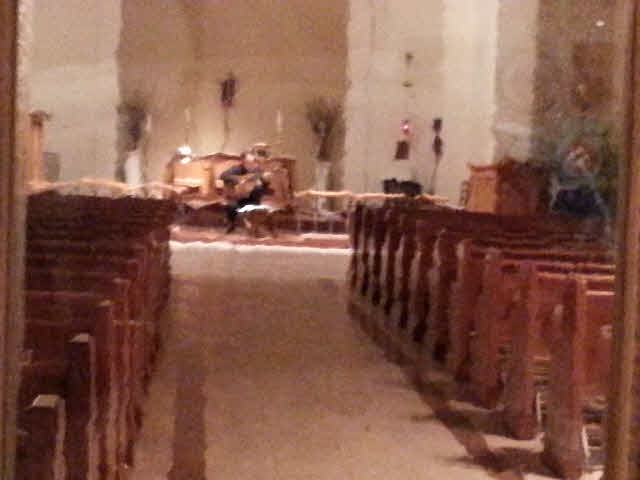
On our first day here we were fortunate in meeting a couple from Illinois who overwinter here. We hit it off right away with Lou and Machiko and passed some pleasant hours chatting in their motorhome. They also took us to a guitar concert held in a Spanish-style church near Miami. The soloist was classical guitarist Adam Holzman, someone I was not familiar with, but who turned out to be probably the best player I’ve heard. Naturally, photos were banned during the performance, but here’s a shot of him practicing beforehand taken through a stained glass panel that gives an unintended surreal effect.

We did discover that it would take four bus changes and 3 hours to get to Miami centre, so we didn’t. Not sensible to take the rv there either due to lack of suitable parking and dense traffic. Tomorrow we head for the Everglades National Park.


Sunday, 3 March 2013

Friday 1st March: Rocket Launch


There seems to be about one rocket launch a month from the Kennedy Space Complex. The one scheduled today at 10:10am is an unmanned Falcon 9 supply rocket. It is destined for the International Space Station which orbits at 370 km (230 miles) above the Earth. The capsule in the nose of the rocket contains the supplies, and when these have been unloaded (Big Macs, popcorn, Cokes etc.?) the nose cone will then return to Earth having been loaded with completed experiments and samples from the space station. And empty cans and packets.
We watched the launch from the Kennedy Space Centre Visitor Center and were patched in to launch control. We’ve all heard it before, but it’s more exciting because you’re actually there: “Three minutes and counting.” Then, “… 3…2…1…zero. We have liftoff!”
 
A confession to make here- this isn’t one of my photos. From where we watched we couldn’t quite see the launchpad itself, and also my camera recorded only the extreme brightness of the rocket motor, and nothing else. This had all the drama of a photo of a 60 watt light bulb.
The Visitor Center has numerous exhibits, for example the rocket garden. Each rocket has an information plaque detailing its contribution to the space story.
Space travel isn’t for the claustrophobic. This Gemini nose cone sat on top of the rocket and contained two astronauts, side by side. They stayed in this cramped space for up to 2 weeks, in their seats the whole time. The Gemini project ran as part of the Apollo moon landing programme, to test the capsule’s capabilities, and also man’s durability, in space. It’s about 12 feet long (4 metres).
We also attended a talk given by a real astronaut. He had piloted the Space Shuttle in 1984, being previously a test pilot as many astronauts were. We learned some fascinating insights into personal aspects of space travel and weightlessness, as well as the broad brush of the overall Shuttle Programme.
You say you won’t fall for that gimmicky photo-shoot- but here we are with astronaut Jon McBride. Actually, one of his aides used our camera and there wasn’t a charge.
The two separate days we spent at the Kennedy Space Complex were truly eye-opening. The whole experience was well organised and presented, and excellent value for money. Of course, there’s a lot of hype and flag waving, but the Americans have achievements to be proud of.
You pick up the mood and even the schmaltzy JFK fountain gives you a warm-hearted feeling as you leave, though you can’t be sure whether Jack is looking with visionary eyes at the heavens or imagining another sort of star!