Wednesday, 1 January 2014

29th Dec: A Walk in Cava Grande Gorge

The Cava Grande Natural Reserve starts two miles from the campsite, where the Cassibile River flows into the sea. At this point the terrain is fairly flat, but the canyon walls build as the Reserve follows the river back into the hills. It’s a good dirt track to start, with scrub vegetation on either side interspersed with orange and lemon groves. The path follows roughly the course of the river

 
It’s a great habitat for wildlife, but the birds flit past too quickly to photograph, so you’ll have to make do with a large green lizard and an unidentified butterfly.


As the hills start to rise on either side, we notice lots of doors and windows cut into rocks far up on the slopes on the opposite side of the river. Later the internet  reveals these to be cave dwellings which were occupied from BC times up to the last century. The info’s pretty vague so I don’t know any more than that. You’ll have to supply your own Flintstones images for life way back when in Cavagrande Rock Village.


We pass olive trees, as well as the oranges and lemons, and one of these presents a most unusual gnarled shape of three trunks growing out of the one base. It’s obviously very old and worth a photo.


Moving on up the valley we come across an abandoned mill outside which we ate our packed lunch. The interior looks like it could spring back into life straight away if you knew how to operate it and knew what you were supposed to be milling. The valley has only the olives, oranges and lemons so maybe it’s a marmalade mill.


 The dirt track merges with a partly tarmacked road leading to a disused hydroelectric generating complex; thereafter it peters out into a barely traceable hillside path. We follow the path for a while to get a view of the steepening valley, as the photo shows, with one of the derelict hydroelec buildings on the valley floor.
The cliffs here are about 1,500 feet high and carry on for a further 5 miles. This further on part is reached from a different access point that involves descending 800 feet to the river before starting to explore, and then 800 feet back up at the end.  We’ll stick with this side, thanks.


It’s easy to dismiss more modern structures in favour of ancient buildings. On our return, I was struck by how harmoniously this railway bridge fitted in to the Reserve, with its elegant arches spanning the river. We also went under the recent motorway bridge on the way back, a real slab which I won’t be reproducing!


The Reserve was unobtrusively managed, so no obvious signs of intervention: in fact no signs at all, so you didn’t get any info as you went round or on which paths to take. But all part of the charm and, really, a smashing day out.




Monday, 30 December 2013

Arrival in Sicily

We are on the mainland looking across the 8 miles of the Straights of Messina to Sicily. Our crossing is flat calm and takes less than half an hour. You can see our caravan in with the lorries. There are railway tracks laid on the floor of the ship for the transportation of trains across. A bridge has been debated for years as the channel is only 8 miles wide and preliminary works were even started but have since been suspended (indefinitely). I wonder who owns the ferry company?


 The ferry docks in Messina, and it takes us half an hour to negotiate the chaotic streets of the town to get onto the motorway less than 3 miles from the port. We have become accustomed to the cut-and-thrust of Italian driving and double parking, but this is something else. Here we have triple parking and vehicles weaving about dodgem style. That’s fine for the numerous scooters and Fiat 500’s, but a car and caravan rig is a bit limiting. 

But soon we are happily trundling along on the motorway, and pull in to the services to eat our lunchtime sandwiches. The services car park seems to be covered in small coal! Has a lorry shed its load?

 
 The answer, of course, lies immediately opposite the car park; it’s volcanic ash from Mount Etna, the most active volcano in Europe. I recalled hearing on the news 3 weeks previously that the motorway had been closed for a few hours due to a small eruption. Etna looks suitably majestic and menacing at the same time, the upper reaches of its lofty 10,900 feet being covered in snow at this time of the year.

We drove past the fuel pumps as we left the services and I thought, hmm, I wouldn’t be first in the queue to work at a petrol station opposite an active volcano.


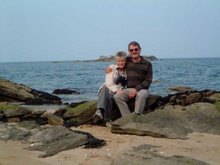
Our first campsite here in Sicily is 60 miles farther south from Etna, in the south eastern corner, near the town of Avola. The last 400 yards from the main road into the site is the narrowest I’ve ever encountered, with a few dog-leg bends thrown in for good measure. Thank goodness we didn’t meet anything coming towards us. But the site itself is very pleasant, and right next to the beach. This is it on a brisk day, but on many days we have sat out comfortably in the sun in shirt sleeves. Big coats on when the sun goes down.


So we’ve really chilled out since our arrival: hence the delay in posting this blog, plus an intermittent wifi connection  A further reason is my cracked rib. I tripped backwards into a drainage channel on our first day here that resulted later in a visit to the local hospital on Christmas Eve.  The treatment there was very efficient once we got accepted into the system; first we had to gatecrash a mini Christmas party to get at the A & E staff on duty. X-rays showed a small cracked rib; nothing to worry about, but light duties for a while. The ascent of Etna will have to wait!


Saturday, 21 December 2013

Mon Dec 16th: Pompeii


At the time of its destruction in 79 AD, Pompeii had a population of around 20,000, about the same size as Huntingdon. It contained the full facilities of a prosperous town of those days, many more than in smaller, residential Herculaneum.
The forum, a large open rectangle, was the centre of civic life, where events and ceremonies would be held. It was flanked by markets, temples and administrative buildings. This is the forum, with Vesuvius looming in the background.


There were bakeries here as well as fast food shops. This intact bakers’ oven is exactly the same as today’s pizza oven, being heated by a wood fire from beneath. Even the fancy brickwork looks modern. You can almost smell fresh ciabatta coming from the oven!


Moving on to other facilities, Pompeii has one of the best preserved amphitheatres anywhere. It predates the Coliseum in Rome by about 100 years. Its large 20,000 capacity played host to gladiator contests and games where the audience would be supporting one side or the other like a modern football match. And, as in the odd football match, feelings ran so high that in 59 AD a major riot broke out between rival fans resulting in the authorities closing the stadium for 10 years. Football hooligans, you have been warned!


The theatre seems somewhat tame after the amphitheatre, but it was very popular and in fact there were two. This is the smaller one, holding about 1500 people. Jane’s the small dot sitting to the left of the far entrance, nursing a numb, cold bum as she forgot to bring her cushion for the performance.


We now come to the delicate matter of more personal facilities provided. The photo below is of one of the cubicles in the town brothel. That is a stone bed, so even with some generous padding you’d need to be desperate to avail yourself of the services there.


The premises still bear signs of appropriate decoration. This is an example of one of the less explicit tableaux adorning the walls. Pursuing the theme of desperation, you’d need to be at the end of your tether to be leapt on by the masculine-looking floozie in the illustration, all whilst lying on a stone bed!


Now to the authority dealing with the seedy side: the Courts of Justice. Roman law is the basis of many European judicial systems, including ours, so we would have recognised the prosecution and defence arguing their case, and then deliberation by a judge to reach a verdict. Not sure if a special sitting was convened to dispense ASBO’s to the amphitheatre rioters.
The all-powerful might of Justice is everywhere underlined by solemn ceremony and magnificent buildings. Here is no exception. The column stumps in the photo would have supported a large roof to shelter the litigants. The judges’ platform is the more intact rear part. The building was then all faced in imitation marble.


Some of the dwellings still retained magnificent original wall decorations (no, I don’t just mean the brothel). This villa just outside the town walls was especially well preserved. It’s a bit overbearing for my taste though: I’m a plain magnolia man.


The levels of sophistication are quite astounding. The bath complexes, of which there were several, had underfloor and cavity wall heating. A break in the wall clearly shows the two skins with the gap for heat circulation.


Finally, the streets: these were fully block paved, with pavements on either side. In fact, the same type of lava block is used to surface many regular streets in southern Italy now. These are very bumpy to drive over, especially when towing then caravan, and make traffic calming measures unnecessary as when exceeding 30 mph your wheels fall off. Some Pompeii  lava blocks show grooves worn by carts, as can be seen in the photo.


Pompeii was a fascinating demonstration of the variety and sophistication of life in those days. There was more to see than could be covered in a day: you could spend a lifetime studying the details.


Monday, 16 December 2013

Sat Dec 14th: Herculaneum

A fairly long but routine journey of 600 plus miles, with an overnight stop, saw us arrive at Pompeii on Thursday evening. On Friday we caught up with jobs like shopping and washing, and on Saturday we visited Herculaneum. 

Herculaneum is 10 miles from Pompeii. Both were destroyed by the same eruption of volcano Vesuvius in 79 AD. Herculaneum is much closer to Vesuvius, so suffered an even more cataclysmic impact. It was buried in volcanic ash 60 feet thick; however, this ensured a better state of preservation, even down to loaves of bread. 

This is the cone of Vesuvius looming over the ancient ruins and also the modern town on the higher level. It’s still active, and overdue another eruption according to the experts. “Don’t panic!”, as Mr Jones of Dad’s Army would have said.
 
The town lay undiscovered until the 18th century when a well digger uncovered fragments of the theatre, and today still only 25% of it has been excavated.  
It was a prosperous residential town of 4,000 inhabitants, and this street could be almost anywhere from any era. It has stone or brick houses, proper paved roads, pavements and a gutter.
 
Like in these days, there were many eating establishments where you could sit in or take away. The photo below shows a countertop with jars inset that contained the hot food. This was Roman fast food, their equivalent of  a ‘big Mac’, or ‘Maximus Mac’ as they might have called it
 
Public facilities were also top class in the town. The ladies bathhouse is particularly well preserved as can be seen from this changing room with its geometric mosaic floor and individual partitions on the shelves for clothes. A sophisticated touch: the roof is fluted so that condensation runs down the walls instead of dripping onto the bathers’ heads. We can’t have drips pestering the lady bathers.  

This public hall in the next photo was very grand and gives an idea of the ornate decoration applied to some of the plastered walls in other buildings. This edifice was used as a shrine to perform rites in honour of the emperor Augustus and may also have been a place for meetings of town dignitaries.

Nearly all of the internal artefacts and decorative panels in the town were carted off by the early excavators for use in their own premises. Some have found their way back to the National Archaeological Museum in Naples, and a few still remain in situ to give us an idea of the artistic excellence achieved in those early times. This wall panel, for example, is the Roman equivalent of the three ducks on the wall (who remembers them?):

It was thought until the 1980’s that most residents would have had enough warning to escape. However, in that decade further excavations along the old shoreline revealed over 300 bodies in boat houses presumably waiting to be rescued by sea. Analysis has revealed that a cloud of super-heated gas from the eruption killed them instantly. Somewhat gruesomely, these skeletons have been left in place, as the photo shows.

Herculaneum was a fascination window into life 2,000 years ago, with many similarities to our modern society particularly if you take our electronic gadgetry out of the comparison. 


Friday, 13 December 2013

Sunday 8th Dec: Malpasset Dam

The campsite is on the edge of Frejus town, not far from the site of an old dam where there are walking trails through the rolling hills. The afternoon light is starting to fade, but the picture below gives an idea of the lovely countryside.


What’s left of Malpasset dam is still impressive. Jane is standing near the base of what was once a 200 foot high concrete dam wall retaining the reservoir lake.


The dam was newly constructed, and had reached full capacity by late 1959 following torrential autumn rains. On the evening of December 2nd 1959 the dam broke, sending a wall of water initially 150 feet high, down the valley towards Frejus and the sea, 10 miles away. The wave was still 10 feet high when it reached the sea. Pieces of dam weighing hundreds of tons can be seen strewn all down the valley as far as a mile away from the breach.


A simple plaque commemorates France’s biggest civilian disaster of the 20th Century. 423 people lost their lives plus an indeterminate number of encamped unregistered workers employed on the new A8 motorway construction.  

Although over 50 years ago, you couldn’t help but imagine the horrors of that evening back in 1959. A bit more to think about than usual during an afternoon stroll.