Tuesday, 11 February 2014

6th Feb: Erice

Erice is a medieval town on the west side of Sicily. My Rough Guide tells me it was founded by the Elymnians, whoever they were, when they settled in this part of Sicily, well before the Greeks appeared, in about 1200 BC. They originally called it Eryx, and I was disappointed not to find an Eryx Bar in the town. You know, as in Eric and Ernie.

Some of the early town walls from 800 BC are still standing, in remarkably good fettle; they’ll outlast the cars, that’s for sure.


The site was chosen for its fortress qualities. It’s on a table-top mountain 2,350 feet high. I should be reporting that the road up was a scary switchback, but it was really very good, twisty of course, but quite wide and well surfaced with barriers. I don’t think Jane had to shut her eyes once.

This is a view from the town looking down over the regional capital Trapani and the Egadi islands. On a clear day you can see Tunisia over 100 miles away. We didn't feel like waving anyway.


The position looks impregnable, but it was conquered in succession by all the invading powers of the day, the Romans, the Arabs, and the Normans. I was surprised to learn how much of Sicily the Normans ruled. This was a boom era for Erice, the Middle Ages, after which not a lot happened so it’s stayed in that time warp until present times. So we have a Norman Castle very much like those at home, looking down from a lofty crag on one edge of the town.


The Norman cathedral is also a familiar type, so instead of a photo of the building, I’ve put in a close-up of its unusual rose window. It’s a wonderfully intricate stone carving of a circle of what appears to be carpet beaters. The Normans may have been savage warriors and tyrannical overlords, but they clearly valued clean carpets!


The guide book says to just wander around the town, there’s no specific route. So we did, and this is a typical sort of alley. The whole town is paved in these medieval cobbles that we saw workmen painstakingly repairing so as to keep the traditional look.


There are 60 churches in Erice. This is just one that we came upon with a pretty bell tower.


I suppose Erice leaves two distinct impressions, firstly, the medieval feel of the place as it’s mostly all of that period and, secondly, the fantastic views in all directions. As well as the big vistas, looking over the edge sometimes shows a precarious church, or fairy-tale castle built on a pinnacle as in the next photo.


The ascent/ descent took us 20 minutes each way in the car for the 8 mile journey, so it doesn’t bear thinking about how arduous this must have been in ancient times. There’s even a cable car up from Trapani now, but closed during the winter.


Monday, 10 February 2014

Sat 1st Feb: to San Vito Lo Capo

We moved about 100 miles to the north-western side of the island. The site is large but quiet as it’s out of season and is also in the middle of nowhere, on the seashore with cliffs behind. It’s the cliffs that seem to generate the customers, i.e. lots of climbers. We have now got used to seeing them swinging from impossible angles on the cliff face.

 
There appear to be a number of pre-prepared routes that have bolts already hammered in. The climbers attach their clips to these bolts through which they feed their ropes so if they fall, they only drop as far as their last clip. Just hope those bolts are in tight.........  well of course they........
 
 
Being on the coast, you’d expect this place to be a swimmer’s paradise. Unfortunately not, as a plaque explains on the nature trail. The seashore fringe, or pavement as it is called, is made from a kind of shell material not unlike a coral reef. It’s between 20 and 50 metres wide most of the way around the big bay and is hard and sharp. You don’t walk here without stout shoes never mind swim. This is the general appearance of the seashore with me well camouflaged on the left. Stick with rock climbing, it’s safer!
 
 
The landscape is certainly beautiful as we are on the edge of the Zingaro Natural Reserve. It’s also part of the state-owned forest. This can’t be too difficult to administer as there don’t seem to be many trees on it. This is a view looking inland towards the Reserve.
 
 
At dusk, a chain of islands becomes visible silhouetted across the far side of the bay, to the right of the headland, looking like the humps on the Loch Ness monster. 

The nearest town is San Vito about 3 miles away. It’s small, pleasant enough with no special features (it does have a sandy beach!!), but as in many parts of western Sicily shows influences of Arab occupation just like southern Spain. This next photo is the church, followed by the flat-topped buildings of the main street; it reminded us of Morocco.  


Wednesday, 5 February 2014

The Inside Treasures


The Valley of the Temples was magnificent, and we now wanted to see the artefacts found there and at other local sites. These are housed in the archaeological museum in Agrigento. It is a huge collection. And because we are pensioners entry was free, as is usual in Italy.

The earliest intact finds are from around 1500 BC. This pot from 1200 BC could be the work of a quality modern potter. It looks like it’s going to stride forward and shake hands with you.

 
Most people would recognise the next photo as Ancient Greek: an urn with scenes and figures in light tan on a black background. These date from about the 6th century BC. The example below features nude men and elegantly dressed ladies doing a kind of dance. The ladies seem quite unfazed so maybe we should adopt a similar dress code for, say, the Christmas Charity Ball.


There are literally hundreds of these vessels, with different artwork and sizes. They are generally in exceptionally good condition because many were discovered in tombs which, as we have seen, were either stone coffins or chambers carved into rock and therefore well protected.
The next pot illustration also looks modern and is of Hermes, the winged messenger. Wings on helmet and boots, so zero carbon footprint. Brilliant idea for eco-friendly commuting. They really were so much smarter in those days.
 

Now for some jewellery: first a gold necklace from the 4th century BC and then some beads of a similar vintage. They are surprisingly intricate and pleasing in design.


The museum also had one of the Atlas type column support figures that we saw lying flat on the ground in the Valley of the Temples, this time assembled upright, with Jane stood nearby to give an idea of the scale. The temple itself was three times Atlas’ height. How many Weetabix do you reckon he could eat?


Next a 6th C BC soldiers’ helmet. The design is similar to helmets used throughout the centuries right up to WW2, as per example underneath.


Across the road from the museum are the remains of a Greco-Roman village, and we thought to round off the day with a quick trip around it. It was closed, but we didn’t know that until we came to leave by the main entrance that was locked. We had entered through a side gate, not realising that it had been left open for workmen who were repairing mosaics. So we had the place completely to ourselves, not thinking this was odd as it was wintertime and a cool day.

I can’t say whether the next photo was a mosaic they had repaired or were going to repair, but it’s quite classy. Many of the ruined houses showed traces of mosaic flooring, so installing these must have been big business, the Carpet Rights and Carpet Cities of their day. I wouldn’t have fancied lugging the pattern books around though.


Ruins are just that- ruins, so it’s difficult to take a meaningful general photo. It’s different when you’re in amongst them and can examine details like mosaic bits and room shapes and drainage conduits. You can slowly build a picture of what life may have been like, probably totally off the mark, but who knows. But we’ve only got that general, meaningless photo to finish with!


We did enjoy our stay at Torre Salsa and our various trips, but now it’s time to move on. Saturday 1st of Feb will see us head for the west side of the island, to a site near the town of San Vico Lo Capo.


Sunday, 2 February 2014

Out and About near Torre Salsa Campsite.

We took a trip up to the small town of Bivona, 40 miles into the mountainous heart of Sicily. The scenery was magnificent, but it came on to rain with low cloud so there are no photos worth reproducing.

So why Bivona?  Well, we’ve been going to Nick’s hairdressing salon in Bedford for 25+ years and know everybody there so well it’s like visiting friends. One of the lady hairdressers comes from Bivona and we said we might have a look-see, so we did. This is one of the squares that the gloomy weather doesn’t do justice to.


There are only half a dozen units on the campsite, long-termers of different nationalities that meet up each winter. They are a really friendly bunch and have included us in all their social activities. One of these was a Sicilian evening at a local pizzeria with traditional music. So here we are, a French, a German, an Italian and an English couple in the pizzeria. Sounds like the start of a joke, “Have you heard the one about the….”.

The music came from an accordionist and a singer who put an enormous amount of energy into his songs and also danced with some of the female diners. Here he is doing an arm-in-arm dance with Jane. The singer’s daytime job is running the local garage!


It was all great fun. The pizzeria was packed with locals, mainly families, so it wasn’t a show for the tourists and certainly wasn’t tourist prices; for starters, pizza, a beer & coffee to finish came to just over £6 a head.

Back at the site, our French neighbour Christian is a keen guitarist. He’s trying to show me here how to play some lively Brazilian rhythms. My hands have turned to wood, but I’ll keep trying.


 The walks from the site contain some fine views. We try and chose different routes, and this time take a dirt road suitable at one time for a car but now, sadly, negotiable only by donkey or tank. We see many rocks with crystals embedded in them; the most spectacular is a rock about three feet square. In close-up, the detail of these sparkling gems looks like this. We’re rich!


A bit farther on, the cliffs look like kneaded dough, formed into patterns and whorls presumably by volcanic activity. It’s almost like tree rings, as you can see.


And now you are not only at the end of the whorl, but the end of today’s blog post.


Monday, 27 January 2014

Jan 22nd: Agrigento and the Valle dei Templi

Agrigento is the regional capital of this area of Sicily, and 30 minutes’ drive from our campsite. My guidebook tells me that the town has an interesting old quarter, but the reason for being here today is to visit the Valley of the Temples that the town overlooks. This is the town colourfully doing a bit of overlooking.


Greeks from a nearby colony founded the original town in 581 BC. They sited it on a ridge, a good defensive position. The town thrived and was enclosed by a mighty wall with nine gates.

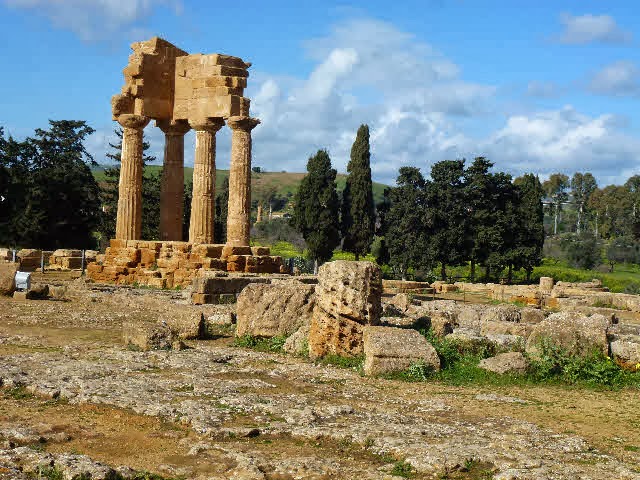
Five main temples have been identified within the town perimeter and form the most impressive such group outside of Greece according to the experts. We entered through one of the old town gates, straight into the ruins of the temple of Castor and Pollux, the Greek Ant and Dec.


There are pieces of temple scattered everywhere, and the elegant columns in the photo were assembled in 1836 from unrelated bits, like temple Lego.

The next temple we came to was apparently the largest of this type anywhere in the Greek world: the Temple of Olympian Zeus. It was never fully completed, and what is left lies in tumbled blocks, the result of earthquakes, destructive raids and, most significantly, stone quarrying by the locals. They built the port of Empedocle nearby with Zeus’ stone in the 18th century, and there’s still plenty left.

An interesting feature is one of the main temple columns, lying on its side. The upper part of this column is an Atlas figure with his arms raised over his head simulating bearing the weight of the building. He obviously got tired and put his arms down because the temple collapsed.


From here on the temples start to look like temples. This next photo is the Temple of Juno, looking down from its elevated position. All the temples are dated from the 5th century BC so have done well to survive in any shape really.


On the site complex is a large house of more recent times. The bronze bust in the entrance is that of a tireless benefactor of the archaeological site who lived in the house from 1921 to 1933. He was Captain Alexander Hardcastle, a retired English army officer whose money came from inheriting the family bank. In 1933 the bank went bust; shortly after, poor old Capt. H entered the local lunatic asylum where he died a little later. Well, he was nuts about archaeology from his first visit here.


The Tempio della Concordia has to be one of the most beautiful ancient temples anywhere. It is remarkably intact and so perfectly proportioned that you keep taking pictures of it from every imaginable angle. They were all good when viewed on the computer later, so out of the window goes my resolve to ruthlessly prune down my huge harvest of digital snaps.

Taking photos is so much easier at this time of the year: no crowds, so you also don’t have to wait for, say, a group of schoolkids to stop swarming over the subject, or that bloke if the bright red anorak to move out of frame.


Superb, isn’t it? The next shot shows part of the line of the original city walls featuring our favourite temple in the distance.


The wall themselves were used by later occupants of the city, in the early Christian era, as burial tombs. You can see below how the stone has been hollowed out into chambers; tombites, so to speak.


A friendly French tourist offered to take our photo with a 600 year old olive tree (actually, she used my camera). Here we are with Olive and, over on the right, a recent bronze statue lying on its side looking like a giant anteater. I’m not sure why they need a modern work here when there is so much genuine antiquity to see.


The Valley of the Temples isn’t a valley at all, it’s a ridge offering fine views down to the sea and up into the hills. Most of all, the site radiated tranquillity; you almost wanted to whisper in deference to all that accumulated history.  I imagine, in its day, it was anything but quiet; full of busy people going about their daily lives. Throw in the odd earthquake and Carthaginian attack and they would maybe think our lives today the more peaceful.


Wednesday, 22 January 2014

14th Jan: Camping Torre Salsa Agriturismo


The coast road from Avola to Torre Salsa is not recommended, so we took the motorway across the centre of the island and cut down to our destination at the appropriate point.

Our journey took us through broad, cultivated valleys with hills or mountains on either side. The towns and villages tended to be on the hillsides as in the photo taken when we stopped for lunch. It looks like Etna’s just exploded behind the village but it’s only a dramatic cloud.


The agriturismo bit in the blog heading simply means that the campsite’s on a farm. It is set on high ground overlooking the sea half a mile away, and is adjacent to a Natural Park. This is the view from the terrace where we checked in.


Strangely, the campsite is also a Nordic Walking Centre and obviously targets the Scandinavian sun seekers  because there are signs near each entrance to the beach stating “No Nudism”; some barely(!) readable. Maybe the Nordic Walkers then walk starkers as a protest- just watch where you’re swinging those poles!

We haven’t seen any proper Nordic Walkers and the few pitches taken are occupied by Germans, who are very friendly. So we’ve got plenty of room to spread out (we’re occupying two pitches), as you can see.


So what’s the metal structure? Are we in a hop yard, or a radar tracking station?  The iron framework is covered over during the summer months to shield motor homes and caravans from the intense sun. At those times it must feel quite claustrophobic, being full of people and vehicles and covered all over in sun-blocking material. Factor 50 material, I’m sure.

Now for some Nordic Walking: not exactly, but there are extensive tracks for the Nordic Walkers that are equally good for normal walking, and most pleasant.

Here’s a typical stretch of path, with Jane holding a bunch of wild asparagus. I’d like to claim we’d picked it ourselves, but it was given to us by a kind German couple who come here every year and know all its secrets. We were advised that wild asparagus makes a delicious omelette, and this is what Jane cooked for our evening meal. It didn’t quite live up to expectations as it was rather bitter, but we enjoyed the experience.


The various trails pass through undulating woodlands, fields and seascapes at clifftop and beach level. Here’s a sea view with a nice sunset.


Sunday, 19 January 2014

Insert: Thursday Afternoon in Syracuse (Jan 9th).


Hopping back a blog to the morning when we visited the Concrete Cathedral, in the afternoon we went to the Archaeology Park across the road. To get “across the road” meant a 5 mile car journey of no-left-turns and one-way streets. But having got there the parking was ample and free, as was entry to the Arch Park.
 
The first port of call in the Park was the Greek theatre, seating 15,000, founded in the 5th century BC and rebuilt in the 3rd century BC. It is well preserved, and a sophisticated, elegant design. How advanced living standards were all those years ago for the better-off citizens!   
 
We even know some of the plays performed here, written by a playwright called Aeschylus. Ten of his plays have survived to the present day and are still performed. The surviving ten are high drama involving both mortals and the Gods, in epic settings e.g. the Persian invasion of Greece. Perhaps the ones that got lost were the comedies and the “It’s behind you!” ones. 


Climbing up behind the theatre we came upon a street with openings carved out of the rock. These are tombs, and date from the period after the Greeks and Romans. The ruts are cart tracks. Heavy stone coffins obviously.


This is the interior of one of the tombs where the niches can be seen chiselled out of the sides.


On the far side of the theatre is a large stone quarry that supplied the material for the city’s roads and major buildings. It was also used as a secure compound for prisoners of war. For example, in 415BC the city was attacked by a huge fleet of 134 ships from Athens. The offensive was defeated, and all those captured were consigned to the quarries. It looks very peaceful now with the orange trees and other bushes in the bottom.


In the quarry is an odd cave known as the Ear of Dionysius. It’s shaped like an ear and you really can hear a whisper anywhere inside the cave: apparently it magnifies sound 16 times. It’s a big ear, which is why Jane is a hardly visible dot at the entrance. But don’t  SHOUT, you’ll deafen her.


Now up the slope and round the corner to the Roman bit, a 3rd century AD amphitheatre.
Again, the amphitheatre is in good nick, and the various passageways and tunnels used by the gladiators and animals can be clearly seen, as can the audience access points to those cold stone seats.


Now here’s an odd one. A church built over the Roman baths. It’s a lovely old church, but why would you build it directly over the baths? They could have ended up baptising the whole congregation as well as the baby. But maybe the church knew a thing or two about Roman building as it’s still there in one piece today.


Last, but not least, is the tomb of Archimedes, a native of Syracuse. He was the genius of his time, an inventor, engineer, mathematician and astronomer. A famous story tells of him getting into his bath and, seeing the water level rise, suddenly realised how being immersed in water affected the weight of objects. He jumped out of the bath and ran into the street in great excitement, forgetting he was stark naked, shouting “Eureka” (meaning: “I’ve found it!”).
He was killed when the city was captured by the Romans in 215BC. It had survived a two year siege and had lasted that long largely due to Archimedes military inventions in the defence of the city.
His tomb is a carved rock doorway and the inside actually looks like a mouth with teeth. Is it meant to be Archimedes smile; or was he the inventor of dentures? Unfortunately, we’ll never know.


You think before visiting yet another archaeological site that maybe it’ll be samey- we’ve seen lots of ancient buildings recently, including really spectacular places like Pompeii. But generally each venue has its own character and this was no exception; so it was another interesting day out.