Tuesday, 18 February 2014

Valentine’s Day in Palermo

Palermo is the 5th largest city in Italy, and is busy and congested. We caught the local bus from near the campsite into the centre, a distance of about 10 miles, and that took an hour.
We started at the Quatro Conti, the crossroads that divides old Palermo into its four original districts. Right there is a small church, La Martorana, dating from 1143. It was built by the Greek chief minister of the Norman King Roger ii, so it is basically a Greek Orthodox Church, with world class mosaics by Byzantine craftsmen. It’s literally covered in mosaics, roof, floor and walls, as the next two photos show.


La Martorana is next door to an even smaller church, San Cataldo, a mixture of Arab and Norman design. It’s now been restored as a church, but was used as a post office in the 19th century. Photo: La Martorana left, San Cataldo right.


In the next square is a beautiful fountain surrounded by white marble statues. You can’t get near the fountain because it’s enclosed by iron railings. A shame, yes, but there is a good reason. It wasn’t originally enclosed, but the statues are all nudes and the railings are there to keep the graffiti artists at bay!


Just around the corner is another lovely church, Santa Caterina, of later date, this time in ornate baroque style (17th/18th century). Every inch is covered in elaborate marble sculptures and decoration, with beautiful inlaid floors. Take a look at just one side chapel.


There’s also a captivating 3D picture of Jonah and the whale. The whale, in the bottom left-hand corner, looks a friendly, cuddly sort. With his twinkly eye and open mouth he could be a muppet character about to break out into a jolly song.


Strolling around the centre we came upon a huge street market that dates back to the Arab era. It still retains that atmosphere, which took us back to Morocco. The photo seems much too orderly and can’t convey the hustle and bustle of it all.


On the other side of the market was a much poorer area where buildings were scruffy and the streets piled up with rubbish. Whilst we couldn’t say the people were in any way threatening, we didn’t feel comfortable so didn’t linger.    
We soon came to the 16th century Porta Nuova, one of the main gates into the old city. It commemorates King Charles V’s exploits in Tunisia, and is covered in carvings of stern turbaned figures, see sample underneath. The upper warrior seems to be holding the hair of the lower one who is grimacing as if to say, “if you keep on pulling my hair I’m gonna thump you.”


Just beyond the gate, and after a tasty hazel nut ice cream, the cathedral comes into view. A beautiful exterior, if you ignore the repair hoardings and scaffolding. In style, it’s a mixture of St Pauls in London and Kings Cross railway station. The interior’s somewhat bare and cold, so no pic included.


An interesting feature is the weather vane above the clock. It’s the figure of a bishop, and could well be a subtle comment on the church hierarchy being inclined to go whichever way the political winds are blowing at the time.
Palermo had much more in the way of churches, palaces and museums but there’s only so much you can do in a day. The overall impression was of a city with a wealth of multicultural roots. We had a very enjoyable visit.






Thursday, 13 February 2014

Zingaro Natural Reserve

The Reserve is on the other side of the mountains from the campsite, only a few miles as the crow flies or via a goat track over the tops. Regular access is around the mountains to the north or to south, and we did both on separate days.
The main route within the Reserve is a rocky footpath following the line of the coast that connects the north and south entrances. This is typically what the path looks like.


The coastline is rugged so it’s a picturesque route with scrub plants and a variety of wildlife. We didn’t see much wildlife apart from the occasional rapidly flitting bird, but Jane did spot these odd bristles on the path (largest one is about 6 inches long).


At the exit, the Reserve Warden (where was the regular one?)  said they were from a porcupine. The internet expanded on this to explain that it was a Crested Porcupine, the only European species of porcupine, and quite rare. They have been known to charge backwards, so maybe it was as well we didn’t blunder into it. 
A few trails from the coastal path head inland into the mountains, wild country as you can see from the photo.

The route goes past a big cave. A plaque nearby describes finds in the cave dating from 10,000 BC, the earliest known inhabitants of the island. The cavemen here had no excuse for not recording details of their history, having generous supplies of porcupine quills lying around.
 

To create a proper path at the southern end, a tunnel has been blasted through the rock. It shows how isolated this area must have been in the not too distant past, with just a few fishermen’s dwelling inside the Reserve only accessible by boat or very rough trails. It was rumoured that the area was a favourite dropping ground for Mafia smuggled drugs, and that the opening of the Reserve in 1981 included negotiations with the Mafia. I’m sure a suitable alternative was agreed.


Just outside the Reserve is an old, abandoned, tiny fishing village, La Tonnara di Scopello. It’s in an idyllic setting with a line of rock pinnacles outside the harbour entrance and a ruined watch tower on the cliffs. How romantic is that? Probably not very, after a hard night’s fishing- you’d swap it there and then for a bottle of Chianti.


There was a small church, the most important building in the village when you’re trying to ensure favourable fishing weather. A miniature, but beautiful in its simplicity.


And what was this sink used for, washing clothes, gutting fish? The triangular splash-back is so beautifully made in mosaic. The discoloured plaster and rusty anchor make up the collage; it looks like it’s grown, like a plant.


We’ve enjoyed the tranquillity of San Vito Lo Capo, and now for something different as we are upping stumps and off to the hustle and bustle of the island’s capital Palermo on Wednesday 12th Feb.


Tuesday, 11 February 2014

6th Feb: Erice

Erice is a medieval town on the west side of Sicily. My Rough Guide tells me it was founded by the Elymnians, whoever they were, when they settled in this part of Sicily, well before the Greeks appeared, in about 1200 BC. They originally called it Eryx, and I was disappointed not to find an Eryx Bar in the town. You know, as in Eric and Ernie.

Some of the early town walls from 800 BC are still standing, in remarkably good fettle; they’ll outlast the cars, that’s for sure.


The site was chosen for its fortress qualities. It’s on a table-top mountain 2,350 feet high. I should be reporting that the road up was a scary switchback, but it was really very good, twisty of course, but quite wide and well surfaced with barriers. I don’t think Jane had to shut her eyes once.

This is a view from the town looking down over the regional capital Trapani and the Egadi islands. On a clear day you can see Tunisia over 100 miles away. We didn't feel like waving anyway.


The position looks impregnable, but it was conquered in succession by all the invading powers of the day, the Romans, the Arabs, and the Normans. I was surprised to learn how much of Sicily the Normans ruled. This was a boom era for Erice, the Middle Ages, after which not a lot happened so it’s stayed in that time warp until present times. So we have a Norman Castle very much like those at home, looking down from a lofty crag on one edge of the town.


The Norman cathedral is also a familiar type, so instead of a photo of the building, I’ve put in a close-up of its unusual rose window. It’s a wonderfully intricate stone carving of a circle of what appears to be carpet beaters. The Normans may have been savage warriors and tyrannical overlords, but they clearly valued clean carpets!


The guide book says to just wander around the town, there’s no specific route. So we did, and this is a typical sort of alley. The whole town is paved in these medieval cobbles that we saw workmen painstakingly repairing so as to keep the traditional look.


There are 60 churches in Erice. This is just one that we came upon with a pretty bell tower.


I suppose Erice leaves two distinct impressions, firstly, the medieval feel of the place as it’s mostly all of that period and, secondly, the fantastic views in all directions. As well as the big vistas, looking over the edge sometimes shows a precarious church, or fairy-tale castle built on a pinnacle as in the next photo.


The ascent/ descent took us 20 minutes each way in the car for the 8 mile journey, so it doesn’t bear thinking about how arduous this must have been in ancient times. There’s even a cable car up from Trapani now, but closed during the winter.


Monday, 10 February 2014

Sat 1st Feb: to San Vito Lo Capo

We moved about 100 miles to the north-western side of the island. The site is large but quiet as it’s out of season and is also in the middle of nowhere, on the seashore with cliffs behind. It’s the cliffs that seem to generate the customers, i.e. lots of climbers. We have now got used to seeing them swinging from impossible angles on the cliff face.

 
There appear to be a number of pre-prepared routes that have bolts already hammered in. The climbers attach their clips to these bolts through which they feed their ropes so if they fall, they only drop as far as their last clip. Just hope those bolts are in tight.........  well of course they........
 
 
Being on the coast, you’d expect this place to be a swimmer’s paradise. Unfortunately not, as a plaque explains on the nature trail. The seashore fringe, or pavement as it is called, is made from a kind of shell material not unlike a coral reef. It’s between 20 and 50 metres wide most of the way around the big bay and is hard and sharp. You don’t walk here without stout shoes never mind swim. This is the general appearance of the seashore with me well camouflaged on the left. Stick with rock climbing, it’s safer!
 
 
The landscape is certainly beautiful as we are on the edge of the Zingaro Natural Reserve. It’s also part of the state-owned forest. This can’t be too difficult to administer as there don’t seem to be many trees on it. This is a view looking inland towards the Reserve.
 
 
At dusk, a chain of islands becomes visible silhouetted across the far side of the bay, to the right of the headland, looking like the humps on the Loch Ness monster. 

The nearest town is San Vito about 3 miles away. It’s small, pleasant enough with no special features (it does have a sandy beach!!), but as in many parts of western Sicily shows influences of Arab occupation just like southern Spain. This next photo is the church, followed by the flat-topped buildings of the main street; it reminded us of Morocco.  


Wednesday, 5 February 2014

The Inside Treasures


The Valley of the Temples was magnificent, and we now wanted to see the artefacts found there and at other local sites. These are housed in the archaeological museum in Agrigento. It is a huge collection. And because we are pensioners entry was free, as is usual in Italy.

The earliest intact finds are from around 1500 BC. This pot from 1200 BC could be the work of a quality modern potter. It looks like it’s going to stride forward and shake hands with you.

 
Most people would recognise the next photo as Ancient Greek: an urn with scenes and figures in light tan on a black background. These date from about the 6th century BC. The example below features nude men and elegantly dressed ladies doing a kind of dance. The ladies seem quite unfazed so maybe we should adopt a similar dress code for, say, the Christmas Charity Ball.


There are literally hundreds of these vessels, with different artwork and sizes. They are generally in exceptionally good condition because many were discovered in tombs which, as we have seen, were either stone coffins or chambers carved into rock and therefore well protected.
The next pot illustration also looks modern and is of Hermes, the winged messenger. Wings on helmet and boots, so zero carbon footprint. Brilliant idea for eco-friendly commuting. They really were so much smarter in those days.
 

Now for some jewellery: first a gold necklace from the 4th century BC and then some beads of a similar vintage. They are surprisingly intricate and pleasing in design.


The museum also had one of the Atlas type column support figures that we saw lying flat on the ground in the Valley of the Temples, this time assembled upright, with Jane stood nearby to give an idea of the scale. The temple itself was three times Atlas’ height. How many Weetabix do you reckon he could eat?


Next a 6th C BC soldiers’ helmet. The design is similar to helmets used throughout the centuries right up to WW2, as per example underneath.


Across the road from the museum are the remains of a Greco-Roman village, and we thought to round off the day with a quick trip around it. It was closed, but we didn’t know that until we came to leave by the main entrance that was locked. We had entered through a side gate, not realising that it had been left open for workmen who were repairing mosaics. So we had the place completely to ourselves, not thinking this was odd as it was wintertime and a cool day.

I can’t say whether the next photo was a mosaic they had repaired or were going to repair, but it’s quite classy. Many of the ruined houses showed traces of mosaic flooring, so installing these must have been big business, the Carpet Rights and Carpet Cities of their day. I wouldn’t have fancied lugging the pattern books around though.


Ruins are just that- ruins, so it’s difficult to take a meaningful general photo. It’s different when you’re in amongst them and can examine details like mosaic bits and room shapes and drainage conduits. You can slowly build a picture of what life may have been like, probably totally off the mark, but who knows. But we’ve only got that general, meaningless photo to finish with!


We did enjoy our stay at Torre Salsa and our various trips, but now it’s time to move on. Saturday 1st of Feb will see us head for the west side of the island, to a site near the town of San Vico Lo Capo.


Sunday, 2 February 2014

Out and About near Torre Salsa Campsite.

We took a trip up to the small town of Bivona, 40 miles into the mountainous heart of Sicily. The scenery was magnificent, but it came on to rain with low cloud so there are no photos worth reproducing.

So why Bivona?  Well, we’ve been going to Nick’s hairdressing salon in Bedford for 25+ years and know everybody there so well it’s like visiting friends. One of the lady hairdressers comes from Bivona and we said we might have a look-see, so we did. This is one of the squares that the gloomy weather doesn’t do justice to.


There are only half a dozen units on the campsite, long-termers of different nationalities that meet up each winter. They are a really friendly bunch and have included us in all their social activities. One of these was a Sicilian evening at a local pizzeria with traditional music. So here we are, a French, a German, an Italian and an English couple in the pizzeria. Sounds like the start of a joke, “Have you heard the one about the….”.

The music came from an accordionist and a singer who put an enormous amount of energy into his songs and also danced with some of the female diners. Here he is doing an arm-in-arm dance with Jane. The singer’s daytime job is running the local garage!


It was all great fun. The pizzeria was packed with locals, mainly families, so it wasn’t a show for the tourists and certainly wasn’t tourist prices; for starters, pizza, a beer & coffee to finish came to just over £6 a head.

Back at the site, our French neighbour Christian is a keen guitarist. He’s trying to show me here how to play some lively Brazilian rhythms. My hands have turned to wood, but I’ll keep trying.


 The walks from the site contain some fine views. We try and chose different routes, and this time take a dirt road suitable at one time for a car but now, sadly, negotiable only by donkey or tank. We see many rocks with crystals embedded in them; the most spectacular is a rock about three feet square. In close-up, the detail of these sparkling gems looks like this. We’re rich!


A bit farther on, the cliffs look like kneaded dough, formed into patterns and whorls presumably by volcanic activity. It’s almost like tree rings, as you can see.


And now you are not only at the end of the whorl, but the end of today’s blog post.


Monday, 27 January 2014

Jan 22nd: Agrigento and the Valle dei Templi

Agrigento is the regional capital of this area of Sicily, and 30 minutes’ drive from our campsite. My guidebook tells me that the town has an interesting old quarter, but the reason for being here today is to visit the Valley of the Temples that the town overlooks. This is the town colourfully doing a bit of overlooking.


Greeks from a nearby colony founded the original town in 581 BC. They sited it on a ridge, a good defensive position. The town thrived and was enclosed by a mighty wall with nine gates.

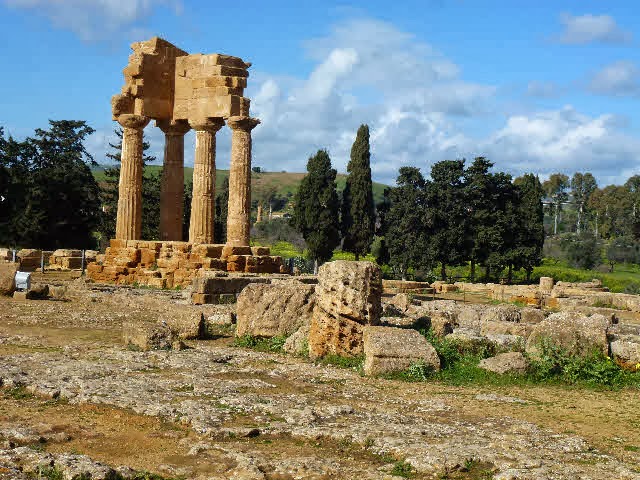
Five main temples have been identified within the town perimeter and form the most impressive such group outside of Greece according to the experts. We entered through one of the old town gates, straight into the ruins of the temple of Castor and Pollux, the Greek Ant and Dec.


There are pieces of temple scattered everywhere, and the elegant columns in the photo were assembled in 1836 from unrelated bits, like temple Lego.

The next temple we came to was apparently the largest of this type anywhere in the Greek world: the Temple of Olympian Zeus. It was never fully completed, and what is left lies in tumbled blocks, the result of earthquakes, destructive raids and, most significantly, stone quarrying by the locals. They built the port of Empedocle nearby with Zeus’ stone in the 18th century, and there’s still plenty left.

An interesting feature is one of the main temple columns, lying on its side. The upper part of this column is an Atlas figure with his arms raised over his head simulating bearing the weight of the building. He obviously got tired and put his arms down because the temple collapsed.


From here on the temples start to look like temples. This next photo is the Temple of Juno, looking down from its elevated position. All the temples are dated from the 5th century BC so have done well to survive in any shape really.


On the site complex is a large house of more recent times. The bronze bust in the entrance is that of a tireless benefactor of the archaeological site who lived in the house from 1921 to 1933. He was Captain Alexander Hardcastle, a retired English army officer whose money came from inheriting the family bank. In 1933 the bank went bust; shortly after, poor old Capt. H entered the local lunatic asylum where he died a little later. Well, he was nuts about archaeology from his first visit here.


The Tempio della Concordia has to be one of the most beautiful ancient temples anywhere. It is remarkably intact and so perfectly proportioned that you keep taking pictures of it from every imaginable angle. They were all good when viewed on the computer later, so out of the window goes my resolve to ruthlessly prune down my huge harvest of digital snaps.

Taking photos is so much easier at this time of the year: no crowds, so you also don’t have to wait for, say, a group of schoolkids to stop swarming over the subject, or that bloke if the bright red anorak to move out of frame.


Superb, isn’t it? The next shot shows part of the line of the original city walls featuring our favourite temple in the distance.


The wall themselves were used by later occupants of the city, in the early Christian era, as burial tombs. You can see below how the stone has been hollowed out into chambers; tombites, so to speak.


A friendly French tourist offered to take our photo with a 600 year old olive tree (actually, she used my camera). Here we are with Olive and, over on the right, a recent bronze statue lying on its side looking like a giant anteater. I’m not sure why they need a modern work here when there is so much genuine antiquity to see.


The Valley of the Temples isn’t a valley at all, it’s a ridge offering fine views down to the sea and up into the hills. Most of all, the site radiated tranquillity; you almost wanted to whisper in deference to all that accumulated history.  I imagine, in its day, it was anything but quiet; full of busy people going about their daily lives. Throw in the odd earthquake and Carthaginian attack and they would maybe think our lives today the more peaceful.