Friday, 13 June 2014

The Buda Side: 6th June

Castle Hill is a mile long ridge, containing the Royal Palace and Buda old town, looming directly over the Danube. It’s a great defensive position, which accounts for it having been ravaged eighty six times in the last 700 years according to my guide book. The last occasion was in early 1945 when the Red Army and Nazis slugged it out with all the destructive power of modern weapons. So what you see today is a painstaking, faithful reconstruction - and you’d never guess.

We cross from Pest to Buda via the “famous chain bridge” (quote from Hop-on, Hop-off commentary) that I’d never heard of before, but it was quite striking. 
It’s a hot day, so on arriving at the far bank we use the cog railway to ascend Varhegy, Castle Hill to us. This was cutting edge in its day, the second funicular railway in the world when it opened in 1870. It’s now cutting edge restoration as it was hit by a shell in 1945.
At the top you’re right next to the Royal Palace that houses the Hungarian National Gallery, the Budapest History Museum and the National Library. The exterior is magnificent and ornate, but inside the reconstruction is functional and did not seek to replicate the elaborate palace that was destroyed in battle of late WW2.
Strolling into old Buda, the most noticeable feature is Matyas Church. The original building dated from the 13th century, but it was adapted and altered so many time that the post 1945 rebuild hardly seems to matter. During the 160 years of Turkish occupation it was even a mosque. It’s beautifully proportioned with a patterned tile roof.
Inside the recreated colour scheme is overwhelming. It looks like mosaic at first glance but is in fact painted: every bit of wall and ceiling, and it’s stunning.
 Outside, next to the church and overlooking the river, is the Fishermen’ Bastion. The fishermen in the Middle Ages apparently stoutly defended this part of the town. But not from the Bastion, that’s a later decorative addition. It looks the biz though. What’s wrong with a bit of Disney?
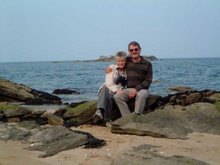
We take another look at the view from the Palace terrace. It’s a terrific panorama of Buda, Pest and the Danube, which is definitely not blue, more a muddy brown. You can’t get all of that in one photo, so this is us with the backdrop of Pest, the Danube AND the Chain Bridge, getting more famous by the minute.
Budapest provided an interesting explore, what you could normally expect from an historic European capital city. It helped that many notices, leaflets and other communications were in English because Hungarian is not one of the languages you can easily guess, in fact it has no connection with any other language apart from a slight similarity to Finnish. And with that, we finish in Budapest.


Thursday, 12 June 2014

Budapest: 5th June

Budapest as a city was created by joining the two towns of Buda and Pest, on opposite side of the Danube, in 1873.
Buda is hilly whilst Pest is flat, and we’ll start with Pest only because the Hop-on Hop-off bus goes there first, and we’ve just hopped on the bus.
From the bus, plenty of elegant buildings drift by that could just as well be part of any European capital. The yellow taxis could be from New York.
We sail past the Gresham Palace, a fine art nouveau building finished in 1904 by a British insurance company. It is now a hotel.
Budapest was occupied by the Turks for 160 years from 1526, so leaving some particular legacies like the Szechenyi Turkish baths. The front looks like a royal palace, and it appears that a favourite pastime, while wallowing in the water, is to play chess. It’s mixed sex, too, so you could take your Czech mate.
This is a building with a more sinister history. First, the HQ of the Arrow Cross fascists in WW2, the Hungarian Nazi Party, then the AVO, alias the KGB, under the communist regime. Now it’s a museum called The House of Terror that commemorates the inhumanities that were committed there.
Hosok Square constructed in 1896 is the area for big meetings and parades. At other times it’s the domain of a few skateboarders, rollerbladers, and pedestrians. That forlorn emptiness could easily be filled by parades of Hop-on Hop-off buses.
Now for some modern architecture. But the ING building looks like it’s cracked into segments and been repaired with bits of wire. Not perhaps the solid image an investment company like ING should be striving for.
 I’ve been neglecting the churches. This is St Stephens Basilica that contains the mummified right hand of St Stephen. This is paraded through the streets on his saints’ day Aug 20th  when the devout can engage it with a “high five".

The Jewish synagogue here is the second largest in the world, after New York. It’s pretty impressive with an elaborate front and gilded towers.
There can be no doubt that the most stunning edifice from any era here is the Parliament Building, completed in 1904. It has 691 rooms and is 315 feet tall: the largest building in Hungary, and the tallest in Budapest. Not that any of this make for better parliamentary decisions or integrity.
We visit Buda the next day, on foot this time, so we’ll see you tomorrow.


Sunday, 8 June 2014

Szentendre Town

Szentendre was one of Huntingdon’s twin towns, and maybe still is.  Huntingdon Town website shows it as currently twinned with Szentendre, but not the other way round!

It’s an attractive town on the Danube that has become a magnet for working artists, about 200 of them. This is the market square, from which radiates a network of cobbled streets.
 Predictably, the main thoroughfare is full of touristy shops and restaurants designed to appeal to the trippers, most of who come by boat or bus from Budapest. Here they are swarming along the High Street.
 To be fair, there are some genuine Hungarian goods on sale as well as the cuddly toys and memento trinkets obviously made in the Far East. This shop is selling only traditional indigo dyed Hungarian clothes. There was even a faded letter in a glass case, dated 1990, from Princess Diana’s lady-in-waiting thanking the shop for presenting Princess Di with some garments.
Taking to the side streets and lanes provided some pretty views that seemed to capture the spirit of the real town more than the crowded commercial areas.
As we walked back to the camp, I thought that Huntingdon’s got some catching-up to do if it wants to attract that many visitors


Saturday, 7 June 2014

June 3: To Budapest

The motorway system runs seamlessly from Slovenia into Hungary. Too seamlessly it seems, because at the border there are warning signs against travelling on Hungarian motorways without a vignette (a permit), and there’s nowhere to buy one.
Is this a scam to catch the tourists? We pass a stationery police car. It doesn’t follow. In about 50 miles a sign directs us off the motorway to a hotel that sells them, so all is well.

We are heading for a campsite at Szentendre, a small town on the other side of Budapest. There is no ring road from our direction so we have to go through the centre of the city: Jane drives, I navigate. It is busy, chaotic, and the road surface is rough, but the Hungarians aren’t too aggressive and we get through just fine. Top driving, Jane.

Camping Pap-Sziget is potentially a peaceful riverside site. It’s currently full of school parties that don’t seem to need any sleep. I’m sure we were like that once upon a time, but one doesn’t think quite so charitably at 2.00am.


Now let’s introduce you to Dave who checked in the day after us and set up next door. 
Dave has cycled all the way from Doncaster in the last five weeks, following the course of rivers, currently the Danube that runs past our campsite. Great achievement, but it’s the tip of the iceberg: Dave’s en route to Doncaster, Australia, over the next two years, through places like Kazakhstan, China, South Korea, Japan, Malaysia, Indonesia.  If he’s pedalling past where you live, do give him a wave.

Wednesday, 4 June 2014

Ptuj

Pronounced Put-toey, in case you’re wondering, but I reckon for me it’ll always be Per-tudge. This small town was chosen as a picturesque stop-off on our way east and is the oldest continuously inhabited settlement in Slovenia. This is the approach to the town from the campsite along the path atop an embankment of the river Drava.
Stone Age remains have been found, but recorded history starts with the Romans, followed by numerous other occupiers and invaders the latest being the holidaymakers. The old town is full of buildings like these in the photo. They look somewhat Austrian in appearance which is not surprising as the town was part of the bishop of Salzburg’s domain for many centuries.
The white monument in the right of the photo also doubled as a stocks to which offenders were chained from rings in the base. Ringtones had a different meaning in those days.
From here we walked up to the castle, a 12th century structure built by our favourite bishop from Salzburg, but much altered since so that is currently looks like a bigger version of the George Hotel in Huntingdon. I say you can’t be a proper castle without a moat, a keep and drawbridges.
The photo below shows a panoramic view over the town from the edge of the castle courtyard. The Town Tower on the left is a splendid feature with its onion dome, and the river Drava top right which has been dammed into a lake. The Drava is an unknown river to us Brits but it’s twice as long as the Thames and has a huge volume of water as can be gauged from the first photo taken from the embankment. 
The olde worlde cobbled path down from the castle was typical of many in the town and the Town Tower again adds its attractive presence. I ought to be writing this stuff for an estate agent. 
Our campsite is 1km from the old center and is part of a thermal baths complex. The site itself is pleasant and modern with cabins and camping pods to let as well as camping pitches. Camping pods? In this case, huge barrels converted into sleeping accommodation (necessarily located close to the loos). If the river overflowed you’d presumably just bob about a bit until rescue arrived.
We also made a quick trip to Ljubljana to meet up with nephew David for lunch and have a wander around in the afternoon. This is us later in the central square snapped by an obliging tourist. 
Ptuj, and Slovenia in general, is a delightful place. There is a great variety of scenery and history, and everwhere is so neat and tidy, particularly the gardens, that it’s a credit to the residents. 
Next stop Budapest, Hungary.


Friday, 30 May 2014

May 28: Garda to Ptuj via Trieste

Trieste is a one night stop-off on our way to Ptuj in Slovenia, and we arrive early enough to walk along the clifftop behind the campsite. There are some pleasant sea views looking down towards Trieste although the path is made of sharp limestone and quite stumbly underfoot.


Presently we come to some military lookout posts hollowed out of the rock. These date back to the First World War. However, this corner of Italy didn’t belong to Italy at the time but to the Austro-Hungarian Empire who were the enemy. And Italy was on our side in WW1 so was fighting to capture this part of today’s Italy. Confusing, isn’t it? You could end up fighting yourself.


The information board outside the lookout cave showed a picture of the enemy observers, who were German naval personnel.
The photo looks humorously boy-scoutish, but there was nothing funny about the war in the Trieste area; it was as hard fought as on the Western Front. There were especially high casualties caused by the shells splintering the limestone into deadly shrapnel, the same sharp shards that I complained was making the path uncomfortable to walk on.


We walked as far as the next photo point where I took this silhouette of Duino castle in the falling light. It was rebuilt in 1920, having been virtually destroyed by Italian artillery in WW1.


Whilst on the walk, we met an Englishman with his wife whose father was from Trieste. His dad considers the Trieste area still as an entity separate from Italy and my guidebook states this is generally felt. Unfortunately, they don’t have any oil like Scotland to fuel an independence movement.


Tuesday, 27 May 2014

Mon 26 May: Mantua


We decided to tear ourselves away from chilling out at Lake Garda and visit the ancient city of Mantua, a drive of 30 miles across the flatlands of northern Italy. It’s surrounded by three lakes with a stunning skyline, best enjoyed as you walk across the causeway from the car park- as long as you ignore the ever-present cranes spoiling that illusion that you are stepping back into the Middle Ages.  


Maybe the old times weren’t so idyllic. When the Pope visited the city in 1459 he complained of heat, mud and mosquitos. Today the chemical works has topped that by lining the bed of the largest lake with mercury.  
The first building we arrive at is the castle of St George, built over 600 years ago, looking all romantic and fairy-tale. To retain that image I’m not showing the slimy green moat.


The castle is part of the Ducal Palace complex that was the biggest in Europe at one time, all 34,000 square metres of it. The average UK home today would be around 150-180 sq. metres, so it was that big. It was built by the powerful Gonzaga (wasn’t he a Muppet character?) family who ruled the town for 300 years from the 14th century. Next is one of the palace facades in the piazza around the corner.


Moving on through the four interlinking squares that form the core of the old town, we come across an astronomical clock. Picturesque, but not very user friendly, i.e. you can’t seem to work out where the time is.
To the right of the clock tower, part of a round structure is just visible. It’s the oldest church in the city, the 11th century round church similar to the one in Cambridge of which there is a picture inside! Round churches were apparently built that shape so that the Devil would have no corners to hide in.


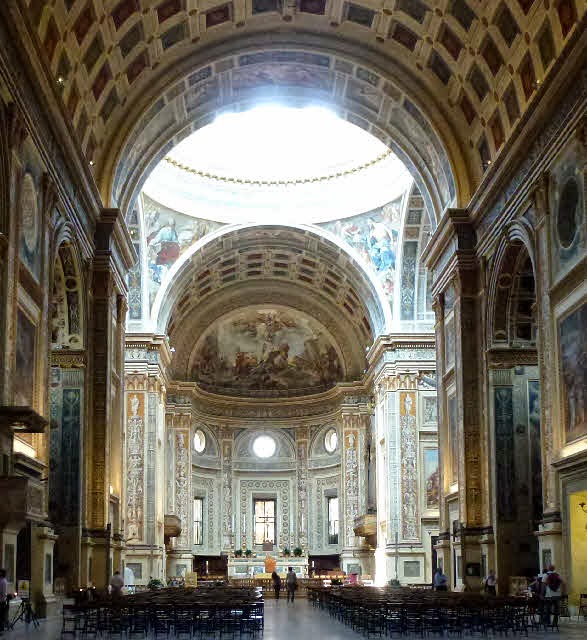
The cathedral was a bit bare, so no pic, but not so St Andrew’s church. It’s a large church dating from 1472 and is covered in what appeared to be wall carvings.


An example close-up looks like this.


They are, in fact, 3-D paintings, brilliantly executed to give the effect of carved stonework.

However, the church’s main claim to fame, and the reason for its magnificence, is that it houses two vases containing the Sacred Blood, brought to Mantua by Roman soldier Longinus. The vases have attracted multitudes of pilgrims down the ages, these sorts of relics being a source of great wealth to churches and monasteries that held them. They aren’t on public display and are only brought out on Good Fridays.

Authentic or not? You pays your money and  you takes your choice, as they say.


These elegant columns next to the river allowed boats to tie up to fetch and carry cattle and fish to the market on the upper level located to the right. They needed plenty of water to gut the fish and slaughter the cattle. The turmoil and smell must have been horrendous.

We had good eats and coffee outside Rigoletto’s house at very reasonable prices. All the cafes and restaurants seemed good value, a big tick here from us compared to rip-off Florence for example, but we felt maybe the town wasn’t quite making the most of its tourist assets. It’s always a pleasure to visit this sort of atmospheric place and we had a great day out.