Saturday, 7 March 2015

For Anoraks Only: Pima Air Museum

Only 4 miles from our campsite here in Tucson is the third-largest aircraft museum in the USA. We visited it on Saturday 28th Feb. It’s a well-run outfit using ex-military personnel as guides so an informed opinion is always to hand.
We took the trolley tour where our guide was a retired pilot, with the navy then commercial airlines. This covered the 2½ mile external display area; we wanted to save our legs for the hangers.


Here are some of the exhibits with a story to tell, starting with the West’s longest serving bomber, the B52. It entered service in 1955 and is still operational today and for the foreseeable future although none have been manufactured since 1962. A few weeks ago one was de-mothballed out of the storage area adjacent to the museum to replace one that had crashed. 
This is the Budd RB, or what’s left of it, a transport aircraft from 1943.The US Government feared that aluminium, the basic aircraft building material then and now, might become scarce, so ordered 800 of these planes in stainless steel. Stainless steel is much heavier than aluminium. Aluminium never actually became scarce so only 17 were ever built. It looks rather sad and perhaps should have been turned into something useful like whistling kettles.
Our pilot guide said this one, called the NASA Super Guppy, needed skilful handling and calm conditions. It flew outsized cargo for NASA in the 60’s e.g. parts for the Saturn 5 moon rocket. The whole front end swung open in order to load up these extra-large items.
Now we have a Sikorsky flying crane. Sikorsky is an American manufacturing company even though it sounds Eastern European. The founder, Igor Sikorsky was born in Kiev and emigrated. The helicopter was much used in the Vietnam War. It looks like a delicate dragonfly, but could carry around 10 tonnes.
United States Presidents’ official planes go by the title “Air Force One”. This Lockheed Jetstar was sometimes used by President Lyndon B Johnson as the presidential plane. He would refer to it, because of its small size, as “Air Force One-Half”. The plane directly behind, by the way, was JFK’s “Air Force One”. 
The Boeing B29 Superfortress was the most sophisticated and largest bomber of WW2 and carried on in service until 1960. It was the aircraft that dropped the atomic bombs on Hiroshima and Nagasaki. Several were used after the war as flying TV transmitters, and a modified version was the first aircraft to fly round the world non-stop. Of the 3,970 built only one flies today.
Moving indoors to the fastest jet aircraft ever produced (as opposed to rocket-driven), the SR-71 Blackbird. This was operational from 1966 to 98 and was highly secret for its early life because it was the front line spy plane. You may recall Russia shooting down a US U2 spy plane; this was the follow-on to the U2, a plane that couldn’t be shot down because it could fly faster than any enemy missile or bullet.
It could cruise at over three times the speed of sound (2,200+ mph) and generated so much heat that it expanded 8 inches in length when travelling at top speed. It still holds the record for New York to London, in I hour 55 minutes, one hour quicker than Concord. Across America: Los Angeles to Washington DC in 64 minutes. It’s an odd looking machine; the front end could be a home-made speedboat. Come in S71, your time is up.
But for real speed the rocket planes went even faster. The Bell-X15 reached a record speed of 4,519 mph in October 1967. This still stands. Astronaut Neil Armstrong was one of its pilots in the test programme.
 The world’s smallest aircraft is this Starr Bumble Bee, built by Robert Starr as a private project and first flown in 1988. It had an amazing top speed of 190 mph but only carried 3 gallons of fuel. The wingspan is only 5 ft 6 inches. It wasn’t really meant to fulfil a practical purpose, just to claim the world record of being the smallest. Only one was made.
Finally, one hanger was a memorial to the 390th Bombing Group in WW2. They were stationed near Framlingham, Suffolk. It was full of personal memorabilia like letters from POW camps. Whereas the museum elsewhere focussed on the machines, this was more a people exercise. An unusual exhibit was the embroidery below done by a POW with time on his hands, using unravelled shoelaces as thread and stitches remembered from his mother’s handicrafts.
The museum had a lot more besides and more than could be absorbed in a single visit but I wouldn’t give in to Jane’s pleas to come a second time. 


Thursday, 5 March 2015

25/26 Feb San Diego to Tucson, Arizona

Leaving the San Diego metropolis on our journey east to Tucson, we passed through green valleys as the road slowly climbed the relatively low mountain barrier between California and Arizona. The pass topped out at 4,200 feet before steeply descending straight into desert at sea level.


The map showed the road now running ever closer to the Mexican border and soon we saw the black ribbon fence that stretches all the way from the Pacific to the Gulf of Mexico. It’s to keep illegal immigrants and drugs out, and is reinforced by vigorous border patrols by Homeland Security agents, two of whom we chatted to the following day at our lunch stop in a rest area. They recommended a good Mexican restaurant in Tucson!
Just before crossing into Arizona the desert becomes total sand. It’s the 200 square mile Imperial Sand Desert, a state controlled recreation area. Good for sand castle enthusiasts.
Yuma is the first town in Arizona famous only for a one-time notorious prison. We only stopped briefly to shop at Walmart and overnighted at an isolated site in the scrub desert. The sunset was lovely and the stars extra bright from the clear air and absence of artificial lighting.
Next day we ran into the saguaro cactus country. These are the cactus of cowboy films. The photo was taken in the rest area where we met the border agents previously referred to. They were armed, as you would expect, but couldn’t be persuaded to have a pretend shoot-out for our photo album.
Now we’re nearing Tucson with its backdrop of stark but dramatic mountains. The motorway we’re on is a typical American freeway with no crash barrier, but generally the central reservations are much wider than in Europe and there’s often a substantial hollow as well. 
So now we’re there and pitched up. It’s about 25 degrees and very pleasant; that would describe both the weather and the tea, and Jane who is also looking very pleasant.
What you can’t quite see, hanging in the green tree in the photo, is Jane’s hummingbird feeder. We bought a cheap one in Walmart, barely expecting it to work, but it hadn’t been out above a few minutes when we had our first visitor. Jane’s not divulging her secret formula that she fills it with.


Wednesday, 4 March 2015

San Diego Downtown & Campsite

San Diego is a lively town with an interesting mix of buildings. The Santa Fe Railroad Depot dates from 1915, when Balboa Park (previous blog entry) was created, and shows similar classical Spanish lines. It’s a bit overwhelmed by the skyscrapers at the back, but they look quite classy in their own right.
In fact, the modern buildings generally seem to fit in as part of a pleasant architectural environment. Here’s another view where the tall buildings’ paint scheme at the top gives the impression of shadows, or maybe the paint pots dripped over one night, but it looks good.
The Gaslamp District is the older quarter, comprising mainly art deco style buildings, with lots of cafes and restaurants. The original gas lamps are still there, lit by electricity. This is the typical look of the area.
One sad feature of the whole San Diego downtown area is the number of people living rough. The mild climate and comparatively affluent tourists no doubt create a hotspot here but it’s a shame to see so many fellow human beings living in such an evident downward spiral.

Now the campsite: “Campland on the Bay”. It sounded idyllic, and it’s also convenient for the centre of San Diego, so should justify the highest price per night we’d ever paid for a site. The photo supports that view, taken from the marina towards the private beach with the campsite behind.
However, the site itself proved to be little more than a concrete car park, with units crammed tightly together as you can see. The facilities were clean but tired and in need of upgrading. The camp shop was excessively overpriced and the wifi kept dropping the line; and many more complaints. But enough: when you feel you’re getting poor value for money a list of grievances starts to write itself in your head. It really wasn’t that bad, it just didn’t justify what they charged. 
We’re the vehicle on the left in the photo. Even though there’s a distant view of the beach, you can’t erase that concrete car park impression. 


Tuesday, 3 March 2015

Monday 23rd Feb: Balboa Park

This has to be one of the most stunning parks anywhere. It’s the USA’s largest urban cultural park and was created in 1915 to commemorate the opening of the Panama Canal. It contains 15 major museums, performing arts venues, beautiful gardens, and the San Diego Zoo.

This is the impressive central mall.
Along this elegant walkway one passes magnificent buildings in the classical Spanish style, for example.
Some of the gardens run beside the mall. This one contains geometric beds and small fountains that reminded us of the Alhambra in Granada. All part of California’s Spanish heritage: just as well it wasn’t the Egyptians or they’d all be slabby pyramids.
This is another view, looking from the main mall to the orchid house that is our next port of call.
My photos can’t do justice to the huge variety of orchids on display. This is probably as close as it gets with this starfish orchid. That’s my description of it- I don’t really know what it’s called and it wasn’t labelled. It’s one of over 22,000 different orchid species in the world so my internet info tells me, so your chances of guessing the right one are about the same as winning the lottery.
It was such a lovely day we decided to stay outside rather than visit the museums, so more gardens now, the Japanese Friendship Garden. It’s sponsored by Yokohama city, which is San Diego’s sister city and hence the ‘Friendship’ bit of its name. The object is to create a space of tranquillity through harmony. This is a good example using a stream, rocks and a bridge. Might there be a modern designer who could create this sort of serenity using plastic bags, used beer cans and a gutter?
The Japanese Garden was created with the rest of the park in 1915 but at a different location and with a Japanese tea house. This was run successfully by a local Japanese family for 30 years, until 1942, when all United States residents of Japanese origin were interned following the Japanese attack on Pearl Harbour in December 1941.The garden and tea house was revived in 1955 at its present site with the involvement of the city of Yokohama.
Now another delicate and expected element- bonsai. This is one of the many tiny trees on show in a wooden arbour.
The main garden trees weren’t generally in blossom, to show the garden at its best, but we came across one that was so gives some idea of how it would look. The garden is built on different, steep levels, which adds to the idea of being immersed in a peaceful setting. You also need to watch you don’t end up at the bottom of the peaceful setting sooner than you planned.

We walked back through the main thoroughfare of the Park to catch the bus back to the campsite, stopping to take in just one more beautiful Spanish-style view.
This had been a delightful day out, and we could have spent many more days discovering the Park’s numerous other attractions.


Monday, 2 March 2015

Fri 20th Feb: USS Midway

The USS Midway is an aircraft carrier. “She”, as all ships are referred to, was commissioned in September 1945 and named after the WW2 battle of Midway Island in 1942 where the US navy decisively defeated the Japanese. The Midway was retired in 1992 and became a floating museum in 2004.


Here she is- the vessel that is, rather than the dubious looking ‘hello sailor’ type on the sidewalk. And we’ve no time see him perform the hornpipe today; let’s go aboard.
The entrance leads into the hanger deck. It’s huge and seems to run almost the full length and breadth of the ship. Here there are examples of the first aircraft that used the carrier, piston engine WW2 types. This is where we also picked up our audio guides that came included in the very reasonable entrance price.
Following the numbered guide, we proceeded into the ordinary crewmen’s quarters. These looked cramped, to say the least, even though she was the biggest ship in the world for her first 10 years, but a crew of 4,500 takes some accommodating. You’ll note they are triple bunks, with lockers in the middle. There’s hardly room for the traditional pin-ups.
One doesn’t give much thought to crew discipline but with 4,500 vigorous males living in close proximity there have to be in issues. The most severe penalty was prison, called the brig in navy parlance, where offenders would be locked up by order of the captain. There were individual cells and a communal cell, which is the one shown in the photo. The layout of the cell bunks actually gives the prisoners more space than the law abiding seamen when you compare it with the previous photo!
Men are fascinated by big machinery. So I’m transfixed by the anchor chains, 2,000 ft. long and attached to 20 ton anchors. Apparently the noise of the rattling chains was deafening when the anchors were dropped.

Good food was provided for all ranks: self-service for crewmen, and in impressive elegance for the officers. Notice the silver service in the glass cabinet that would have been used for formal occasions. No salt beef and hard tack biscuits for these guys.
The whole purpose of the ship was to provide air strike capability. To that end, some 200 pilots were available to fly the assorted complement of 70 or so planes and helicopters. In the Vietnam War they might have flown this Skyhawk, currently patrolling over the café area. 
The Midway was in service for 47 years, with several major refits along the way. It started as a 45,000 ton ship and ended weighing 69,000 tons. One of the ex-navy guides on the ship said that she ended up being top heavy. I wonder if the captain had to sometimes announce, “Sorry lads, bit of a swell today, so we’ll not be leaving port. We can’t risk capsizing.”
The ship always carried top of the range strike aircraft of the day, finishing with the 1,500 mile per hour Tomcat fighter that featured in the movie Top Gun.
This is the communications room where intelligence was received and messages sent. It looks old fashioned now and probably all of it would fit in a modern laptop computer. This was the nerve centre of the ship as you will have guessed from the nervous figure in the background.
The Operations Room shows the original maps used in planning the first Gulf War. The Midway was the command centre for the military task force so contained an admiral as well as a ship’s captain. 
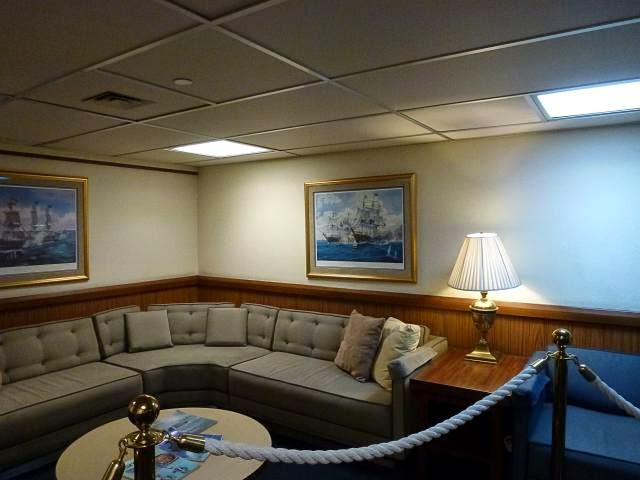
The admiral and captain occupied similar private accommodation aboard, well up to best hotel standards. They were the only personnel to sleep in ordinary beds. The Admiral’s lounge gives an idea of the sort of comfort afforded.
There were many more areas on the audio tour e.g. kitchens, operating theatre, dentists, laundry, engine room, chapel, briefing rooms and so on, all well laid out and described. It was a full and fascinating day out and a tribute to its creators and to those who now operate the Midway Museum.


Tuesday, 24 February 2015

Wed 18th Feb: San Diego

We travel 170 miles to “Campland on the Bay" in San Diego without incident.


The following day we catch the bus to San Diego Old Town, which is a California State Park and consists of restored and reconstructed buildings dating mainly from the 1820’s to the 1870’s. The object of the park is to present a range of different living styles and capture something of the atmosphere of what life was like for residents of San Diego during that era. Naturally, parts of the town resemble the cowboy towns we remember from westerns, but the Park structures have a proper historical base rather than being simply a film set.
The building nearest in the above photo is the Racine and Laramie tobacco store, reconstructed faithfully as it was in 1869. Inside were all the appropriate products that gave it a truly authentic feel, including tobacco pipes of all qualities from many parts of the world.
There are too many buildings to describe in detail, so I’ll select a few, starting with the Wells Fargo History Museum. The exhibits contained a genuine 1867 state-of-the-art Concord stage coach that featured a sprung passenger compartment that could hold 9 travellers, with a further 9 on top. 
In 1857 the company launched the first trans-continental service, from St Louis to San Francisco. It must have been desperately uncomfortable although there was apparently a degree of acclimatisation to the motion sickness of the swaying carriage along its journey of 2,757 miles and 25 days.


The coach rolled along at between 5 and 12 miles per hour almost continuously with changes of horses (or mules) every 18 or so miles. I’ll never complain about Cambridgeshire buses again, even if one of the operators is, coincidentally, called Stagecoach!

An earlier and more primitive carriage, really a cart, was featured in the Stables Museum. The photo is below. This is a wooden carreta made in 1806 that reputedly carried a Spanish lady from San Francisco to San Diego, taking three months. It sported a weatherproof cover but no springs. The expression numb bum comes to mind.

The Stables Museum generally contained a wealth of beautifully preserved exhibits from the mid-19th Century, like branding irons, an Indian feather headdress, patent medicines, a large variety of carts and carriages, etc. Just picking an example, here’s an exquisite, ornately embroidered saddle.
The earliest buildings in the Park date from the Mexican period, 1822 to 1846. These are made from adobe i.e. mud bricks. The most elaborate of these is the 1827 Casa de Estudillo, built by Jose Maria de Estudillio, a local administrator and dignitary. It’s a walled courtyard house that takes a splendid photo with the lady sitting in period costume in its pretty garden.
The cemetery reminds us of the tough life they faced in the 19th century. Many died young from disease, and others violently in a manner that fits our image of the Wild West. 
The Park also contains an area of later dwellings, in the Heritage Park Victorian Village. These are from the 1880’s and 90’s, and represent the homes of the wealthier inhabitants, and fine homes they are too. You can’t help wondering if the house with the lookout tower belonged to the local fire-chief.
Towards the end of our meanderings, we pass a car park, and do a double-take. This car is totally decked out with Christmas decorations and articles. On the bonnet, too! The car bodywork is daubed with Christmas scenes and messages. Inside it’s totally full of Christmas baubles and articles, apart from the driver’s seat. It has to be Father Christmas on vacation. Surely it couldn’t be driven? But we actually saw it, impossibly, on the road the following day not far from our campsite, a good 5 miles from this car park.
It had to be a great day out: how often do you have a close encounter with the Wild West and Santa Claus in the same day.