Monday, 4 May 2015

April 26th: Henry Cowell Park Redwoods

The mountain redwoods are the most massive; the coastal redwoods are the tallest. We are near the coast so search out a coastal redwood park to visit. We thought we’d come to the wrong place when we arrived because next to the redwoods car park was a small reconstructed cowboy town with a railroad station.
Next up, the train arrives, an old wild west steam engine. I’m now half expecting a re-enacted Indian attack, but disappointingly the train puffs and hisses to a halt with its load of tourist coaches. It’s a great sight nonetheless.
A yes, nearly forgot, we came to see some redwoods. The grove starts on the other side of the car park. It’s a sunny day and the light shafts shining through the big trees makes a lovely picture.
You can’t really give the true impression of the height of these trees, some reaching 300 foot plus. 
It’s easier to convey the size at ground level with a person in the frame. The figure is a woman in white in the gap, dwarfed by the tree.
Some trees had apparently harmless carbuncle-type growths on the base. In this case it looks like a monster’s foot from a horror film.
A lot of trees had multiple trunks growing from one root system. Here’s Jane modelling as a forest gnome standing in front of one such example. 
Although we’ve seen quite a few huge redwoods in different places, they never fail to impress. 

We're now leaving for Santa Margarita Lake where there's no phone signal or wifi, so we'll be out of contact for a time- just like it was in the old days before mobile phones and the internet. You remember, when you used to send postcards.


Saturday, 2 May 2015

April 21st to 28th Moss Landing and Monterey

We moved 100 miles south of San Francisco to a campsite near Monterey. The campsite itself was no great shakes and hemmed in by roads and an inaccessible hill at the back so we couldn’t safely walk outside the camp perimeter. We therefore took the camper out most days and firstly headed for the nearest bit of coast, the small harbour of Moss Landing. The lovely beach there was backed by sand dunes, and nearly deserted.
As pleasant as it was to walk along the sands and listen to the pounding Pacific surf, the real fascination was watching the wildlife. The most impressive part of that was the whales.

There’s an annual migration of grey whales from the Arctic to Mexico and back every winter and early spring, and we were lucky enough to be there at the peak time for their return journey. You would first see great spouts of misty water as they came up for air and then usually a huge tail flipped up as they dived again. Just occasionally one would breach, that is, come nearly right out of the water. We must have seen over 60 whales altogether; what an amazing experience. Unfortunately I have no photos; my camera’s digital display just couldn’t pick them up.


What the camera did catch ok were the sea otters. These were active in the estuary, just beyond the end of the beach, that let to a wildlife reserve.
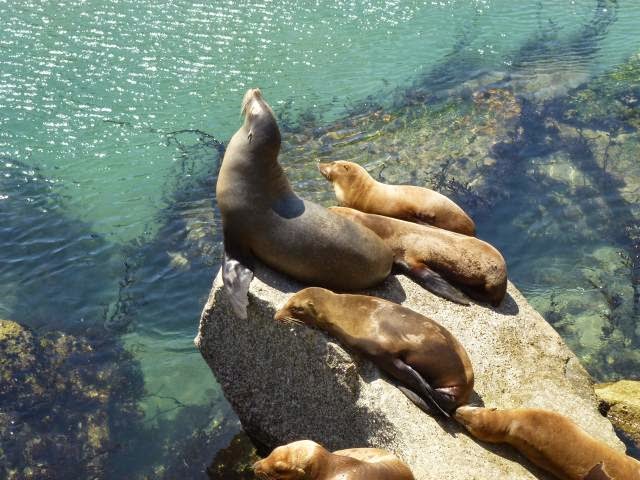
There were plenty of pelicans and seal lions too. I’m sure you can work out which is which.

Another day out was to Monterey, a fairly up market town, next to Carmel which is a very upmarket town where Clint Eastwood lives and was once the mayor. The walkway along the coast and around the harbour was especially pretty.
Lots more sea lions as well on the breakwater, and an unusual starfish that you can see next to the kelp, that’s the green seaweed rising  from the bottom, that grows extensively off the coast and provides a rich habitat for the varied sea life here.
Monterey town is quite pleasant with some buildings from the 20’s and 30 like the Golden State Theatre here opened on 1926.
The main source of employment in the town was fish canning between the early years of the last century and the mid 1950’s, featuring in John Steinbeck’s famous book Cannery Row. Some of the old canneries are still there, turned into tourist shops and hotels. The photo shows part of Cannery Row that still has an original cannery name left.
Monterey had a Mediterranean feel and was a pleasant place for a day out. It had some nice parks, even a Dennis the Menace Park which we didn’t see, but then I was a Desperate Dan fan. 


Monday, 27 April 2015

Monday 21st April: Alcatraz

Alcatraz lies in San Francisco bay 1½ miles off-shore. Soon after California became part of the USA in 1848, Alcatraz was turned into a military fortress and then in 1867/8 became a military prison. In 1933 the US Dept. of Justice took it over as a federal penitentiary to house the country’s most difficult convicts. The first prisoners were installed in 1934, and the jail served in that capacity for the next 29 years. The island was totally self-sufficient, with a power generation plant, food processing, laundry etc. Water was shipped over in bulk.

The next photo is taken from the boat taking us to Alcatraz and shows the island’s rocky profile and isolation, making it an ideal prison location. The bay waters are cold throughout the year, so discouraging an escape attempt by swimming. The prison block is the building right on the top of the island.
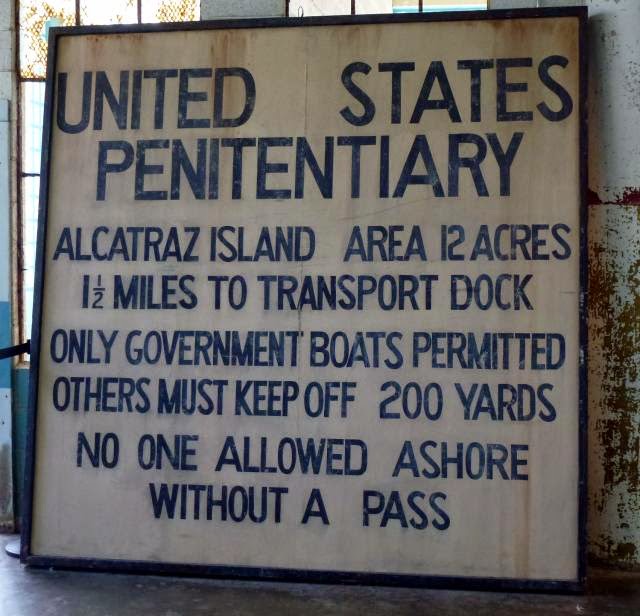
 Official business only! This notice greeted all who approached too close.
This was a no-nonsense prison. Warders were called correction officers and tight discipline was enforced with armed guards patrolling from behind a barred gallery so they could not be overpowered and their weapons seized. They were guarding these three-tiered cell corridors, of which there were three main corridors and an isolation block. This is the central corridor known as Broadway.
Individual cells throughout looked like this. They housed major criminals like Al Capone, Alvin “Creepy” Karpis, and “Machine Gun” Kelly. 
“D” Block, or the isolation section, was reserved for the most troublesome prisoners. The most famous of these was Robert Stroud, the “Birdman of Alcatraz”. He spent all of his 17 years here in isolation due to his extremely violent history, including killing a prison guard for which he narrowly missed the death penalty. This is the “D” Block
Yet Stroud was a very intelligent man who had become a world expert on canaries at his previous prison where he finally killed the guard and got transferred to Alcatraz. He was denied access to his bird studies as part of his punishment. This is what Stroud looked like.
There was a more severe regime available in “D” Block: the “Hole”. These were solitary confinement cells where a restricted diet and total darkness was sometimes applied. Those deemed to deserve such treatment were held there for several days, up to a maximum of 19.
There was a daily recreation period, to be taken in the exercise yard.  Bridge was especially popular and the men stayed outside for the full term of several hours even in the bitter cold. The yard looks a forbidding place, as you can see. Reminds me of my old school playground.
There were 14 separate escape attempts and the official line was that no convicts made it. The bloodiest attempt was in 1946 when three convicts and two guards died.

The attempt in 1962 was, and still is, the most intriguing. Three prisoners made dummy heads for their beds so that the guards saw them “asleep” when they made their regular inspections. Supposedly in bed, they headed up a ventilation shaft that led out onto the roof. They had with them 50 rubber raincoats from other inmates that made into a raft, and wooden paddles scrounged from other sources. They planned to climb down from the roof, reach the sea, and paddle away.

The official version is that they drowned, but no bodies were ever found, although bits of the raft and paddles were discovered on the shore of another island in the bay. However, there were reported sightings of the men for many years afterwards and the families claimed to have received postcards in the men‘s handwriting. The US Marshall’s file will remain open until they all reach the age of 100.  

The prison closed in 1963 and lay abandoned for 6 years until occupied by Native Americans demanding just treatment for the return and self-government of Indian territories. They were there for two years. This high water tower is still inscribed with slogans for their cause that sought to generate public sympathy. Their campaign was partly successful and a turning point in the government’s attitude to Indian administration within their own lands. The Prison Governor’s old residence was accidentally burnt down during their occupation. 
Another kind of protest was taking place on Alcatraz during our visit, this time with official approval. Art activist Ai Weiwei was exhibiting a set of dissidents’ faces from repressive political regime. They are all made from Lego and are divided into world sections. He himself can’t leave China for his political statements through his art. So he’s a kind of prisoner, exhibiting the faces of many who are in prison, in a prison. Very appropriate.
This final photo sums up, for me, the chilly, moody atmosphere of Alcatraz, looking from the island towards the misty Golden Gate Bridge over a grey, cold sea.  


Saturday, 25 April 2015

April 16th/17th : San Francisco

San Francisco is a city associated with big events and times: the 1849 goldrush, the earthquake of 1906, the Golden Gate Bridge (opened in 1937), hippies in the 60’s and flowerpower in the 70’s, Alcatraz, and so on. My thoughts before visiting  San Francisco were- how would the city square up to its image?


Well, the Golden Gate Bridge didn’t disappoint. The hop-on/hop-off bus trundled off to the bridge as one of its first stops, and very impressive (and windy) it was too. When it opened, it was the longest single-span bridge in the world. The colour is called International Orange, more rust than orange to me, and would you buy an orange that colour in the supermarket?
And are those street as steep as they look in photos? Some of them really are, and here are the famous cable cars that ply these slopes. Between 1873 and 1890, twenty three cable car lines were created; only three now remain, largely as tourist attractions. The cable cars were introduced by a Mr Andrew Hallidie to alleviate the suffering to the horses that hauled goods up and down the city’s perilous gradients and sometimes slipped and fell. 
Lombard Street is reckoned to be the steepest street in the world. The top part has a natural slope of 27%, that’s steeper than 1 in 4, but is modified by a series of 8 hairpin bends so that vehicles can safely manage the incline.  
The hippy and flowerpower area of yesteryear still maintains an ‘alternative’ appearance with brightly coloured shops, and associations with famous musicians who lived there. This was Jimmi Hendrix’ house, although I can’t imagine he had his face painted on the side when he lived there.
The hop-on/hop-off guide said pot (cannabis) was freely and legally available, as the next photo indicates. The sign says “Day Dream Smoke Shop”. There were quite a lot of drifters around that seemed to be keeping in touch with the ‘change the world’ culture of the 60/70’s, but the reallity is that the world itself has changed a lot since then and sadly left them behind.
A more cheery sight was to be found in the harbour. Pier 39 has been the site for many years of a congregation of sea lions. Hundreds gather there on wooden rafts, with the dominant bulls displaying their prowess and making a huge noise by constant barking and grunting
Nearly a quarter of San Francisco’s population is of Chinese origin.Chinese culture and language is very much alive, to the extent that chinese rather than english is the first language for many.  China Town is the original Chinese quarter but these days this is as much a tourist attraction as a residential district. The shops and buildings were quite different from the rest of the city so it made an interesting walk-through.
San Francisco was a town full of victorian houses until the earthquake of 1906. The fire following the earthquake destroyed most of the wooden buildings. But some survived and are preserved as architectural treasures. Here are a couple of photos, but probably not the best of them.

Modern buildings dominate the skyine in the financial district, but nothing on the scale of the cities in Eastern America. Another two photos give examples that show pleasant modern designs.

The city will always be associated with Tony Bennet’s song, ‘I left My Heart In San Francisco’. The words and music endear you to all of San Francisco’s charms, even the fog that is actually clammy and unpleasant.

Tony Bennet is himself a New Yorker, but really does have a soft spot  for San Francisco. He should do, the song’s earned him a lot of money! Also, Tony is an artist, and has painted the heart that he left behind. Here it is, in the central square, featuring also the bloke on the left’s behind that he’s in the process of taking with him.
Our verdict is that San Francisco was an interesting  and compact city, so fairly easy to see in a short time. However, although three days of visiting a city is hardly enough to know it properly, we couldn’t say we would be drawn back to it- so we didn’t leave our hearts there.

But we’ve not finished with San Francisco yet: the following blog is Alcatraz.


Tuesday, 21 April 2015

Mariposa Grove

We called in here as the last part of the Yosemite tour just outside the main park. More sequoia, the mountain giant redwoods. This massive tree, with me skulking alongside it, is about 1,000 years old.
An even more remarkable photo is that of a tree that toppled over about 300 years ago. Because of the tannic acid in the bark, redwoods are almost indestructible alive or dead. I must start sprinkling redwood bark dust on my breakfast cereal. Jane, standing by the roots, gives an idea of the size.
You would walk straight past these two green saplings. They’re about a foot tall, and the significance is that the one on the right, a pine tree, is two years old, whilst the left hand one is a sequoia and is fourteen years old. That’s how slowly they grow.
Next our guide points out a patch of snapgrass that the Native Americans used for cleaning and scouring. It’s about three feet high and snaps off easily at the joints on each blade, hence the name. It is also rough enough to use as sandpaper. 
Many strange plants inhabit the forest, like this one, a snow flower. 
We learned so much about the forest and Yosemite in general from Saul, our knowledgeable guide. Another remarkable experience.