Friday, 23 October 2015

Friday 16th Oct: Big Pine Key

Big Pine Key is about 2/3 of the way down the 100 mile Keys island chain. Our campsite is directly on the bay and caters for boaters so it has its own quay and a separate small harbour. This is the quay; the campsite stretches off to the right. Well bring our inflatable plastic dinghy next time.
It’s the low season until the end of this month; on 1st November, we are told, the site fills up completely almost overnight. Still, right now we get the choice of an excellent pitch overlooking the bay. Doing a holiday blog, it’s tempting to always use photos bathed in sunshine, but the view from our pitch looks more dramatic with the dark clouds. Jane’s taking her tea out- abroad we may be, but we’re British and can’t function without tea.
Big Pine Key is a national sanctuary for the only remaining population of Key deer, a small species that seems to have made a remarkable comeback going by the numbers that we saw. This is a stag crossing a side road. 
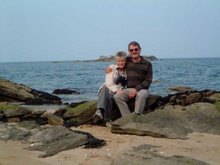
There aren’t many beaches in the Keys, and most of those are artificial. Our nearest local beach is called Long Beach. We set off in anticipation, imagining a beach a mile long with a hundred yards width of sand. A little deflated when we arrive at a beach a couple of hundred yards long and five feet wide; that is, depending on the tide; tide in = zero feet wide. Still, it takes a pleasant enough photo, particularly as I haven’t stripped off for a skinnydip.
People will dump stuff anywhere, we thought as we came across this plastic helmet.
How wrong can you be! It’s a horseshoe crab, evident when we turned it over; deceased of course.
The campsite nature trail reveals some interesting features: this gumbo limbo tree for instance. With its peeling bark, it’s also known as the “tourist tree” as it looks like a holidaymaker’s skin who’s been sunbathing too long.
The area is full of birdlife, with its shallow ponds and abundance of vegetation and fish. This next photo contains white ibis, great egret, reddish egret and snowy egret.
Much of the rock around is coral from past eras when sea levels were much higher. This is an example of two types (two photos joined together); the left hand one is called brain coral because it looks like a brain. So it’s a good place to come for a top-up when your brain starts wearing out: that’s the reason we’re here.




Monday, 19 October 2015

Middle Keys

The Middle Keys are about half way along the hundred mile chain of islands. We decided to take a trip to check it out before relocating at the end of the week. In particular, we wanted to look at some campsites. But we did stop in places along the way.


When the mangroves aren’t clogging the shallow coastal waters there are some fine, sandy beaches, like Sombrero beach on Marathon Key, with clear water and many fish species visible from the rocks.
We also saw lots of big lizards called iguanas. These live everywhere on the Keys but are non-native, and probably established through escape or abandonment by pet owners. They can grow up to 5 feet in length and are good climbers. Here’s one up a tree on the campsite.
Observe from this closeup how dragon-like they appear. Unlike a dragon, they aren’t dangerous, but are unpopular with the residents as they will eat a wide variety of garden plants. They have no natural predators except for angry residents.
We called in on a dolphin show that was most entertaining, and it was clear that the dolphins enjoyed it too. This one is walking backwards using his tail.
A few of the audience got to stroke a dolphin near the end of the show. Jane was one of the lucky ones. She said the skin felt smooth and silky
Some people think these places should be banned because the animals are not living according to their natural behaviour in the wild. However, this place is a far cry from zoos with bored animals in confined cages; the dolphins interacted enthusiastically with the humans and appeared to be quite contented. 
We saw some lovely orchid plans in the tropical gardens where they grow outdoors in this climate without seeming to need any special attention.
We travelled two-thirds of the way down the Keys before returning to our campsite in Key Largo. On the farther reaches of our journey, a disused railway track was visible for many miles, running more-or-less alongside the road.
The history of the line is that it was built by oil baron Henry Flagler between 1905 and 1912, and was the only direct link joining the many islands of the Keys up to that time and for some years after.

Flagler was an oil baron who spent the winter of 1878 in northern Florida’s warm climate for health reasons.He quickly realised that, because of the climate, there was development potential throughout Florida and became involved in railroad construction in order to make this happen.The Keys railroad was his last and most difficult project, 100 miles of track that linked all the most important islands right down to Key West.

Later, during the 1920’s, some of the Keys were connected by small, meandering  roads over rickety wooden bridges, but the 1935 hurricane changed it all. This devastated the Keys, and destroyed so much of the railroad that it never re-opened. However, the government bought the track, repaired it, and converted it to roadway, with the added benefit that it also  replaced the previous winding  roads with the railway’s gentle curves.

This new road was opened in 1938. Since then, new bridges have been built with wider carriageways, leaving the railway with its road conversion to decay, although part of it has more recently been turned into pedestrian access for fishermen.

We also found a campsite we liked that we booked for the end of the week (Friday, Oct 16th). See you there, next blog! 


Friday, 16 October 2015

Oct 13th: Everglades Anhinga Trail

We’re still at Key Largo, which right on the edge of the huge Everglades National Park. There’s only one access road to the Park so it’s a 40 mile trip to get to the entrance. We plan to spend a few hours exploring the anhinga trail that starts soon after passing through the Park entrance. We stop at the Visitor Center first to get a map and some information. We’re warned by a ranger that the mosquitoes are still highly active on another trail that we thought we might also try.

We drive on to the trail head where ample car parking is provided. Oddly, most cars in the car park are shrouded in blue tarpaulins. Notices explain these are provided free by the Park because the resident vultures are attracted to the window glass rubber surrounds and can cause extensive damage. We sheet up.
The shallow ponds and sawgrass of the Everglades surround us as we start our walk on the well-made path. This is the end of the rainy season so the water table is quite high. This is a typical view.
Not much wildlife in evidence? It is there, but well camouflaged. Jane’s particularly good at spotting creatures that merge into the background, as with this green heron that is actually in the reed bed photo above.
It’s a mistake to be looking exclusively for large animals as you’ll miss strikingly marked insects like this lubber grass hopper. It’s about 4 inches long.
Of course, everybody wants to see the alligators. They are easy to miss as they blend into the environment so well. This one’s wake gave the game away as he glided through the ponds.
This is no zoo, and while the gator above may be comfortably at arm’s length, the next one was in a dip beside the path. He looks docile enough, but they move fast so you don’t disturb him. He’s about 8ft long.
Much of the trail is on sturdy raised boardwalk, in order to cross the shallow standing water of the sawgrass beds. It enables visitors to use the trail in any season.
It’s called the anhinga trail: so what’s an anhinga? It’s a largish, diving, fishing bird something like a cormorant that needs to dry its wings after getting wet as they don’t contain waterproofing oils. In other words, the bird’s feathers’ get waterlogged. We just happened to see one drying its wings as described.
We saw some butterflies and dragonflies, vultures and ravens, and small flitting unidentifiable birds. There’s a lot more stuff in there but nothing’s guaranteed to appear, and I suppose that’s the fascination: you might just be lucky enough to see a puma.
As it was, it was a great day out.


Thursday, 15 October 2015

Around Key Largo Campground

The whole of Florida is more or less flat, and the Keys are even flatter with a highest point of 16ft above sea level. The sea is therefore accessible from almost every part of this narrow chain of islands. Building developers have used this to construct many housing estates where each house backs onto an artificial canal that then leads to the open sea. So each habitation has a boat mooring.  
Unsurprisingly, boating activities predominate throughout the Keys: fishing, scuba diving, snorkeling, canoeing and pleasure boating, for tourists and residents. And that’s not including the smugglers! On that theme, drugs are clearly a local problem, as this notice on a park near our campsite shows.
Using a perverse logic- does it mean that drugs are allowed in parks where these signs are absent?
Residents we talk to say it's Paradise here- so it is, but at a cost. Any residential or other developments have first to clear the mangrove swamp and drain the soil. Mangrove swamps appear impenetrable, as the photo shows, so clearance is expensive. 
Paradise also has mosquitoes. Without mosquito control, most of the Keys would be uninhabitable. The Florida Keys Mosquito Control District employs 75 inspectors who visit all properties four times a year looking for any stagnant water sources where mosquitoes might breed. There is also an active spraying programme. Several mornings we heard an aircraft flying back and forth in a grid pattern, spraying the whole area. The number of mosquitoes was noticeably reduced thereafter.
The next issue is hurricanes. We’ve had very little wind, but the rain is a deluge when it occurs. This is something unusual to us Brits. It’s difficult to capture on camera, but here goes. A full-on hurricane is something way beyond this of course.
It’s not all top-end, modern housing either; there are many poorer dwellings like the one for sale below.
Our daily walk takes us first to the main road, which has a wide cycle and pedestrian path, before we turn off into side roads. The main road here is busy, being the one through-road serving the Keys.
There’s an indoor/outdoor market, just off the main road, featuring quirky stalls as shown underneath. We’re thinking of buying the buffalo head as a Christmas gift for someone. You’ll have to hope that someone isn’t you.


Saturday, 10 October 2015

Key Largo, Florida: Thursday 1st October

We took a late flight from Washington to Miami, so stayed overnight at a hotel near Miami airport. The higher temperature and humidity hit us straight away. At 90 degrees air con is essential; the hotel room air con was set at 60 degrees and felt far too cold. It makes one realise that “comfortable” for humans inhabits a narrow temperature range.

The next morning we take a taxi from the hotel to the motorhome depot. We’re using Cruise America, who provide functional but fairly basic vehicles. It’s only 18 miles, but the address seems to confuse the taxi-driver’s satnav. To be fair to the satnav, it’s really the taxi-driver who’s confused. The journey takes longer than anticipated. No problem, none of us get it right all the time- except that with taxi fares the customer pays for an unnecessarily extended journey. Am I turning into a grumpy old man, or what?

We’re not going far, less than 50 miles from the depot, to the first island in the Florida Keys, Key Largo. The Keys are a chain of islands joined up by a road that runs for the most part along an old railway track built in the 1890’s. Before that time these low-lying, mosquito infested mangrove swamp islands were accessible only by boat, if anyone thought it worth bothering. Pirates, wreckers and some Indians did.


Our campsite at Key Largo is very laid back and tropical looking. It’s hot and humid, and feels more Caribbean that American. We hear more Spanish than English spoken in the area. Look, here’s Jane: Tarzan’s taking the picture.
 The site has an inlet giving access to the sea so it’s popular with boaters. There are a number of (expensive) waterside pitches. These are also more mosquito-prone, being nearer to the mangrove swamps, so you get bitten twice. It’s very picturesque, though.
We have some interesting daily visitors to our pitch. Firstly, a pair of chickens who are inseparable. Perfect, caring companions, it appears- until food is thrown down, when it’s every man for himself. 
The squirrel eats out of Jane’s hand. They are best walnuts, so he’s quite keen.
And, lastly, our resident crab. He looks like he might break into a dance, perhaps a hornpipe. We’ve also spotted several bird species new to us but these have been too busy to pose for the camera. I’ll keep trying.
Just for the moment we’re chilling out. Chilling is perhaps the wrong word as it reaches over 90 degrees (32C) during the day and 77 (25C) at night. The pool is kind of essential.


Monday, 5 October 2015

Autumn 2015: Virginia & Florida

Start: Thursday 24th Sept 

Flying used to be such a big adventure; now it’s like catching the bus. We boarded the 11.00 am fight from Heathrow and landed in Washington DC at 2.15 pm local time. Good flight and on time.


Our first port of call is indeed a port: Portsmouth, to see Ralph and Kelly, and now also our lovely new granddaughter Virginia, all of 7 weeks old and really cute. Here she is, apparently balancing a chair on her head. You’ve got to start them young if you want a circus performer in the family.

 We all head over to Norfolk on the little stern–wheel ferry. Norfolk is the major US naval shipyard on the East Coast and has many warships being refurbished in the inlet that we cross. We are visiting a naval museum in Norfolk that sets out the naval heritage of the area from colonial times (that’s when we Brits lost the American War of Independence. They do mention that a lot!). But, typically of American museums, it’s very well presented. There were even uniforms to try on, as modeled by this jolly jack tar who looks kind of familiar.
Norfolk is full of all sorts of ships, and here’s an old sailing vessel being used for a marriage ceremony. Let’s hope the groom isn’t influenced later by the ship’s name.
Back to Portsmouth now, and its picturesque Old Town. It’s all much like the photo, with a few grander buildings here and there dating back to the late 18th century.
Baby Ginny (Virginia) entertained us all the while. One forgets just how constantly active babies are. Quite unexpectedly she gave us a wonderful first smile at a meal out on our final evening. I was lucky enough to capture the moment on camera, not that a photo can do it justice. That was the cherry on the top of our time with Ralph and Kelly, so nice to see such a happy family.
It takes about three hours to drive the 200 miles to Claire’s, near Fredericksburg. Unfortunately the weather’s rather wet but we manage a trip into Fredericksburg Old Town. It’s very much like Portsmouth Old Town with wooden colonial-style houses and porches with swings. 
To make up for the poor weather and lack of photo opportunity, here are some nice family portraits of firstly, Scott, Steven and Mathew, and then Claire and Katy.


Wednesday, 13 May 2015

Santa Margarita Lake: April 28th to May 10th

We started off in a regular campsite but moved to the Santa Margarita Lake County Park campground when we realised how lovely the area was directly around the lake. There weren't any facilities like electricity or internet and  not even a phone signal, but it’s a huge natural park with plentiful wild life, and peace and quiet. In fact, we were the only residents in the motorhome area! We overlooked the lake from the bottom of our pitch, where our chairs are (between the two trees).
 Of course, we’d like to have seen some bears but didn’t, although all the bins had chained, bear-proof, lids and warned against leaving food out.
The only food we left out was in the hummingbird feeder and that was particularly successful.
There was a huge variety of birds, even big ones like the bald eagle, red tailed hawk and a golden eagle, and numerous turkey vultures. Here they are flying off the road, having just read the notice behind that says “No Parking At Any Time”.
There were small ground squirrels everywhere. Very cute.
The dead oak tree branch looks like it’s been riddled with machine gun bullets. In a way it has; these are oak woodpecker holes in which they store their acorns. 
Walks took us up high for a good view of the lake. It’s shrunk immensely over the last five years like all of California’s water resources due to the drought.
The drought is worth mentioning in more detail. Everyone is worried about it; the Governor, ex filmstar Arnold Schwarzenegger, has declared a 20% saving target for the whole state.

However, it’s hard to see what practical steps are being taken at street level. Lawns and grass verges are still being watered by automatic sprinklers that distribute as much on the pavements and roads as on the grass. People are still washing vehicles with generous amount of water. Swimming pools are all in operation.

But the State is serious about it. Many State-owned campsites now have the water completely turned off. The campsites are still open, but you have to bring in your own water. Motorhomes and caravans here all have big water storage tanks, so it’s just an inconvenience. But hang on, where will the campers fill up their tanks? They’ll use the previous campsite, or if local,  fill at home- so the water still comes from the State of California. So where’s the saving?  This could have been a Goon Show script!

Santa Margarita Lake was a really lovely, relaxing place. We now go to manic LA for two days to sort our the motorhome before returning it to the El Monte depot on the 13th. We fly out  later that same day to Washington DC from where we’ll be visiting Claire and family, and also Ralph & Kelly. This is the family part of our trip that we are very much looking forward to.