Friday, 13 May 2016

Monet’s Garden

We’re now at a campsite by the Seine, 30 minutes from Giverny where the impressionist painter Monet lived from 1883 until his death in 1926. Throughout the time he lived there, Monet developed his garden into a showpiece of colour, with features such as a lake and a Japanese bridge, which he used as the subject of many of his paintings.
Monet’s son inherited the property and left it to the French Academy of Fine Arts on his death in 1966. The house and gardens were restored as they were in Monet’s day and were first opened to the public in 1980.

We are visiting in early May, the best time to experience the vibrant spring colours. Many others thought so too, so the entrance queue was a long one but it was well worth the wait. This is a general overview.
The arch running through the centre is particularly attractive.
The beds are themed around groups of colours; in front of the house are red and pink tulips with blue forget-me-nots.
There is a huge number of tulip varieties; here are a few in this collage.
Monet painted in the impressionist style, and it was interesting to see how well my photo shop programme converted a few of my photos into this genre. Instant Monet?
We enter the house now; the rooms are furnished in late 19th/ early 20th century style with Monet’s collection of Japanese prints on the walls of many of the rooms. This is Monet’s studio which had copies of his paintings hanging on the walls.
The kitchen’s a cheerful yellow and can be compared with an old photo of Monet himself in the same room. I’m not sure what he would have made of all the tourists.

It’s the garden that really holds our attention, probably because it was the subject of so many of his paintings. We make for lake and the Japanese bridge; it’s beautifully laid out like the rest of the gardens, and the bridge is instantly recognisable especially if given the Monet photo shop treatment.
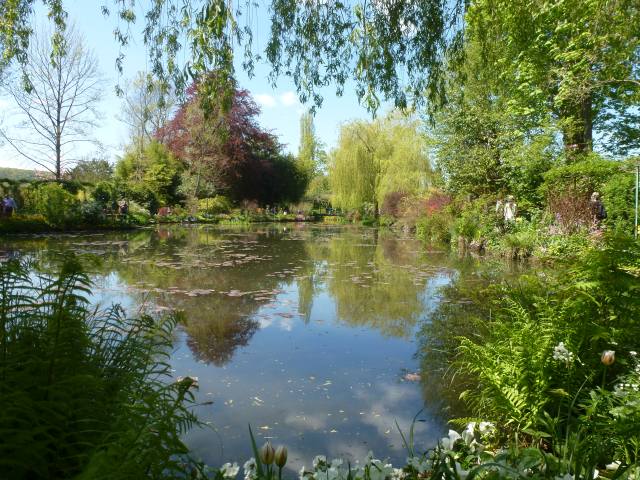
An overall view of the lake is also worth taking in; he often painted the water lilies here.
Monet’s garden was a stunning experience and so evocative of his paintings. However, he wasn’t the only artist in Giverny in that era: there was a thriving colony of mainly American artists, and these are presented in the Giverny Museum of Impressionism just up the road. Here again there are beautiful gardens, so Monet hasn’t got it all his own way.

Inside was an exhibition of works by Gustave Caillebotte. We’d never heard of him, either. He was apparently a close friend of Monet’s, and a few of his paintings seemed familiar, for example this one. I reckon he’s just dumped the girlfriend over the side and is rowing off for dear life.
Giverny village is pretty but obviously touristy given the numbers of visitors, but it avoids being too tacky and commercialised. This is one of the many cafes and looks very much in keeping with the village setting.
We were lucky, of course, with the time of year and warm sunny weather, but what a delightful day out. It certainly left a lasting impression!


Monday, 9 May 2016

Oradour-sur-Glane

Oradour lies 15 miles from Limoges and has a sad tale to tell. We start at the visitor centre that describes the background and the incident that changed the village for ever. 
The time is June 1944, and it’s just after D Day; Resistance activity has increased dramatically all over the country. The 2nd SS Panzer Division has been rushed to the area to repel the threat of the Allied advance, and is also facing local Resistance operations, in particular the kidnapping of an SS officer near Limoges. The commander of the Das Fuhrer Regiment, part of the 2nd SS Panzer Division, decides on a reprisal against the locals because of the Resistance nuisance.
On the afternoon of 10th June, a squad of about 180 SS soldiers began searching isolated farms to the south of Oradour, working their way towards the village which they sealed off on arrival. The inhabitants were told to assemble at the Fairground so that papers could be checked and an arms search carried out. This is the Fairground today.
The villagers were largely unalarmed by this, having been under the authoritarian rule for four years; in any event, the village was not a Resistance stronghold nor were there any arms caches to be discovered.
The women and children, 452 in total, were taken to the church, so they were told, while the arms search was in progress. 
The 190 men left were split into 6 groups and held in different places ostensibly while this arms search was being conducted. However, at a given signal, they were all simultaneously shot dead. A plaque commemorates each of these 6 locations.
The church containing the women and children was then set on fire and locked after being sprayed inside with gunfire. All perished, apart from one adult. The heat was so great it melted the bell that still lies today where it fell.
The simple, dignified interior of the now roofless church still shows signs of the fire and numerous bullet holes.
It doesn’t stop there, even: the SS now burned the whole village. The horror of it all was revealed in the days following. Photos from that time in the visitor centre recorded the destruction; in fact, one’s own photos seem to capture the mood of desolation better in black and white as in by my next two snaps. 

After the war, the French Government decided that the village should be left exactly as it was to serve as a monument to the war crime committed on that day. Even the doctor’s car is left to rust in the crumbling ruins.
Much of the contents of the houses, shops and workshops, too, were left. This is what remains of the smithy.
You may ask, why preserve this chilling time capsule?  Do visitors come simply from morbid curiosity? What real purpose does it serve? We remembered asking these same questions after visiting Auschwitz.

The answer has to be that it keeps the awfulness of these events alive and real when standing in the very place where they happened. If it influences some visitors into adopting a less ruthless approach and that is also passed on to their children, monuments such as this can be a positive force. Atrocities have taken place throughout history, some on a much greater scale, so humanity’s not going to change dramatically, but just maybe places like Oradour can alter the future a little for the better.


Saturday, 7 May 2016

Limoges

Limoges is a pleasant if unspectacular city that produced enamelware in the Middle Ages and fine china from the 18th century.

After parking the car in a multi-storey clearly designed for bubble cars, we start our walk-about in the cathedral grounds. The cathedral itself dates from 1273 but has been subject to much piecemeal amendment, so isn’t an outstanding end result, although it takes a nice enough photo.
 The gardens are laid out in a formal manner divided by paths which is ideal for people strolling. Beyond the hedge on the right is a parapet overlooking the river Vienne. It’s a relaxing space in a busy city.
Another part of the grounds is planted with herbs and shrubs, all neatly labelled, and then small trees and bushes. It’s been well thought out and adds variety and interest.
Up next to the cathedral is the Bishop’s Palace that houses the fine arts museum. It’s a handsome building with an external sculpture exhibition one item of which can be seen in the right foreground.
It’s difficult to make out what the sculpture is and there are 74 of them all in the same gloomy vein. They all depict skeletal figures in various poses of anguish. They’re all by a much acclaimed sculptor called Marc Petit.
A close-up, this is entitled “Quarantine”. So if you’re feeling low, definitely don’t go for a stroll near the bishop’s palace in Limoges.
It’s a happier story in the old town where they’ve got the flags out for a festival. These medieval buildings look like they're part of a fairy story.
 More up to date is the Hotel de Ville, or Town Hall, about 150 years old. It looks more like a chateau than a municipal building, and is set in lovely gardens as the photo shows.
The fountain on the left bears closer examination, as it is made with enamelling in honour of Limoges heritage of enamelware. It really is beautifully turned out.
We are in France, so it’s appropriate to insert a photo of what takes place daily in every village, town and city: the game of boules. Here they’ve just finished their shots and are determining (or disputing) who’s won.
The Limoges area, the Limousin, was once a byword for easy living and prosperity, hence the name limousine for a luxury car. Today it’s a workaday city with an interesting old town and is no doubt an agreeable place to live.


Thursday, 5 May 2016

Short Stop: Short Blog

Benicarlo was our first stop on the way home, roughly halfway between Valencia and Barcelona. We stayed for two nights. The site led directly onto a shingle beach, golden grit rather than golden sand, but very pleasant.
The town has a large fishing fleet and we observed the extraordinary sight of the fishing boats all racing in for the start of the fish auction. There were well over a dozen coming from all directions so I couldn’t get more than a few in one photo.
It looks more dramatic on telephoto, like Formula One, neck and neck for the finishing line.
This one’s so low in the water it might sink- it’s caught that many fish. Come on, you’ll make it!
Enough excitement for one day. A day’s travel from Benicarlo and we reached Carcassonne in the south of France and then, another day on the road, we’re in Limoges. Here we stayed for a few days.


Monday, 2 May 2016

The Rambla

This dusty track leads to our best walk directly from the campsite. It’s not a group walk so Jane and I often head there on our own. It goes into a rambla, a dry river bed that can turn into a raging torrent after heavy rain. No chance of that today though.
It’s also a Natural Park with a few dwellings so it also serves as a primitive access road shared with the walkers and cyclists. We noted a new sign that specifies a speed restriction for walkers only: no rambling at over 30kph (19mph). 
The hills rise on either side of the rambla. That dark shape Jane’s looking at is a cave: the cave of the horseman. Can’t say how the horseman managed to ride up the side of a near-vertical hill to his cave, but they were a different breed in the old days. Or maybe the horse was really a mule. 
The scenery isn’t all rocks and cliffs, now we’re passing through bamboo beds where the ground hangs on to the occasional rain for longer.
We come to an old farmhouse that is designated as a picnic area. It’s not much used except at holiday time; at Easter when we walked there must have been several hundred people in the vicinity.
Perhaps the nicest viewpoint is coming round the corner onto this straight with the White Cliffs in the background. These are the cliffs we climbed to the top of on our last walk with the group, the previous blog, so the valley we were looking down on was this rambla. 
The rambla is also a haven for birds and other wildlife. Some years there are bee-eaters nesting and you often see wild boar rootings but these are rarely spotted. It’s just a beautiful, peaceful place to be.


Friday, 29 April 2016

Peñas Blancas

The White Cliffs, the highest point locally, rise to just over 2,000 feet. The rough track starts from the backroad to Cartagena and climbs steeply.
We quickly look back to the road where we parked the cars to see the unfolding panorama.
As we approach the top of the cliffs, we see the valley below as from an aeroplane.
Looking sideways along the cliffs the view is even more dramatic, enhanced by the haze, which is actually smoke rising from the tomato growers burning old plants on the coast way below.
The countryside looks barren from a distance but at this time of the year there are flowers and shrubs that bloom before the savage summer heat.
There are even some unusual butterflies like this swallowtail with a three inch wingspan.
There’s a refuge on the top. Don’t underestimate the chance of severe weather on such an exposed ridge for walkers and climbers even in this generally benign climate. There was a bottle of wine in the hut, so maybe it’s really a party venue.
We take in some disused iron ore mines on the way down. Jan our walk leader guides us to avoid the hazards or in case we get lost. That's quite a drop on the left.
Climbing out is even more of a scramble.
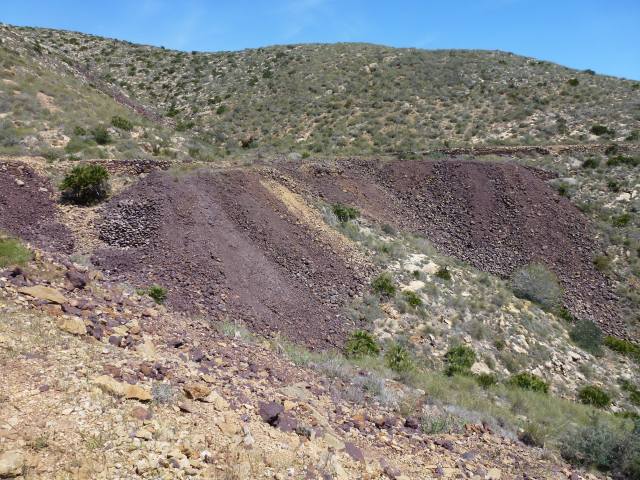
Outside, the spoil heaps were used to shore up the footpath we’ve been using, and which originally must have been a track used by the miners and also to take down the iron ore by mule. Hot work in the summer!
We continued down to the track to the road and the cars, avoiding the thorn bushes. Another great walk, thanks to Jan and Marjon. 


Thursday, 21 April 2016

The Guns

Cartagena is the second city in the region of Murcia. Due to its superb natural harbour it is a major port, cruise ship destination, and naval base. It has been the Spanish fleet’s Mediterranean HQ for many centuries. 
By the start of the 20th century it was clear that the harbour defences were inadequate; technology had moved on from cannon balls to modern shells. In 1912 the Spanish Government commissioned a study of the defences, but it was not until 1925 when the “Vickers Deployment” report resulted in positive action. 
Pursuant to this report, the British firm of Vickers supplied all the armaments for two batteries of guns, one on each side of Cartagena harbour, to provide an arc of protective crossfire. 
One of those two batteries was sited on a headland about 5 miles from our campsite. It was active until 1993 when it was abandoned. The Spanish seem to be in the habit of just walking away from facilities they no longer need, like the Mazarron mines, but that’s great for exploring because everything’s left as it was.  

The stars of the show are the Vickers 15 inch guns. The photo is courtesy of our friend Stan, with Jane and me in front of the barrel for scale.  
These guns now had plenty of range, over 20 miles, and clout from a shell weighing nearly a tonne. The guns in this battery were never fired in anger, but those on the other headland covering Cartagena were in action once, near the end of the Spanish Civil War. 
On the 7th of March 1939 a fleet of ships containing Franco’s landing force of 20,000 men was approaching Cartagena, one of the last Republican strongholds. Franco believed that the city would fall easily, but when the invasion force arrived it was clear that they would encounter stiff opposition, so the fleet was instructed to withdraw. That is, except for one ship, the Castillo de Olite that had a broken radio so could not hear the withdrawal order. 
The Castillo de Olite was hit by three of the massive shells which sunk it, resulting in the death of 1,476 men out of the 2,112 on board: the greatest loss of life ever in a Spanish vessel. This is an archive photo of the ship.
The gun batteries were constructed between 1926 and 1933. They built a new jetty at the local fishing village of La Azohia to deliver the equipment by sea and a new road to transport the material to the remote headland designated for the installation. Here one of the gun barrels is being dragged up the road using tracks that are removed from the back and put to the front as the load progresses.
It’s the same access  road we use today that can be seen threading its way through the difficult terrain.
For reasons I’ve been unable to discover, the gun emplacements are hidden behind a Disney-like facade.Was the designer taking the Mickey?
One year we found an access door to the firing and control area within the gun turret itself. This has now been blocked off presumably for safety reasons. It was pitch black, but our team of explorers took torches and had a great rummage around.
There are many other military buildings in various states of decay: barracks, officers’ housing, canteens etc. More hardware, too, all supplied by Vickers as part of the defence package: anti-aircraft guns and 6 inch guns. The anti-aircraft guns have gone but some of the 6 inch guns remain. These would have looked hugely impressive if you hadn’t seen the 15 inch guns first.
It’s all located in a very picturesque but remote setting with lovely views of the sea and hills. Cartagena harbour is in the distance; this is what they were defending.
It’s an unusual tourist attraction generally deserted outside of public holidays that adds to the abandoned, ghost town atmosphere.