Monday, 4 September 2017

Saturday 26th August: The Wedding

Steven is Jane’s grandson and is marrying Lauren today at the New Life Church of which they are both members. Weddings photos are of most interest to family members, so general Blog readers’ indulgence is requested for this entry. Presentation is everything, so here is Adam and Jane nearly ready to leave for the church. Mustn’t forget the hat, Jane!
Steven and Lauren are now man and wife. They are standing on a raised area like a stage, so we all get a good view of the ceremony.
Claire, Jane’s daughter is with her husband Scott and their son Mathew and daughter Katy. The bits on the floor are rose petals that have started to become scattered.
There has to be a close-up of the bride. Lauren is with Jane, now with hat. It should be noted that part of Lauren’s bouquet was a beaded flower posy made by Jane.
Jane is modest about her beading skills but I’ll take this opportunity to showcase the posy as it is really a work of art and much admired.
Ceremony over, we head outside to the church lawn for the reception. It’s open-air with tables as can be seen.
Our grandchildren have a wide age-spread. Steven, the groom, is 27 and Ginny has just turned 2. She’s here with son Ralph and his wife Kelly. Ginny’s been so good in the church and continues to be delightful.
Ginny is very photogenic (it’s the best age) so it was impossible not to take cute photos of her the whole time they stayed with us. Her she is playing peek-a-boo under a cane sunchair.
We all felt that the day had gone perfectly, and Steven and Lauren left at dusk to the guests best wishes for a happy and successful future.


Saturday, 2 September 2017

USA Autumn 2017: Start: Wednesday 23rd August

It’s a longer delay than usual in starting the blog due to the Steven and Lauren’s wedding and other family arrangements. But here we are at last, on page one.


We met with Adam at Heathrow and flew together to Washington DC. The flight arrived on time at 3.10 pm but, with a congested immigration process and a 100 mile drive, it was 9.00 pm before we reached our destination, a holiday home at Colonial Beach. Here’s a photo.
We decided to rent a holiday villa rather than stay in a hotel as Adam was with us; also Ralph, Kelly and Ginny would be joining us for a couple of days to attend the wedding. It’s on the waterfront and that’s our own pier. Looking towards the pier from the house gave us a lovely view, especially in the soft twilight.
Colonial Beach is in the state of Virginia and the far shore is in Maryland. However, the Maryland state boundary runs along the shoreline of the Virginia coast at this point- so our pier is, in fact, in Maryland. If the south had become a separate country following the American civil war then our pier would be in a different country, maybe even with its own customs and immigration officials! “Sorry, sir, crossborder food is not allowed so you can’t bring your sandwiches onto the pier.”

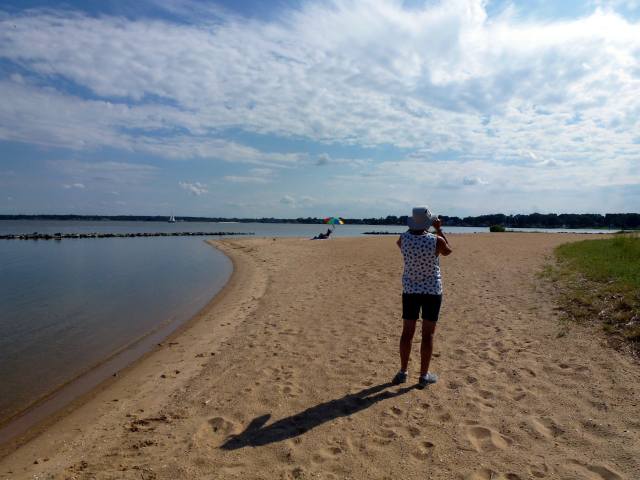
There are some nice strips of sand although it’s actually on the Potomac River estuary, which is about 10 miles wide at this point. That means we don’t get much tide or rough seas here. The water is warm and shallow, although a bit murky. Jane is scanning for murky characters on the beach.
The murky water doesn’t seem to affect the fishing birds, the most spectacular of which is the osprey. There are literally scores of them here, as many, it would seem, as in the whole of the UK where they are rare and vigorously protected. The osprey is on the post and the bird flying top left hand corner is a turkey vulture, also quite common in the USA.
Colonial Beach consists of hundreds of houses all built in the same style as ours: the colonial style, hence the name, and clearly enforced by the planners as nothing conflicts with the general appearance. Well, not quite. There are some touches of individuality- use restricted to the hours of darkness.
Boats are much in evidence, and most inlets contain a marina. The owner of this boat must like the place so much that he’s made it into a floating office, complete with outboard motor for chugging around the harbour.
Just to prove we are here together, we’ll finish with a photo of Jane & me on our pier. And then we’re going to a wedding.


Tuesday, 4 July 2017

Saturday 1st July: The Battle of the Somme

We moved from Brittany to Picardy last Tuesday/Wednesday. The weather on Tuesday was appalling for most of the journey with torrential rain after 11:00 am. Wednesday was fine for travelling, apart from a motorway services being closed for fuel when we were running low. We reached the next one- just- showing empty.

Our campsite is in a small village near the town of Peronne, and is directly on the 1916 World War One front line. This morning 101 years ago, at 7:30 am, the Allies (that is, the French, and the British and Commonwealth troops) launched the biggest counter-attack of the war in an effort to overrun the German trenches and thereby break the stalemate that had existed since late 1914 between the two opposing armies.

The first day could not be described as a success. The British alone suffered 57,000 casualties, 20,000 of them fatalities, for very small territorial gains. The Germans had dug in well and were an efficient fighting force. The problem was that defence was mechanised and modern with machine guns, barbed wire, spotter planes, snipers, but attack was not. Our masses of unprotected soldiers swept towards the enemy lines to be mown down. 85% casualties within the first hour were reported by some units.

The Somme offensive lasted until mid-November 1916 when it was called off. Nowhere along the front did the Allies advance more than 8 miles.These tiny movements could in no way justify the staggering human losses, mainly military but some civilians as well.


Let’s run through an example of a typical British sector along the 18 mile front, say at La Boiselle, that morning of July 1st. Soldiers of the Tyneside Scottish and Irish battalions of the 34th British Division would be waiting in the trenches for the signal to go over the top at 7:30. This is probably today's best preserved example of a 1916 trench. The second photo is a WW1 real-time trench.

But here, at La Boiselle, there is a mine due to blow just before the assault begins. Teams of Welsh miners have spent weeks tunneling under the German lines and then packing the tunnels with nearly 30 tonnes of high explosive. At 7:28 precisely the charge goes off and creates the largest deliberately made crater ever made up to that time. It is said that the blast could be heard in London. Other mines were also detonated, but this was the biggest and is also the best preserved. The photo does it justice when you see the motorhome  for comparison in the background, top left.
7:30. The whistles. The infantry goes over the top and advances toward the enemy lines a few hundred yards away. The photo below is the ground they would have proceeded over, but not looking anything like this as the British guns have fired 1½ million shells along the front during the previous week to destroy the German defences: their trenches, dugouts, barbed wire, field guns etc. Now the big mines have finished the job. They hope.
The General Staff have told the officers in the field to order the men to walk, as all resistance will have been wiped out. Some damage has been done, of course, but the German line is essentially in good order and the troops largely unscathed. But the military planners should have known that anyway from previous experience.
So our soldiers are decimated by enemy machine gun fire. Our 34th Division here lost 4,292 men on the first day with 4 divisional commanders killed. Territorial gains: minimal. Result: photo below. There are 410 British military cemeteries like this on the Somme alone.
In time, dignified monuments were erected, the greatest of which is at Thiepval, not far from La Boiselle and also a scene of great losses in the Somme campaign. It was designed by the foremost British architect of the time, Sir Edward Lutyens, and completed in 1932. It contains the names of over 72,000 soldiers whose remains were never found.
It’s majestic size can be better appreciated from the following photo of the inside walls that contain the fallen soldiers’ names where the tiny person in the blue coat gives an idea of the building's scale. 
The after-effects of the war were felt in all the combatant countries, not only from numbers killed but by the wounded and the mentally damaged. Post traumatic stress wasn’t recognised then.
The injustices of the peace settlement also sowed the seeds of discontent in Germany that directly led to the Second World War.
Having seen many battle sites, cemeteries and museums here on the Somme that is just part of one war, in turn one of many wars, does pose the question as to how far mankind has really progressed along the road of civilisation.  


Sunday, 2 July 2017

Saturday 24th June : Quimper

Quimper is the oldest Breton city and ancient capital of the Duchy of Cornouaille. It sits on the junction of two rivers and has a good size medieval quarter centered on the cathedral. This is one of those picturesque streets.
It seems to be the focus for activities. Here’s a jazz band stomping up the street, an odd assortment of players, some even wearing back-packs, but making a great rhythm. We later noticed tents where a pop music festival was in progress, and in July there is a week-long jamboree of Breton music, costumes, theatre and dance.
The cathedral is the largest in Brittany, a 13th-15th century Gothic building with spires that were added as late as 1856 but have weathered in perfectly. I didn’t take a photo from the front elevation as a children’s roundabout had been stuck right by the entrance. Can’t win them all- swings and roundabouts as they say!
The interior is, as expected, as magnificent as the outside. Lovely old stained glass. Problem is, unless churches are your hobby, they can look a bit samey. But this one has a deliberate mistake to look for….
Spotted it? ... it’s not straight: look at the roof line. To later add the nave, at the far end, the builders had to avoid the edge of the un-channelled river, so built it at a slight angle to the main church.
The river is now fully channelled and embankmented, and looking colourful with the flower baskets on the bridge; in fact, all the central bridges have flower baskets.
A smaller river joins the large one in the centre, also an attractive setting for flowers and old buildings.
The city had many delightful squares, like the one in the photo below, and gave us a pleasant, undemanding day out.


Friday, 30 June 2017

Brittany: Scenic Panoramas

Brittany is as far west as France goes, and we are staying nearest one of the most westerly points. The sun sets at 10:20 pm at this time of year so there’s some twilight left even for us late birds at bedtime.

Two headlands together mark the western extremity and we chose the one called the Pointe Du Van to check out. It’s wild and rugged with a huge views all around.
You might notice a building on top of the cliff. It’s a chapel dedicated to St. They, an obscure local saint. We walked over for a closer look and found a well maintained but locked chapel perched on the cliff edge. The figure on top of the statue pole is of St. They, so they say.
There were miles of paths on the level clifftop area with shrubs and plants attracting birds like stonechat and skylarks.
There must have been more people living on this flat, empty expanse in past time as there were two ornate wells, one of which Jane is stood next to. We spotted this from a distance when it looked like a large dog kennel within which might have lurked a fearsome beast ready to rush out and see you off.
In the hazy distance the island of Sein can be seen. It has a population of about 500 and the traditional occupation is fishing. It is only half a square mile in area and low lying, and was totally covered by the sea in 1868 and 1896. The possibility of global warming and melting icecaps is a real worry here. 
In June 1940, when General de Gaulle appealed for volunteers to join the Free French Forces, the entire 130 strong adult male population sailed for England to answer the call. De Gaulle came personally in 1946 to award the island the Liberation Cross.
Our next viewpoint: a mountain, Menez-Hom. A mountain in Breton terms, that is, just over 1,000 ft high, but with a 360 degree panorama. It was a blisteringly hot day when we went, with the idea that it would be cooler on a mountain top. Perversely, it worked the other way round. The car showed 27 degrees at the bottom, and 30 degrees at the top.
The car park near the top led onto a network of paths, but walking in that  temperature didn’t appeal. We simply plodded up to the top, where a survey point stood, and viewed the panorama. It was extensive, but hazy because of the hot weather.
Just one photo then, from the survey point, that hopefully gives an indication of the view that probably best emerges on a cold, clear winter’s day. Then we’d be complaining about the cold!
At the bottom of the mountain we stopped in the village of the same name to admire the church of Ste-Marie-de-Menez-Hom, but first noticed a monument in the car park. It commemorated the French Resistance seizing Menez-Hom from the Germans in 1944 after a bitter fight. We noticed some concrete ruins when we were on the mountain so these must have been the German defences that were attacked and captured by the Resistance.
The church itself was magnificent, dating from 1739, with a typically Breton ornate bell tower.
 The detail on the calvary crosses is very fine but not possible to exactly interpret.
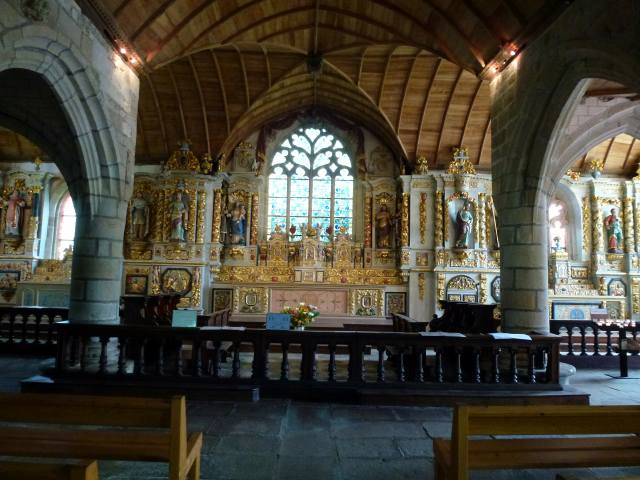
The altarpiece of guilded, carved biblical figures covered the whole of the eastern wall. These were of fine quality and unexpectedly extensive for a small rural church.
It’s strange how things turn out. It was too hot and hazy for us to get much out of Menez-Hom the mountain, but Menez-Hom the village church was a delight. That’s the unpredictable delight of travelling.


Wednesday, 28 June 2017

Thursday 24th June: Locronan

Locronan is a tourist town, a time warp from the 17th and 18th centuries, when fine buildings were erected with wealth derived from sailmaking. Locronan sails were sold to French, Spanish and English navies, even though the Royal Navy was often at war with France. Business is business.

Sailmaking started here in the 15th century and grew into a rich industry several centuries later that gave us the town we see today. This is part of the main square.
The town has some Roman roots but it’s generally allowed that it was founded in the 7th century by Bishop Ronan from Ireland. “Loc” means “place” in the Breton language so Locronan means “Ronan’s Place”. St. Ronan introduced Christianity to the area that was Druidic before he arrived and his miracles gave Locronan its first prosperity as people flocked here as to pay homage. The miracles must still be working as they’re still flocking in.
The solid main church is dedicated to St. Ronan and fits in nicely with the look of the main square where it is located.
The whole place looks similar, being of the same period and built of  granite. That’s its charm and also its drawback because the photos look similar, but we’ll run through a couple more. First the Town Hall.
Now the creperie where Jane and I enjoyed a crepe & coffee before we left.
And a side-street.
There were a lot of niches in the dwellings for saints and other religious icons. This one houses Mary and Jesus under a heart-shaped top stone
The atmospheric Notre Dame de Bonne Nouvelle chapel dates from 1439. That means “Our Lady of Good News” chapel. The good news may be that the chapel is still standing.
The town has been used many times as a film location, for instance Roman Polanski’s Tess that won various achademy awards.
Locronan is touristy, with the expected tourist shops, but these were of good quality if somewhat expensive. It was all well run and we certainly had a good day out.


Sunday, 25 June 2017

Walk to the Mill, & the Rescue

We decide to walk along the cliff path to the restored mill, a different direction from the way we went previously. Looking down on the spectacular jagged rocks and steep-sided coves made us realise that it wouldn’t do to slip off the path. 
En route, we pass a rock housing a cormorant colony where they are feeding young. You’ll have to take my word for it as the birds look tiny on the photo, but we could see them clearly through binoculars.
Before turning inland to the mill, we arrive at Miller’s Point.The house on the Point, in the photo below, is run by the lighthouse and coastguard authority according to the sign on the gate. It has a great perspective along the coast, but no evidence of a light or coastguards, so maybe it’s a home for retired lighthouse keepers.
Now we’re at the restored mill. It’s set in an idyllic green valley with the wheel slowly revolving. The wheel is large and slender, more like one of a set of gigantic wheels on an ancient machine that plods its way through the undergrowth belching smoke and steam.
Inside it’s been nicely restored with cogs going round operating a millstone, as restored mills do, but this one had an unusual feature- the miller’s bed, with what looks like a guest appearance of the miller’s ghost.
We returned via easier inland tracks to the campsite. Our thoughts about the dangers of the rocks and coves became fact a few days later. Sat outside the caravan, we heard emergency vehicles heading for the beach; minutes later a helicopter sped over. We then saw it hovering somewhere to the right of the beach over the rocks.
We walked down to the beach to see what was happening. Clearly a rescue was in progress.
The helicopter circled many times around the the beach and into an adjacent cove that was cut off by the sea. The winchman went down, and each time a survivor was brought out. It was flying of the greatest precision as the blades were close to the cliff.
 We learned later that the oldest member of a family diving party, a 54 year old man, had been taken ill in the cove. The younger members had signalled for help and then tried to revive him. They were all now trapped in the cove. The eight youngsters were all airlifted out with minor injuries but the paramedics couldn’t revive the older guy. So not a totally happy ending, but certainly not for any lack of speed in response or professionalism by the rescue services in attending the incident.