Monday, 23 October 2017

Calico Ghost Town

Ghost towns are big business in America. Of course, when you visit one, it’s anything but a ghost town. The idea is to give you the atmosphere of the original town that was abandonned and at the same time have shops and attractions that tourists love which may have little connection with that
original town.

Here’s our local contender, Calico, close to our campsite here in Barstow, California. The campsite even runs a free shuttle up to Calico.
Note the obligatory narrow gauge steam train in the background.
The community of Calico started in 1881 with the discovery of silver. It grew rapidly until the price of silver halved in 1907, following which the town was practically abandoned. It regenerated briefly in 1915 with a recovery of silver prices; that was also when a young carpenter called Walter Knott came to work in the town. More about Walter shortly. The original town looked like this.
This is looking up the main street as it is today.
Calico went into a permanent decline after 1915 and Walter Knott moved on. By the 1940’s he had built his own sucessful theme park business, that included a ghost town. He liked ghost towns,  so in 1951 he bought Calico, now in advanced decay, to restore it, which he did using original plans and photos. In 1966 he donated Calico to San Bernadino County who still own and run it.
The school house can be recognised in the old photo, at the top of the hill.
The town has several museums containing items from Calico’s early days, including some unusual curiosities like this wooden bath. You’d have to be really quick before the water ran out of the cracks.
The old fire engine looks the part, Keystone Cops style, but was essential in a wooden town with wood stoves for heating and cooking. Calico had several serious fires.
Being a mining town, facilities were basic in the early years. Some dwellings were constructed around hollows or caves in the rocks.
Inside is about what you would expect.
 There are 30 miles of old mine workings, but only one safe enough to walk through unescorted. It was a tough life mining ore but wasn’t as primitive as you might imagine; they had some compressed-air tools powered by a steam compressor.  
We don’t realise how big Halloween is in the USA. Shops were already selling Halloween goods in August when we arrived, and Halloween parties and events are advertised from mid October. Needless to say, in Calico – remember it’s a ghost town- they go overboard. The town is festooned with spectral figures, skeletons and pumpkins. Can’t imagine that being haunted by a pumpkin is very scary. For us, it took away the "olde mining towne" image a bit, and my photos minimise the Halloween paraphernalia. However, it’s the American thing, and they do it very well, so here’s an example of someone you don’t want to bump into when driving home on a dark night.
It was an interesting visit, but with a few reservations (not Indian ones this time). The town seemed to be more about tourist shops than its history, and some of the restoration owed more to theme park imagination than period accuracy. In fact, the one building that survives intact, from 1885, looks fairly ordinary- not what attract the visitors. 
As we were leaving, the wind started to get up. By the following day it had turned into a full scale dust storm. This picture of the motorway near the campsite was taken after the worst had passed.


Saturday, 21 October 2017

Lake Havasu

We’ve got the motorhome back, duly repaired, and head for a chill-out week at Havasu City, a holiday resort in the Mohave desert. It was founded in 1964 and developed largely by the Robert McCulloch corporation. Most Brits have never heard of it, but would be familiar with its main tourist attraction- London Bridge!
By the 1960’s London Bridge was unable to cope with modern traffic, so was put up for sale. It was bought in 1968 by McCullough as a feature for his ongoing project at Havasu. Rumour has it that he thought he was buying Tower Bridge, a much more recogniseable structure.
He paid $2.5 million and then spent another $7 million in shipping and reconstruction. We weren’t that impressed (we have a much  older bridge at Alconbury!) but it is a focal point that attracts many holidaymakers and weekenders, particularly boaters.
 Havasu City’s existence as a holiday resort is totally reliant on the 45 mile long lake of the same name created in 1938 by damming the Colorado River. It’s wide enough and long enough that the speedboats can run at top speed along the centre of the lake.
Some of the speedboats are really powerful. This is one, close up, on the forecourt of a big repair yard just in front of the campsite. When they throttle up the monster engines, that seem not to have silencers, the whole campsite vibrates. Good earthquake training.
But let’s not be a spoil-sport; the campsite is just up from the lake shore that is most pleasant to sit by or walk along. Temperatures are in the mid 90's F (35 C) for the whole week.
The rapid tropical sunset gives some unusual shots of the palm trees in the dying light.
There is another Havasu: the nature reserves. In the northern reserve, 30 miles from the resort, we saw absolutely no-one. It’s not part of the main lake  and is maintained as shallow pools with creeks and marshes.
However, it wasn’t exactly teeming with wildlife, but we did see various birds, including a roadrunner, and also a coyote. He waited for me to point the camera, unlike the others.
Some of the original trees were visible sticking out of the water, a stark picture against the jagged mountains.
The temperature here is hovering near 100F, so we leave the mosquitos to pester someone else, and the animals to their shady resting places.

On another day we head 30 miles south along the lake shore. This reserve here is part of the main lake but joins onto the reed beds of the Bill Williams River that runs into the lake at this point. Bill Williams was a trapper and frontiersman, definitely not the Bill Williams I knew that ran our school sweet shop.
There are many more birds here. Again it’s very hot. We need to watch where we’re walking.
Fortunately, we don’t see any rattlesnakes, but apparently there are plenty around. We go farther into the reserve on a dirt road, but it’s too rough for the hire car really, so we proceed on foot. It gets bleaker and more remote. We are at the meeting place of two deserts, the Mohave and the Sonora. It’s too hot to walk any further, so we go back to the car.  
Our week at Havasu gave us a refreshing rest, and we left on Tuesday, 17th Oct, for Barstow in California.


Wednesday, 18 October 2017

The Meteor Crater and Hualapai

We’re doing some trips out while the motorhome is in the repair shop, and the first of these is right on the doorstep: the world’s most perfectly preserved meteorite crater.

50,000 years ago a chunk of metal 150 feet across and travelling at 26,000 miles per hour hit the Arizona desert. This is the kind of terrain it impacted, almost flat and barren.
A piece of the metal meteorite survives. Not much to look at, but the whole lump created an explosive force equal to a 20 million tonnes of TNT.
It made a crater nearly a mile in diameter and 700 feet deep, created in less than 10 seconds.
I took lots of photos of the crater, but essentially they all look the same, a huge hole from slightly different angles. Highly impressive, but one picture tells it all.

Next destination, Hualapai. This small mountain range takes its name from a Native American tribe. The tribe fought a war with the settlers in the 1860’s but surrendered in 1870 under their chief Levi Levi. This is his photo much later as an old man, not looking at all imposing in western dress – he might even be wearing Levis.
The mountain, however, is not part of the Indian reservation and is managed as a recreation area. It has a maximum elevation of 8,500 feet, so its green and tree-lined slopes make a change from the arid desert at the base.
We were disappointed not to see more wildlife, but were told by one of the rangers that sometimes elk gathered at a nearby privately owned lake. Not much chance there, then, but we had some pretty walks through the woods.
We finished with an ice-cream from the store at a rather run-down small residential area nearby. Ironically, at the side of the store we saw a life-size model of an elk.
Just a minute: it’s walking!
Now we spot several elk are moving through the trees. It’s a small herd.
These are the second larges deer species after the moose, some standing about 6 feet at the shoulder. Not showing fear of humans (i.e.us), they seem quite relaxed and gentle, reminding us of camels. One even sat down.
So the day redeemed itself, but it was a lovely area anyway.


Monday, 16 October 2017

Route 66

Route 66 was the first motor road to run from the American east to west, 2,500 miles from Chicago to Los Angeles. It opened in 1926 and was decommissioned in 1985, at which time it had long been surpassed by interstate highways.
But the legend lives on, fuelled by songs like “Route 66”, and much of the original route still remains as local or secondary road. It’s been seized on in a big way by towns on the old route as a tourist attraction, generally with a 1950’s or 60’s theme.

Seligman, Arizona, is a good example of a small town totally given over to the image.
Cars from the 1950/60’s are a must, even rusty ones that I presume are meant to enhance the time-warp atmosphere.
All the shops sell fairly grim Route 66 souvenirs, and fairly grim fast food. We ate hotdogs here, in keeping with the era: the store and the food seemed a cut above the others.
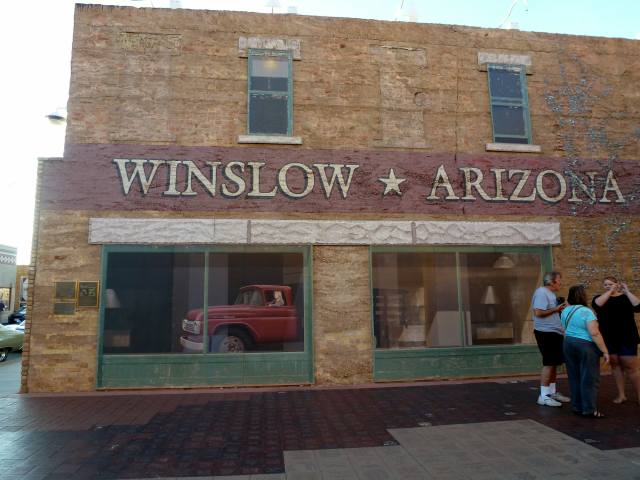
Winslow, where our motorhome is being repaired and also where we are staying to wait for it, is also on Route 66. But it also has another even more lightweight claim to fame. There was a 1970’s hit song written about Winslow called “Standing on the Corner” by The Eagles.
We had apparently just missed the “Standing on the Corner” festival, but the corner itself is preserved for posterity, that is, for the tourist trade. Standing on the corner might put you at risk of being picked up by the cops these days.
This is where “Standing on the Corner” and “Route 66” meet, in Winslow old town centre.
Sprinkle around some 1950’s cars- these are beautifully presented, and roadworthy- and you have a real focal point for visitors.
Some of the town architecture is pleasing anyway, like this building, originally a bank, built in 1904.
There are dozens of towns like Seligman and Winslow that have successfully adopted the Route 66 marketing approach. One could be cynical and label it as superficial tackiness, but it’s all lighthearted fun and some of the towns have other features worth seeing, as we will find out from our enforced but pleasant stay in Winslow. 


Friday, 13 October 2017

Cortez, Colorado

We had an interesting journey to Cortez. We’ve seen so many fabulous rock formations that another one might seem one too many. But here it is, like it’s been squeezed out of a tube and dried in the sun.
The population is sparse. Most of our journey is through Indian Reservation territory. The land is dry, covered in mainly scrub sage bushes that support a few horses and cows. This is a typical isolated ranch.
This arid region of several thousand square miles, is known as the “Four Corners Area” because it’s where four states join. There is an actual survey point where Arizona, New Mexico, Colorado and Utah meet in a square. It’s in Indian Territory and they charge $10 to look at it. Most tourists passing by ante-up, as we did. Ticked the box. It reminded me more of a skate park.
We arrive at the campsite in Cortez and are allocated a prime, big pitch overlooking open countryside.
 Looking over the bushes in front of our motorhome into the lower camping area we often observe mule deer browsing.
And beyond that, we can see the San Juan mountains. At over 13,000 feet, these are snowy peaks.
So, a lovely pitch and great things to see in Cortez, already blogged under Durango and Mesa Verde headings. It’s now time to move on to Holbrook. Problem is, we don’t quite get there. This is the reason.
It’s a block of wood; 25 miles from our destination, it appeared in the road and, although swerving, the inner rear wheel hit it. There was an immediate grinding noise and I pulled onto the hard shoulder. Nothing for it but to ring the rental company, the breakdown number we had in the info pack, and the police. Fortunately, we had a phone signal, which is unusual in open country. After several hours of organising and phone calls, the breakdown truck arrived and off we go on a two hour journey to the garage at Winslow. Winslow is 50 miles from where we were heading.
The news from the garage is not good: about a week to repair, as the wood has damaged not only the wheel but part of the brake mechanism. We book into a hotel in Winslow, and start to replan. Watch this space. 


Tuesday, 10 October 2017

Mesa Verde

All of the American south-west was part of the Spanish empire for centuries, and then became Mexican when that country gained independence from Spain in 1821. In 1845 the USA and Mexico fought a war over the sovereignty of Texas that Mexico lost. The peace treaty of 1848 gave the USA the disputed territory of Texas,  and also the bargain purchase of what are now the states of California, Arizona, Nevada, part of Colorado, and New Mexico. Not a bad haul.

However, the USA inherited the Spanish speaking inhabitants and place names. Both survive to this day, somewhat watered down by the English speaking occupation of the last 150 years.

Mesa Verde is one such original Spanish name. It means green table, that is, a fertile, high plateau. It’s a picturesque climb to the tabletop level especially in autumn when the leaves are just starting to turn.
But Mesa Verde is much more than a pretty upland: it hold the remains of an area once occupied by the Puebloans, a sophisticated civilisation that disappeared by 1300 AD.
Archaeologists determine that the Peubloans first appeared around 550 AD on the Mesa Verde plateau, farming, weaving baskets and living in pit houses like the one excavated below. The walls were made of wattle and mud daub.
The mainstay crop was maize, which keeps for years. These ears are at least 1500 years old. Anyone for prehistoric popcorn?
Between 550 and 1100 the civilisation progressed to living in villages of multi story large dwellings built from stone with mud mortar.
The circular design of the old pit houses is still retained as living and communal quarters. The archaeologists call these kivas. The kiva layout is quite complicated with shelves, fresh-air ducts and tunnels leading to other parts of the complex.
Bows and arrows were, used for hunting and stone and bone tools refined for manual work like felling trees, trimming building stone and scraping hides. By 1100 pottery had developed into a vast range of items, many with highly artistic decoration. 
Dogs and turkeys were domesticated, and turkey feathers were even used in weaving. This is a woven turkey-feather boot. Take note, Clarks, this could be the next big fashion trend.
In about the year 1200, an amazing thing happened; the Puebloans moved from their elaborate and convenient villages built on land to equally elaborate cliff dwellings. Not so convenient, though.
 To give a better idea of where this is perched, I’ll step back with the camera, but not too far as it’s 700 feet to the bottom.
They still worked the fields and hunted, so access to and from the cliff dwellings was frequent, and was by a combination of wooden ladder, stone staircase  or precipitous hand-holds cut into the rock. But this next dwelling is something else- how did they manage to build and then safely use it?
The above picture doesn’t tell the full story. The houses are at the tip of the arrow in the next photo. Imagine- you’re stood on the clifftop, it’s dark, maybe icy, you’re tired from hunting all day, and you have to scramble down a sheer rockface.  Perhaps the turkey-feather boots had flying properties.
Even the visitor’s paths can be difficult, especially with the high altitude. Some sections of Mesa Verde reach 8,500 feet, so it’s not that flat.
The big question is why was all this abandonned around 1300 AD, and where did they go? Modern archaeologicals can give some indications. Tree ring data reveals a 25 year drought from 1274 onwards, and this coupled with soil depletion perhaps caused the Puebloans to move away. Their descendants can be traced to 24 tribes living in New Mexico and Arizona. Also, why did they previously move from their land villages to the cliffs? We can only guess that it was for defensive purposes.
One thing is clear, that they progressed far ahead of equivalent tribes of the time in the quality and range of their lifestyle. We might be even more surprised at their achievements had they been able to leave a written record.
Mesa Verde is a World Heritage Site, and the National Park Service has a fine line to tread in showing visitors this remarkable area and at the same time preventing them from wrecking it. Environmental events don’t help either as the region is prone to forest fires caused by lightning strike, the aftermath of which is much in evidence.
Although known to the Native American Indians, the white settlers only set eyes on Mesa Verde in 1888 when two ranchers went searching for stray cows. America actually does have a bit more history that is generally realised. We were most impressed by the well presented archaeology and by the fascinating story that it told.