Wednesday, 7 November 2018

Seminole Rock Paintings


The park has rock paintings dating back between 2,000 to 4,000 years. These are only accessible via an official tour due to their historic importance. The ranger tour guide leads us down the steep paths and steps into the canyon.

Our guide is enthusiastic and knowledgeable, pointing out features as we proceed. We walk along the canyon floor that is normally bone dry but, due to the recent excessive rains, has some pools and running water.
She leads us up some steep steps to a long ledge, about two thirds up the canyon face with a large rock overhang. This is where the tribe lived and their rock artists painted. Rubber mats have been placed for visitors to walk in safety but also to protect the floor surface as this is comprised of spoil from limestone rocks used in their cooking ovens. Mixed in with the spoil are artefacts, discarded and mislaid, from that age. The substantial size of the overhang can be judged from the tiny group members in the photo.
The cave or rock designs are, as expected, primitive. These are human figures in a line, arms outstretched. Although science has deduced much about their diet and nomadic movements, we have no insight into their culture, so are unable to understand the significance of the figures’ postures. Their society was probably a lot more sophisticated than we imagine.
Some of the shapes are completely unfathomable. Of course, the group would come to the conclusion that the next object was a tele. Watch those old Flintstone cartoons again for more details on how they really lived.
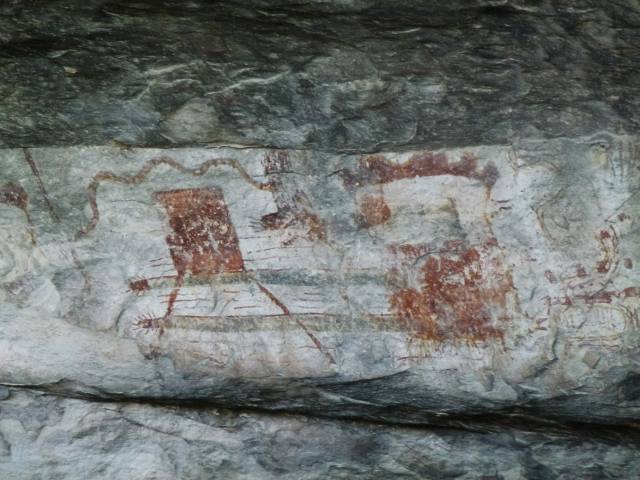
There are many drawings, all suffering the effects of recent erosion to a greater or lesser extent. But all is not lost as they were all carefully copied in the 1930’s by a commercial artist and his wife when they were in good condition. The guided tour is also there to stop further damage from graffiti and touching. But one item of graffiti got through.
The date is June 1884, when the railway was built that used to run through the park before it was a park. It was re-routed in 1892. However, because of the graffiti’s age, it is now itself protected just like the ancient works.


The ledge houses an old mesquite tree. These are claimed to be almost indestructible. It looks like somebody had a good try.
Looking out from the ledge where they lived is a beautiful view of the canyon; they must have felt secure, and very much at home with their living quarters and rock paintings.
With no written language, there is no way of knowing how these people’s society ran in any detail. They were hunter-gatherers so needed to move seasonally to new hunting and crop areas. Clearly they spent a considerable time in Seminole, which was perhaps their main base. Could they even have run a little campsite for other tribes just passing through? 


Sunday, 4 November 2018

Seminole State Park


I want to call it Semolina State Park. It backs on to the Rio Grande, the river that separates the USA and Mexico. It is semi-desert for most of the year but due to higher rainfall this autumn, the Park Rangers tell us it is greener than usual. Seminole canyon runs into the Rio Grande. 

The camping pitches are large and well spread out, overlooking open countryside. This is our site and camper (the replacement). We also get a shelter with picnic bench, the roof of which you can see, that looks towards Mexico about three miles away. So we get a great view of the wildlife and the illegal immigrants.
The park is all about wildlife, especially birds. We have a cactus wren nesting in the picnic shelter. It’s bigger than UK wrens, about thrush size.
Some creatures that look ordinary are anything but. The desert snail living in a bush on our pitch survives by sealing the entrance to its shell in dry periods and reappearing when it rains.
 Most of the park is dirt path hiking trails, but on one short walk the native plants are labelled. Some of these are quite unusual: the candelilla for example. Its stems are covered in wax which helps to retain moisture in desert conditions. The wax has traditionally been harvested to make candles, and during WW1 and 2 was used to waterproof military tents. The plant itself hardly merits a second glance.
On our walk to the canyon overlook we notice a stick insect, almost invisible on a purple sage bush. Well camouflaged.
 Jane is at the overlook, absolutely gutted that she’s forgotten her hang glider.
Both there and on the way back we walk through clouds of butterflies. This is a migration route. We also see them in groups on the floor, as in the photo. As you walk past they rise up and flutter around like confetti. Beyond my photography skills, unfortunately, to capture the moment.
Then wonderful sunsets to round off the day, just the kind the traditional cowboys would ride off into.


A remote and lovely place. But it has another dimension, coming next blog.


Thursday, 1 November 2018

Fredericksburg TX


A short ride away is a town founded by German settlers. It still presents as German in its main street buildings, and many businesses are German themed, bierkellers and restaurants particularly. Here are some examples.


Underneath is the charming courtyard of the old hospital. Closed in 1971, it’s now a German restaurant and bierkeller. They should have kept the hospital A & E going to deal with any overindulgence.
Fredericksburg has a famous son, Admiral Chester W Nimitz, who ran the naval campaign in the Pacific during the last war and was the USA’s signatory to the Japanese surrender in 1945. There is, of course, a larger-than-lifesize statue of the great man who looks like he is ready to sort out any bother in the street. Yobs and drunks beware.
The family hotel, the Nimitz, dominates the High Street with its steamboat frontage. Did this inspire Chester to join the navy? The hotel was built by his grandfather and now serves as a museum to Admiral Nimitz’ career.
 But the big museum here is the National Museum of the Pacific War. For such a small town to house a major museum is quite a tribute to Nimitz’ standing as a military commander. It’s a wet day, as the previous photos show, so we’re glad to get inside.

At the ticket desk the receptionist asked how much time we had. Couple of hours, we said. Ah: the information boards in the museum take about 28 hours to read. Ok, we’ll skip some. In we go.

The displays are beautifully laid out, and the information clearly described in minute detail. Every action in the Pacific War is covered, with exhibits and film coverage.

After half an hour we are overwhelmed by information, drowning under a waterfall of data. This happens in some museums, so wouldn’t it be better to have summary boards as well as the detail so you could at least emerge with a general idea of the museum’s purpose.


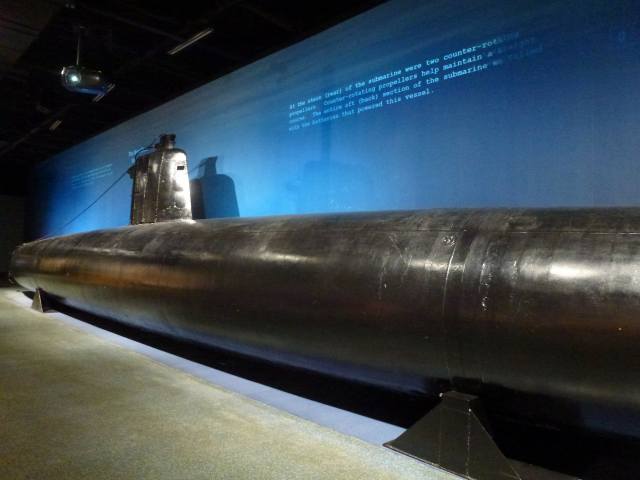
Moan over, and there were some interesting exhibits, like this Japanese miniature submarine, one of six used in the Pearl Harbour attack, December 1941. If this was a miniature, how big were the standard subs?
The surprise Pearl Harbour attack brought the USA into WW2. The Japanese believed and acted as if they were invincible: America wanted to prove otherwise and thereby dent their morale. They decided to bomb Tokyo, but no aircraft had nearly enough range, so the bombers selected were launched from aircraft carriers and told to fly on to China after the raid and land as best they could. All pilots and crew were volunteers, led by Major James Doolittle. None were expected to survive, but a few did including Doolittle. This is one of the bombers, a B25 Mitchell. 
This cannot fail to overawe; a replica of the atom bomb dropped on Nagasaki. Not so huge, given its devastating power, Jane is standing by the nose for size comparison. At the time, the two A bombs brought the war to a swift end, so saving thousands of American lives, and thus an understandable decision, though not one we are so comfortable with today given that we know more about the doomsday effect of these weapons.
Now we come to a full size patrol torpedo craft (PT). President J F Kennedy was commander of one such vessel that was sunk by collision with a Japanese destroyer. Kennedy helped save all his crew by swimming to a nearby island from where they were eventually rescued. He was decorated but made light of his heroism.
Lastly is a recreated typical Pacific island combat Zone where re-enactments take place, but not during our visit. It’s always good to scale back violence even in re-enactments, so I suggest they lob coke cans (Americans) and Sushi (Japanese) at each other.
Overwhelmed by the weather and the museum, but we came out on top. That’s what winning wars is all about.


Tuesday, 30 October 2018

San Antonio and the Alamo


San Antonio is one of the earliest Spanish settlements, centred around a mission built in 1718 on the banks of the San Antonio River. Travelling in from our campsite we pass through the usual urban sprawl and confusing road system. Texan drivers take no prisoners, but the satnav wins through.

Once in the Downtown area, it’s very pleasant. Even the highrise buildings have an air of mature elegance.


 Downtown is built around the Riverwalk. This is a scenic pedestrian thoroughfare threading its way along the banks of the San Antonio River. It is entirely separate from the road system. This is where we joined it.


There is a small theatre where the stage is on one side of the river and the seating on the opposite bank. The complete answer to the audience rushing the stage.
The lush greenery they’ve managed to pack into the walkway is amazing. Jane is looking suitably flabbergasted.
We stroll past hotels and the many riverside restaurants. Our goal is on the far side of the Riverwalk: the Alamo. If one historical building symbolises Texas, this is the one. I’m looking very proprietorial in the photo, as if I’ve just bought it.
The Alamo mission church is only part of the complex that grew up from 1718 onwards. Extra buildings were erected to service the conversion of the local Indians and also to establishing a Spanish presence in the area.


The mission was closed in 1793 and taken over by the Spanish military soon after. Part of the barracks is still standing and is used as a museum. These are the arches leading into the quarters.

Mexico successfully fought a war of independence from Spain in the early 1820s, so thereafter Mexican troops garrisoned the Alamo fort. The new Mexican Government encouraged settlers from the bordering United States, and copied the American arrangement where each state had a large degree of autonomy.


In 1833 President Santa Ana came to power in Mexico. He had different ideas, gradually and forcefully increasing central control. In 1835 the Texan settlers rebelled, capturing the weakly defended Alamo. Santa Ana sprang into action and personally led a force of 2,000 soldiers to re-take the fort. Imagine the 200 Texan volunteers in the Alamo observing the approach of the smart massed ranks of Mexican regulars. This is a Mexican uniform.
February 1836: battle commences. The Texans included legendary heroes like Jim Bowie and Davie Crockett. They had a few cannon, but otherwise relied on primitive weapons such as these.
The colourful Mexican army uniforms made good targets for the defenders’ muzzle loading rifles, demonstrated by the re-enactment Texan Volunteer soldier below, and the cannon kept the enemy at bay for the time being.
After 13 days, the weight of numbers triumphed, and the Mexicans broke through; the defenders all perished.

The church (no photos inside) is a shrine to the fallen, with the full list of names and flags representing their place of birth. I was surprised to see a Welsh flag, and discovered that a certain Lewis Johnson who moved to Texas from Virginia had been born in Wales. However, they’re now not sure about his birthplace so but the Welsh flag remains until they decide.

A happy ending to the Texan uprising in the capture of Santa Ana later that year at the battle of San Jacinto. Texan independence was granted in exchange for his safe return.

So, all heroed out, we walk back along the Riverwalk to the car park. We were amused to note that the ducks have no respect for the exclusive riverbank dining experiences in their quest for food.

San Antonio downtown, as they call it- the old part in other words- had more character than most American cities because of its history and the Riverwalk, a real gem.


Saturday, 27 October 2018

Onwards to Kerrville and LBJ


Next morning, Tuesday 16th October. We move campsites in a few minutes. Cruise America say they are working on our leak problem, can maybe arrange a swap at their San Antonio depot. We say we’ll go to Kerrville via San Antonio, so please have one ready. Let’s push them along. We arrive San Antonio depot at 1:00pm. The manager there says he JUST received a call from the Assistance desk, but he does in fact have a spare motorhome, old and grubby, but weatherproof. Yes, we’ll take it.

Now rainproof in Kerrville, the next day we visit a local attraction: LBJ’s ranch. You wonder- who was LBJ?

Lyndon B Johnson was the 36th President of the USA. This is his most iconic photo, being sworn in as President on the day of Kennedy’s assassination. Johnson, as vice-president, automatically took over. Jackie Kennedy is standing alongside.

Johnson’s family story is interesting. His grandparent came as settlers in the 1850’s and started out in this “dog trot” cabin. It is so named because a dog could trot through the empty space between the two sections. One part was living quarters, the other for sleeping, and the separating space a working or even sleeping area in hot weather.
                           
The Comanche tribes were a frequent threat, understandably, because, they were being driven off their lands. LBJ’s grandmother hid in the crawlspace under the cabin with her daughter whilst they plundered the cabin on one occasion. They’re not looking happy in the photo, so let’s hope they didn’t scalp the photographer.
Granddad made a fortune organising 4 cattle drives from 1867 to 1870, then lost it all when the market collapsed. Cattle thrived in this area, called the Hill Country, with the lush, tall grass as in the next photo.  Me there for scale. It misled the early settlers into thinking it was rich soil. However, it was thin and poor for crops and only suitable for grazing.

LBJ was born in 1908 in this a dog trot cabin a few miles away from his grandparents dog trot home. The family photo shows the cabin at the back. It’s worth looking at some of the formally posed characters, particularly the two ladies who appear to be bound together with barbed wire.
LBJ’s schoolroom also takes a good photo, particularly the heating system: a wood stove with a long hot pipe. LBJ himself taught for a time in a poor Hispanic area and this fired his political aim to provide a good education for all children. His many education reforms substantially achieved this, the most significant of which was signed into law outside this very schoolroom in the presence of his original teacher!
The LBJ family moved to Johnson City, named after a relation, 15 miles away. His parents were comfortably well off and involved in politics inspired young Lyndon’s political ambitions. He gave his first speech from the veranda of the home. He addressed an invited audience rather haranguing, bible-puncher style, the few passers-by from the local farming community.
Following political success by election to the US Senate in 1948, LBJ bought his aunt’s run-down ranch estate in 1951, which also included the house he was born in a few photos above. He steadily improved it so it become known as the Texas White House during his Presidency, but even then it was more a large family home than a grand mansion.
An airstrip was built on the ranch that could accommodate executive size jets but nothing as large as the Air Force Ones of other Presidents. In fact, he would refer to his small aircraft as Air Force One-Half.
Inside, the plane was modestly furnished and rather cramped.
 LBJ had a weakness for cars, not just the big showy models, of which he had several. He would take visitors in a particular car to a lake and drive the car straight into the water, much to their alarm. But it was an amphibious car and so became a boat. This is it, made in Germany.
The most bizarre vehicle used for transporting guests was LBJ’s fire engine. This was a gift from a town in Texas, being out of date for regular use.
So much for the trappings of LBJ’s office. As person he could be crude, aggressive and domineering. His was not an endearing personality, but in his 5 years of office he signed more bills into legislation than any other President: over 1,000. He made into law bills on civil rights, education, environmental protection, gun control and social security, including Medicare and Medicaid. He truly believed in equality of opportunity.

The downside of his term was the escalation of the Vietnam War, but that was an unwinnable situation for any President. Without the war his even more ambitious plans for a fair, just and equal society might have been realised. He really was a great President, an unsung hero, and perhaps heroes can’t always afford to be nice people.