Friday, 6 March 2020

Seville Cathedral


The cathedral is huge but I found no angle to take one photo that does it justice. This is one of the facades, imposing and ornate.
This corner shows the Giralda tower, built by the Moors between 1184 and 1196 as a minaret ,and part of their mosque. Some time after the Christian reconquest in 1248 the mosque was replaced with the cathedral (1402 to 1506), but the Giralda tower was deemed too beautiful to be demolished and was altered slightly to became the cathedral bell tower.
Visitors to the cathedral can climb to the top of the Giralda from inside the cathedral. The ascent is unusual in that it is by a series of 35 ramps, rather than stairs, wide enough for two mounted guards to pass.
 We slogged up the ramps to the top, from where the view is extensive.

This elevation shows the dense mass of houses in the old town.
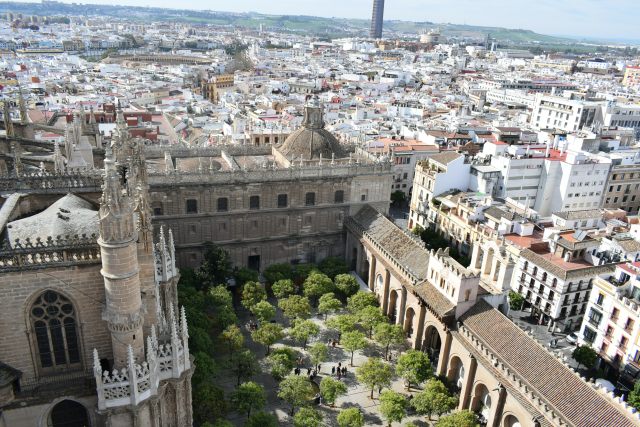
The view below is towards the river, and looking down on parts of the cathedral and the Courtyard of the Oranges.
The bells are suspended above your head from whichever point of the compass you view. Let’s hope the fixings are secure!
Another notable feature of the Giralda is the weathervane. The tower takes its name from geraldillo, Spanish for weathervane. A ground-level copy shows it is a handsome piece of work and appears to be based on a ship’s rudder. The lady is perhaps the ship’s cook.
The next photo gives an idea of the cathedral’s interior vastness. 
The workmanship in the cathedral was meant to surpass anything of its day. Even the ceiling.

Of particular interest is Christopher Columbus’ tomb – or is it? Columbus was buried and reburied in a number of different locations, the previous time before this in Havana, Cuba. In 1898 Cuba gained independence so Columbus was brought back to Spain for burial in Seville. But then another Columbus body was found in Santa Domingo, Haiti, a previous resting place.  No reason why he shouldn’t be shared around, I suppose. It’s fine tomb anyway.

In St Anthony’s chapel is the famous Vision of St Anthony by artist Murillo. St Anthony is said to be transfixed in ecstasy by infant Jesus and attendant throng appearing out of a golden cloud, but it actually looks like he’s trying to shoo them away. The font is old, Renaissance, and beautifully carved.
The largest altarpiece in the world adorns the main chapel. Begun in 1482, it was the lifetime’s work of Flemish artist Pieter Dancart and contains over 1,000 carved figures. Bet he wouldn’t even carve the Sunday joint after he retired. Enough is enough.
In the vestry are more wonders, like this monstrance by Juan de Arfe, the wedding cake ornament in the centre of the photo. A monstrance is a showpiece for public display at important festivals like Easter. This is a monster monstrance, weighing nearly 500 kilos, Arfe a tonne near enough. Beautifully made, a craftsman who doesn’t do things by Arfe.
Here’s another monstrance, a bit smaller, showing a true thorn from the crown of thorns in the glass circle. All good crowd-pullers.
And this gold crown holds the second largest pearl in the world.
The cathedral project was the product of the great wealth created from trading with, and plunder from, the New World, so no expense was spared in constructing it and filling it with treasures.
We leave the cathedral through the Patio de los Naranjos, the Courtyard of the Oranges,  and then through the very same door the Moors built for entry and exit to their mosque.  
We spent an enjoyable and varied afternoon in the cathedral, and at the same time avoiding information overload, after which it all becomes a blur. How do trippers take back anything on the “10 country in 2 weeks” type tours, apart from hundreds of selfies?




Tuesday, 3 March 2020

To Seville


We intended to leave Santillana early on Saturday 22nd Feb, so hauled ourselves out of our muddy pitch on Friday night and parked on the campsite internal road.
A good hour saved, so we arrived in good time at our intended night halt half-way to Seville. The site was mainly residential- these campsites seem to have a common theme of small pitches and occupants covering every square inch of their plot with awnings, sheds and lean-to’s, as well as accommodating the caravan or motorhome dwelling itself. Overall impression: refugee camp.
The Seville site, however, was good, in quiet suburbs with a frequent bus connection to the centre. So we bussed in and went walkabout. The bus dropped us at the edge of the old centre, and first impressions were of elegant buildings, wide avenues and spacious parks. This huge edifice we came to is what? The plaque on the wall told us.
It’s the old tobacco factory and the second largest building in Spain after the Escorial palace. It’s now part of the university. It also figures in the story of Bizet’s opera Carmen: Carmen was a cigar maker here. No Carmen brand cigars on sale for the tourists though, not even Carmen cough drops. Missed opportunities.
All of the short walk to the centre was interesting. Now we passed a busker, and stopped to listen: a flamenco guitarist who could really play.
The old centre is dominated by the cathedral and contained a mixed range of buildings from many eras. Two examples:

Design often shows influence of the city’s Moorish past, the Arab occupation from year 712 to expulsion in 1248: the interior of this public building, for example. It reminded us of Morocco, from where many of the Arabs came.
The Santa Cruz quarter that backs on to the cathedral is a maze of small streets containing bars, a few flamenco clubs, and dwellings, some with entrance doorways and courtyards also in the Moorish style.  See following photos. Arab design was meant to create cool calm refuges in the scorching Spanish summer heat. 

The bars in this area are all from yesteryear, like this one with the dried hams hanging up, and dark décor.
There was also a guitar museum within a small flamenco theatre. Some were over 200 years old and looked quite different to modern style guitars.
Out of Santa Cruz, we wandered towards the river and past the bullring. Bullfighting still occurs in Spain, and its stronghold is here in Andalucia, but it’s more low key these days as many Spanish now find it unacceptable as do most of the tourists. The Plaza de Toros took a nice photo though even if we wouldn’t want to see a live performance. Live, that is, apart from the bull at the end!
At the wide Guadalquivir river we looked across to the Barrio Triana, the gypsy district. Also here the ancient shipyards and the gunpowder factory thrived when Seville was the main port of entry for commerce with the New World. In the 1680s the river silted up and Seville went into a decline. Shockwave damage from the Lisbon earthquake of 1755 completed the downturn.
There are wide and pleasant promenades along the river bank. We walked along the embankment and stopped at the Torre del Oro, the Golden Tower, constructed in 1221 and much amended later. Pleasant enough and remarkable for the complete absence of any gold colouring.
We haven’t yet finished in Seville: the next blog will focus on the cathedral, the largest gothic cathedral in the world but also the largest cathedral from any period by volume (Guiness Book of Records). Did they have to fill it with liquid to measure the volume- holy water of course, as it’s a cathedral!


Friday, 28 February 2020

AltamIra: 21st February


The Altamira cave paintings were designated a World Heritage Site in 1985. The caves themselves were discovered in 1868, and from 1879 an archaeologist called de Sautuola started examining the paintings on a scientific basis. He was the first to propose that paintings of this type, also being discovered elsewhere in Europe and Africa, were from pre-history, in this case late Stone Age. Other experts disagreed as they believed that people of those times had neither the talent nor imagination to create such fine works of art.

A few examples below illustrate the quality of the work, notably the use of charcoal and red ochre to produce colour. The first animal is recognisably a bison, and the second a deer.


Modern research has of course confirmed that de Sautuola was right: these works are from the Stone Age (no Flintstone jokes, please), more precisely from 15,000 to 13,000 years ago.

It appears they had a technique for blowing paint onto the walls enabling hand outlines to be created.
The above photos are all authentic reproductions rather than originals. Cave visits were unrestricted until 1977 when it was clear that the volume of visitors was substantially affecting the condition of the paintings. The caves were then closed completely to the public, but since then small numbers only are allowed to see the originals. Currently, 5 visitors are chosen each Friday by ballot and taken on a 90 minute tour, all kitted out in special overalls and shoes. We weren’t lucky in the selection, but the Brit lady next to us was first out of the hat.

We did however see examples of the painstaking excavations where different levels reveal occupation artifact from different dates.

Most of the finds are very fragile, but some remarkably complete objects have emerged. This flute, made of animal bone, is from the period 38,000 to 28,000 years ago.
From a slightly more recent period is this selection of harpoons.
Now two more carvings from this same later period, 28,000 to 18,000 years ago.

Both were carved and decorated for art’s sake, and the flute was to make music. Just because these folks had no written language doesn’t mean they were savages. They would have had a spoken language, with customs and practices passed down by stories and word of mouth. In fact, a life-style similar to primitive tribes surviving to within recent times e.g. the Eskimos, the Aborigines, the Bushmen of the Kalahari.


So maybe the modern day sophistications depicted in the Flintstones cartoon weren’t too far off the mark!


Wednesday, 26 February 2020

North Coast of Spain: 20th Feb

It’s a bright, sunny day, so we go for a sightseeing drive along the coast. Our first impression is of empty roads and pretty villages, some with distinctive features like this church.
The Atlantic coast provides some fine, sandy beaches, and the day is warm enough at our first stop for a party of schoolchildren to be playing on the sand. The warm weather is perhaps misleading as the campsite receptionist tells us that the main season is the same as in the UK: June, July and August. This accounts for the deserted campsite.
Further along we pause by an inlet, part of a bird sanctuary, that looks almost tropical
We are heading towards the small town of San Vicente de la Barquera, getting a fine view of the snow-covered Picos de Europa before we drop down into the fishing port.
The town is more than just a port: there is an ancient stronghold on the hill from where the above photo was taken, with water on three sides and a defensive wall.The next photo shows its impregnable position.
We decide we will assault the stronghold. On the way, walking through the modern town, we pass an unusual avenue of trees where the overhead branches have been grafted together to form a continuous canopy. No doubt keeps the Mayor and civic dignitaries cool during summer processions.
We puff on up to the 13th century church, but can’t look inside as it’s not open until later. Photo underneath. The building on the right,with the sailing ship on the wall, is a school. What looks like an info plaque on the bottom right of the ship is actually a satellite disc, so we don’t know why it’s there. Maybe signifies that the ship traded sat discs instead of beads with the natives of newly explored lands.
The church stands at the end of the hill and the town wall: it looks even more fortress-like from that side.
Looking the other way, off the headland, is a great view showing the commanding elevation and the surrounding water. The panorama of the Picos mountains that we saw on the way is apparently equally breathtaking from here, but the Picos are now entirely shrouded in mist. It was a mist opportunity.
We drive back from San Vicente after another splendid day in northern Spain, normally sadly overlooked as we dash to the sun spots of the south. 


Friday, 21 February 2020

France & Spain Feb 2020: The Start


We planned to leave home on Monday 10th February but the weekend storms and high winds hung on. The weather forecast predicted a calmer few days mid-week before another storm, storm Dennis, hit. So come Wednesday we go for it, but buffeting winds along the Calais to Boulogne motorway forced us to shelter for the night at a local campsite.

Since then it’s been good travelling, and we are now in the province of Cantabria, northern Spain. This is our pitch at Camping Santillana, a large but totally deserted site. It’s like our own private field, complete with long grass,  trees and soft earth, all of which made pitching difficult. But what a lovely view, and the beautiful small town of Santillana del Mar lies within walking distance!

Next morning we follow the cobbled road connecting the campsite to Santillana. The town is reputedly a medieval time capsule, although the two hotels in the photo, while attractive, don’t look that ancient.
We path arrives in one of the town squares. Santillana grew around its 12th century church, which we will see shortly, and became a settlement for noblemen made wealthy mainly from trade and plunder from the New World after its discovery by Columbus in 1492.
The whole place presents a consistently ancient appearance, supported by planning laws in operation since 1575 to preserve the integrity of the town.
It’s worth looking at the detail at some of the coats of arms on the building facades. The craftsmanship is skilled and intricate.
 The jewel in the crown is the 12th century church of Santa Juliana that gave the town its name. Differing accounts say it was preceded by a hermitage or a monastery. The blue van probably dates from a little later.
To prove the town was occupied by real inhabitants, there is a picturesque clothes washing area. Not so romantic for the ladies who did the laundry in all seasons.
In the square behind the church is the impressive 16th century Palace Velarde. It looks like a two-dimensional film set in the photo, but is actually very atmospheric. Any film directors looking for a good Dracula movie location?
Santillana delivered just what the guide books claimed: an authentic medieval experience. Disappointingly, and unusually, neither the travel guides nor the internet could provide much detailed history of the town or specific buildings. There has to be an opportunity here for some fascinating reading.
Now a stroll back up the cobbled way to the campsite for lunch.


Friday, 24 May 2019

The Basque Country


The northern coast is also called green Spain. Here’s a view that confirms it from just outside the campsite. Notice the vines in the foreground.
The vines here are on steep slopes, and very neat. First assumption is that they are tended by hand, but not so- we saw this specialised tractor going up and down the terraces cutting the grass. The grapes are enveloped in diesel fumes so the wine perhaps develops a unique premium quality. Just don’t light up while you’re sipping.
The campsite is also very green, with many trees. We’re the second unit in on the right. The problem is green = rain, and we had torrents of it towards the end of our stay.
There were some lovely walks from the site, which is on the top of a headland. This is the view down to Zarautz town from one of the paths.
A sign on another path proclaims it was part of the pilgrim route to Santiago de Compostela, 400 miles away. Being only 15 miles from the French border, this could have been a main thoroughfare for this popular pilgrimage in the middle ages. In the last few years these old routes have been successfully revived as long distance walking paths.
The ancient small town of Getaria is connected to Zarautz by a 3 mile coastal walkway. We couldn’t park in Zarautz to start the walk so took the car to Getaria instead. Narrow streets with old buildings made it an interesting place to stroll around. Couple of photos next as examples.


It had a nice beach and scenic views of the coast with our campsite headland just visible on the other side of the bay.
The statue next is Juan Sebastian Elacano, born in Getaria, who became the first man to circumnavigate the Globe. Never heard of him? The expedition leader was the famous Magellan for whom Elcano was a navigator. They set out from Spain in 1519 but in 1521 Magellan was killed  by natives in the Philippines; Elcano completed the voyage, having been promoted to captain, arriving back in Spain in 1522. Some lesser crew members also completed the full trip, although most expedition members died from disease, malnutrition or violence like Magellan himself. 
We had passed through, but never stayed, in the Basque region several times previously and were pleasantly surprised by how many interesting places there were, and by the picturesque countryside and craggy coastline. But you do need the weather!