Wednesday, 18 March 2020

The City of Almeria: March 9th


Almeria city is the capital of the province of Almeria. It is less well known than other regional capitals like Seville as it has less ‘A’ list attractions. Nevertheless, it is a pleasant city and an important port with ferry links to North Africa. We parked by the port and strolled up the attractive main boulevard that used to be a dried-up river bed.


Trees feature plentifully, most with this bottle stopper clipping treatment that would do credit to any barber.
There were a few individual typical Spanish buildings that stood out.
And even in the backstreet quarters, some inhabitants made an effort to brighten things up. This flowery balcony is an example.

Approaching the cathedral we noticed a large sun symbol on the wall. It’s not certain who authorised the carving during the building of the cathedral in the 16th century as it is represents Sol the Roman sun god and nothing to do with Christianity. However, because Almeria is the sunniest province in Spain, it has been adopted by the Almeria Tourist Board as their logo.
 Moving to the front of the cathedral, it looks more like a castle. This was the intention as the city was plagued by pirates and the upper parts of the church were designed for, and actually held, cannon.


That’s the trouble with having visited the stunning Seville cathedral, others look like a poor relation. However, the photo of this fine chapel shows a silhouette on the right exclusive to Almeria cathedral. By his horns, it has to be the Devil himself!
To be fair, the altarpiece is magnificent, and compares favourably with the best.
Going through the cloisters on the way out, it’s charming but functional. You can imagine the scurry of men passing powder up to the cannon when the city was under threat.

In the old quarter we walked through pleasant squares and elegant buildings like the town hall.
And this courtyard, beautifully proportioned, was a location for the film Indiana Jones and the Last Crusade.
Probably the best monument in Almeria is the Alcazar, the fortress on the hill overlooking Almeria. It was started by the Moors in 955 and extended in the 11th century. There are  at 3 rings of walls and at one time contained a population of 20,000. We did not visit due to shortage of time. The photo is from the car park just before leaving the city.
Almeria, although not spectacular, had a really nice feel and merited more time than we gave it.

The blog is usually written about a week after the event. After visiting Almeria we travelled the next day, March 10th, to our destination campsite near Mazarron. A week on, at the time of writing, we are in lockdown at that site. Spain is now just behind Italy in the surge in Corona virus cases. In the next blog I’ll attempt to describe how we are coping locally and at our campsite.




Sunday, 15 March 2020

Cabo de Gata Natural Park


We travelled the 270 miles from Seville to Cabo de Gata on March 1st. The park was created in 1987 and covers 71,000 acres of coastline and adjacent countryside. This is part of the unspoiled coastal area.
There are a few simple resorts on the coast like this one at Las Negras, but basically the whole park is totally uncommercialised. Las Negras looks almost abandoned, but then it’s out of season.
We decided to spend a day in the more remote parts of the park, and headed off along the coast until the tarmac gave way to a rough dirt road. We continued on the dirt road through small green hills, as in the photo. The small tower on the right on the horizon is a traditional windmill.
Looking inland, the green growth is exceptionally bright, with purple flowers in the foreground. This lushness strikes us as unusual because this is the driest part of Spain with around 4 inches of rain a year (10 cms): thirty miles inland is Europe’s only true desert, where the Clint Eastwood Dollar films were shot. 
On the seaward side are splendid empty beaches. Some other cars and cyclists were also using the dirt road so we had some company. No doubt at weekends anytime after Easter it could get quite busy with visitors from the city of Almeria only half an hour’s drive away.
 Miles from nowhere we noticed an odd structure- a bus stop, with bus stop sign. By the condition of the shelter, we imagine the last bus was at least 10 years ago.


The track now got smaller and rougher, and as it started to climb the mountains in the photo below, our progress was stopped by a barrier: only walkers and cyclists can continue beyond (and perhaps the bus!)
We were hoping to reach the salt flats with flamingos on the other side of the mountains by following the dirt road, but we could backtrack and go another way. Didn’t bring the zoom lens so the 50 or so flamingos in the photo are barely visible.
The vegetable greenhouses surrounding the park are on a larger scale than anything we’ve seen anywhere and we estimated the total area, of which the next photo shows just a part, to be at least 10 square miles of solid plastic.
 A large workforce is needed to service the crops, paid at the bottom end of the wage scale. We noticed many very dark Africans in the vicinity and then alongside the road was a shanty town which housed them. There are doubtless more that we didn’t spot. You just hope it’s a better life for them than the one they left.
One evening at the campsite there was a most beautiful sunset. The only problem from a photography point of view was to avoid the flapping giant Red Dragon Welsh flag hoisted by a neighbouring camper in honour of St. David’s day. 
This was our chill-out stop, and with the well-run modern campsite we are staying at, we have soon achieved a quick recovery from the long journey down. But the unknown issues of Corona virus are now on the horizon.


Wednesday, 11 March 2020

Seville: the Royal Palace, the Alcazar

The palace entrance is through a gate in the old city wall; what remains of the city walls now surround the palace. City walls existed since Roman times, and even before that an enclosure of logs and mud, but today although much modified over the centuries, they are essentially the structure of the Arab regime before the Christian reconquest.
The palace was originally built by the Moors and extended many times, for instance by ruler al-Mu’tadid to accommodate his extended harem of 800 women. Imagine the queues for the bathroom!

After the Christian reconquest, king Pedro 1st started rebuilding the palace from scratch using the same floor area. He was known as Pedro the Cruel or Pedro the Wise meaning, like President Trump, you love him or you hate him. His justice chamber near the entrance looks out onto the only part of the original Moorish palace he retained. The plasterwork is still very fine, and the tranquility of the little patio is quite delightful.
Before entering the palace we took a detour into the Cuarto del Almirante, the Admiral’s room, in which many of the voyages of exploration were planned. Founded in 1503, the purpose was to plan, recruit and set in motion expeditions. In the room adjacent is a chapel where the Virgin of the Navigators painting depicts scenes from early journeys, including Columbus’. The detail is so fine that it has provided historians with information not available elsewhere. 
In the next room was a collection of fans from different countries, very beautiful, but the connection to the palace is not clear. This is an example in case you were thinking along the lines of stuffed Man United or Real Madrid supporters.
First impression on stepping into Pedro’s palace proper was that it could have been made by the Moors. In many ways it was, because Moorish architectural practices continued after the Christian reconquest using Moorish craftsman that simply carried on working and passing on their skills.

This type of work is called Mundejar, and the first courtyard is a good example. It is the Patio de las Doncellas, built in memory of the annual tribute of one hundred virgins demanded from the Christians by the Sultan ruler. Might not be so easy to supply that number these days.
The quality of the work is amazing as is the harmony created by the design.
The Salon of the Ambassadors coming up next is the most stunningly decorated room in the palace. An Arabic inscription says it was constructed in 1366 by craftsmen from Toledo. No jobbing workmen here.
This is another wall of the great room leading onto the Patio de las Doncellas, the courtyard shown earlier.
And not let’s forget the ceiling, a great work to contemplate should you happen fall flat on your back.
The Patio of the Dolls below is so named after two tiny faces in one of the arches, that we didn’t spot. The arches themselves were brought from a 10th century ruined palace near Cordoba. The room was reputed to be the harem in Moorish times, but hardly room for 80 never mind the 800 mentioned earlier.
Pedro was supposed to have murdered his brother here in 1358, and on another occasion topped a royal guest for his jewels. One of these, a giant ruby, he gave to Edward the Black Prince which is now in the British crown jewels! 
Next is the beautiful Salon of Carlos V built by Pedro for his mistress Maria de Padilla who reputedly had magic powers such that some of the courtiers
would drink her bath water for a knock-on effect. They’d have certainly got that if bubble bath or Radox had been around in those days.
The palace of Carlos V built later is elegant but seems almost bare by comparison with the lushness of Pedro’s works.
Out into the gardens now and the Mercury pool, the statue in the middle. NIce effect of being cool and exotic.
More gardens, these laid out within the last 100 years, looking more like a conventional UK park. Very pleasant but unremarkable.
This is the unusual Garden of the Cross, a pool containing a giant green dumpling. We’re not awarding full marks for everything.
One last general view of the formal garden looking very exotic.
Pedro achieved exquisite layout and workmanship in his palace, but unfortunately we have to rule against him for his misdeeds: he’s definitely Pedro the Cruel.

Seville was a city full of interesting attractions, many of which will need to wait until next time as we now move on to the Cabo de Gata.


Friday, 6 March 2020

Seville Cathedral


The cathedral is huge but I found no angle to take one photo that does it justice. This is one of the facades, imposing and ornate.
This corner shows the Giralda tower, built by the Moors between 1184 and 1196 as a minaret ,and part of their mosque. Some time after the Christian reconquest in 1248 the mosque was replaced with the cathedral (1402 to 1506), but the Giralda tower was deemed too beautiful to be demolished and was altered slightly to became the cathedral bell tower.
Visitors to the cathedral can climb to the top of the Giralda from inside the cathedral. The ascent is unusual in that it is by a series of 35 ramps, rather than stairs, wide enough for two mounted guards to pass.
 We slogged up the ramps to the top, from where the view is extensive.

This elevation shows the dense mass of houses in the old town.
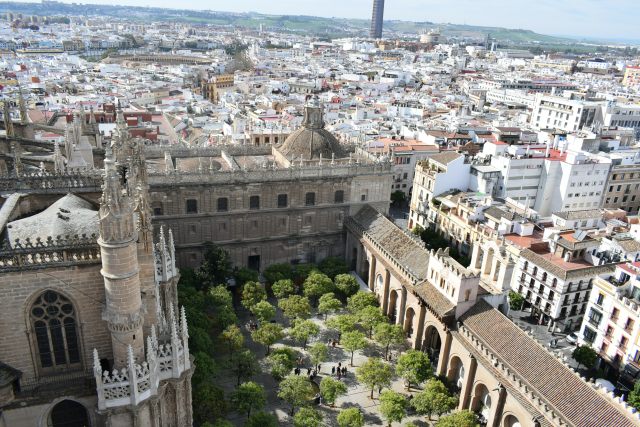
The view below is towards the river, and looking down on parts of the cathedral and the Courtyard of the Oranges.
The bells are suspended above your head from whichever point of the compass you view. Let’s hope the fixings are secure!
Another notable feature of the Giralda is the weathervane. The tower takes its name from geraldillo, Spanish for weathervane. A ground-level copy shows it is a handsome piece of work and appears to be based on a ship’s rudder. The lady is perhaps the ship’s cook.
The next photo gives an idea of the cathedral’s interior vastness. 
The workmanship in the cathedral was meant to surpass anything of its day. Even the ceiling.

Of particular interest is Christopher Columbus’ tomb – or is it? Columbus was buried and reburied in a number of different locations, the previous time before this in Havana, Cuba. In 1898 Cuba gained independence so Columbus was brought back to Spain for burial in Seville. But then another Columbus body was found in Santa Domingo, Haiti, a previous resting place.  No reason why he shouldn’t be shared around, I suppose. It’s fine tomb anyway.

In St Anthony’s chapel is the famous Vision of St Anthony by artist Murillo. St Anthony is said to be transfixed in ecstasy by infant Jesus and attendant throng appearing out of a golden cloud, but it actually looks like he’s trying to shoo them away. The font is old, Renaissance, and beautifully carved.
The largest altarpiece in the world adorns the main chapel. Begun in 1482, it was the lifetime’s work of Flemish artist Pieter Dancart and contains over 1,000 carved figures. Bet he wouldn’t even carve the Sunday joint after he retired. Enough is enough.
In the vestry are more wonders, like this monstrance by Juan de Arfe, the wedding cake ornament in the centre of the photo. A monstrance is a showpiece for public display at important festivals like Easter. This is a monster monstrance, weighing nearly 500 kilos, Arfe a tonne near enough. Beautifully made, a craftsman who doesn’t do things by Arfe.
Here’s another monstrance, a bit smaller, showing a true thorn from the crown of thorns in the glass circle. All good crowd-pullers.
And this gold crown holds the second largest pearl in the world.
The cathedral project was the product of the great wealth created from trading with, and plunder from, the New World, so no expense was spared in constructing it and filling it with treasures.
We leave the cathedral through the Patio de los Naranjos, the Courtyard of the Oranges,  and then through the very same door the Moors built for entry and exit to their mosque.  
We spent an enjoyable and varied afternoon in the cathedral, and at the same time avoiding information overload, after which it all becomes a blur. How do trippers take back anything on the “10 country in 2 weeks” type tours, apart from hundreds of selfies?