Tuesday, 24 May 2022

The Pyrenees

 It’s another hot day for our journey from Albarracin to the Pyrenees: 34C in the shade. We arrived mid-afternoon at our destination campsite, Camping Gavin, and chose a terraced pitch overlooking the foothills. The sound of cowbells drifted up from the valley. All very pleasant, as the photo shows.

The cowbells carried on into the evening, at a volume which would indicate a large herd just outside the campsite boundary several terraces below.  Still pleasant, yes; too loud, yes; conducive to sleep, no. We decided to investigate the following morning, and took the footpath to the village that ran just outside the camp boundary where surely we must pass the cowbell culprits. The path is an ancient track and very atmospheric.

However, we didn’t see any cows although we could hear them through the undergrowth. We carried on to the village, of solid stone construction to protect against the mountain elements. Flimsy coastal tourist condos just wouldn’t survive here.

We stopped for a reliably tasty and cheap coffee in the village. Jane’s trying to hide behind one of the umbrella poles where we were sitting.

We took a different route back to the campsite as we were determined to flush out the source of the cowbells. And here they are, only 20 to 30 happy cows vigorously chomping on the lush grass of this small meadow. Nothing like the large herd we were expecting. It’s a just a pity the bells aren’t tuned to harmonise so the cows could be trained to play, say, “Viva España” or “Ding Dong Merrily on High”.

The following day we went into the high Pyrenees at Ordesa National Park. Here’s the dramatic approach. There is snow, but not much on the vertical rock surfaces.

The tourist centre for the park is village of Torla, even more solidly set in stone than our village near the campsite.

We came across lots of serious walkers doing steep trails, but we opted for a more gentle river walk.

The river was a fast-flowing green/blue colour, perhaps from recent snow melt following the sudden high temperatures (34C again today). The old bridge we next came to was the perfect vantage point to observe the rushing current.

Downstream, we saw this group of kayakers preparing to take on the white water as it flows through  a gorge.

A close-up shows how skilful these folks were, as these were boiling rapids. So here goes!

We have had an enjoyable but hot few days in the mountains, and now we go to the village of La Romieu in France. 


Sunday, 22 May 2022

Teruel: May 18th

 Teruel is where we left the motorway to travel the 20 miles inland to Albarracin, but Teruel is a destination in its own right.

It has a history stretching back to pre-Roman times, in fact, the Romans destroyed the city as a reprisal. It was a Moorish stronghold after the 8th Century and later architecture reflects the Moors’ influence long after they were deposed: it’s called Mudejar style.

The cathedral, dating from the 13th century, shows this mixture of Christian and Islamic influence. The cathedral bell tower which could comfortably fit into any Arab city.

Inside, it’s mostly traditionally European Spanish, with amazingly ornate decoration everywhere. Just look at this domed ceiling.

And the intricacy of these wood carvings! The photo is but a small part of a huge floor to ceiling work behind the main altar.

Now we’re back again to Islamic design, with an incredibly detailed ceiling. The photo is quite inadequate.

We’ll leave the intensity of the cathedral after a final look at how the two styles combined to produce these most elegant arches.

The city itself feels very Spanish, with squares, pavement cafes and bars. There don’t appear to be many foreign visitors as we all stand out like sore thumbs so can't be missed.

Even the manhole covers display a certain elegance. Tempting to bring one back to replace the dour Anglia Water manhole cover from which our garden is regularly flooded.

Running into the old quarter is a 600 year old aqueduct, of course, not functioning any more.

The above photo was taken from an unusual small public garden where the plants were displayed vertically, set in a moisture-retaining type of felt. Jane was very impressed, but I’m not sure how our version is going to look back in our garden in Hartford!

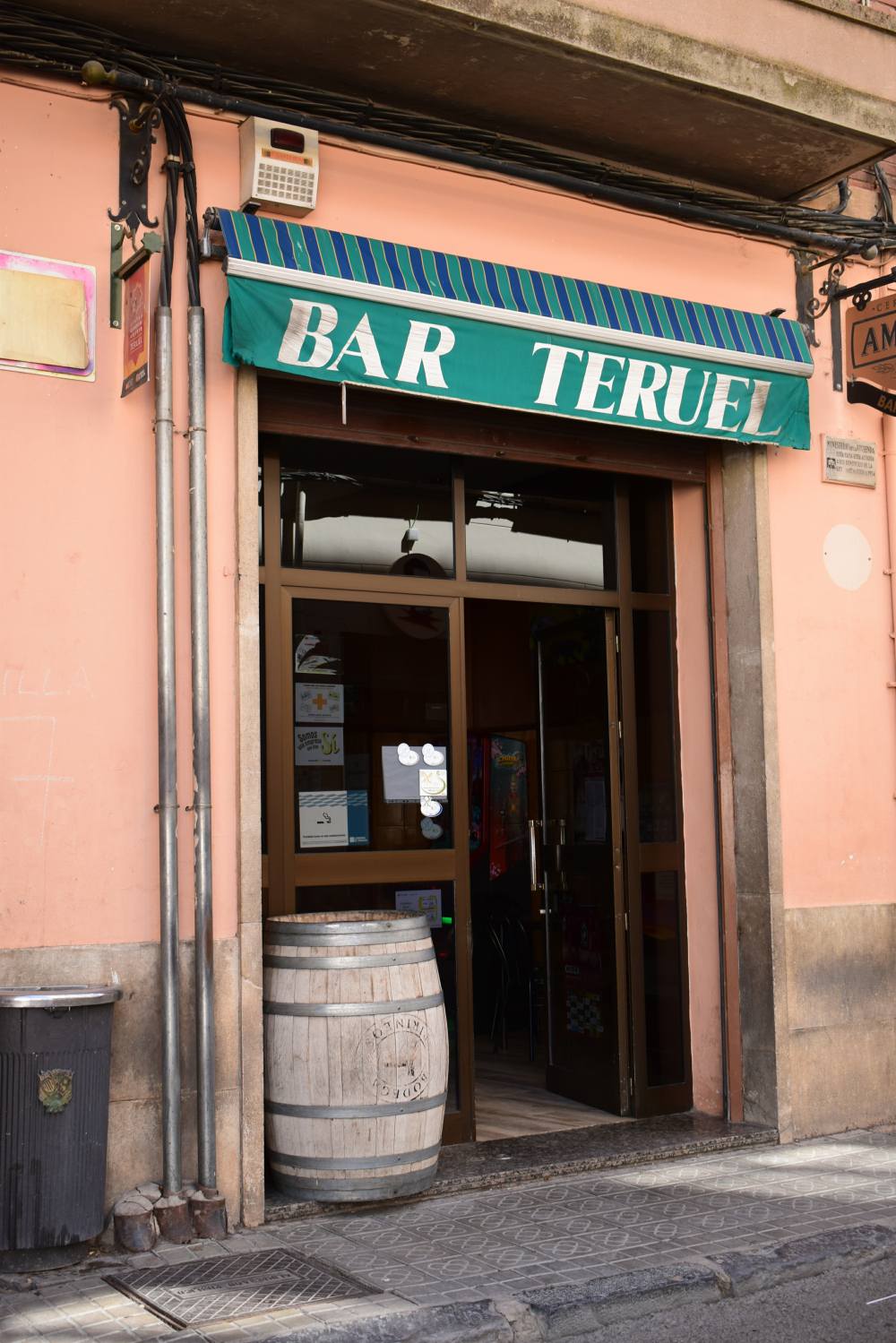
Teruel is a middle of the road city, rather than a primary tourist destination, so it has plenty of typical Spanish establishments like this bar.

The city’s recent history is more tragic. It occupied a strategic position in the Spanish Civil War and a bitter battle was fought during the winter of 1937 – 1938. It was a record cold winter, with 4 feet of snow and temperatures dropping to -18C. Each side suffered over 100,000 casualties but finally Franco’s army triumphed having superior weapons and supplies – and not inconsiderable help from Nazi Germany.

We headed back to Albarracin for our final evening before leaving. On the way back, Teruel airport grabs our attention as it’s full of parked planes. It seems the airport is used by fleet operators who park out-of-service planes, presumably at low cost. The photo only shows a few of the many aircraft as it’s difficult to the right angle from the road.

Leaving the airport, the road follows the twisty river back to Albarracin. It’s a pretty run, on well surfaced roads. In many places the scenery is more dramatic, but there’s nowhere to stop to photograph. More excuses!

We have enjoyed our visit to this area, and tomorrow we’re bound for the Pyrenees Ordesa National Park, just on the Spanish side of the border with France.  


Wednesday, 18 May 2022

Albarracin: May 16th


 We arrived two days ago from the coast, near Valencia, where we were visiting old neighbours who have settled in Spain.

Albarracin is in the central mountains about 150 miles inland, and has been described as one of the most beautiful towns in Spain. It certainly has a long history, starting as a Roman settlement and then becoming a regional centre under the Moors following their conquest of Spain that started in AD 711.

We can see part of the old town from the campsite located about half a mile out of town.


But of course, we’ve taken a closer look. The climb up to the old part is steep, reminding us that this was a fortified town.

Getting into the town itself, it’s a maze of different levels, small streets and alleyways, for example: 

There are some open spaces, this square for instance. We expected to see a number of cafes and restaurants but there were none except for fine dining hotels offering a full luncheon menu. We just wanted a coffee. The square is very picturesque, though, with its balconies.

Now we’re looking at the cathedral. The tower dates from a later century (15th) but looks very much in keeping with the rest of the older buildings with its distinctive Moorish appearance.

From higher up we can marvel at the city walls as they rise even further at impossible angles.

A passing couple took a rare photo of us together. The view looks down into the newer part of the town towards our campsite in the distance.

Another reason for the success of the town is its amazing defensive position. It’s built on a crag almost totally surrounded by a loop in the river. A zoom picture down to the river shows a simple water wheel for irrigation onto the non-fortified bank where there is some sparse agriculture.

The lasting impression has to be one of the higgledy-piggledy buildings. As rickety as they seem, they must have some substance having endured all these centuries.

On the walk back to the site we spotted a flock of large birds wheeling high in the sky. We counted 11, and managed a telephoto shot of one of them which the book identified as a black vulture. These birds can have a wingspan of over 9 feet – so stay as high as you like, guys!


Thursday, 12 May 2022

Cartagena

 The city was founded in the 3rd century BC by a Carthaginian general who named the city after his home town of Carthage in north Africa. It flourished as the main city in a mining area, which was further expanded under the Romans. It was conquered by the Moors and then retaken in the 13th century. It became a great naval port under King Phiip II (ye king of Spanish Armada fame), and still remains so today.

We started our visit with a boat trip to look at this great harbour, and here’s the boat, run by the local authority, hourly, at very reasonable rates.


We spotted a small naval vessel straight away. The photo shows how effective the grey camouflage is compared to the red ship which really stands out..

Now we’re passing a submarine under repair, or maybe scrapping: I don’t think Putin has anything to fear from this one.

Chugging round the harbour, next up is a fort. This protected the harbour entrance and dates from the 19th century. It’s called Fuerte Navidad: Fort Christmas.


Passengers can alight at the fort and be picked up by the next boat, but we stayed aboard. After pulling away from the small jetty, the boat ran alongside a mole. At the end of which is a lighthouse – Christmas lighthouse, as it happens. Now from the mole came a strange wailing sound, difficult to place in sunny Spain, but lo and behold, it’s the bagpipes. A piper was playing on the mole, oddly dressed in a rugby shirt and shorts. Maybe Father Christmas would have been a more appropriate costume given the names of the fort and lighthouse.


 We passed by the Christmas lighthouse that marks the harbour entrance, and make a slow turn round the headland which is still studded with old fortifications, part of which seems to have fallen into the sea.

Cruising back down the other side of the harbour a strange floating contraption came into view. It’s a dredger, or at least we thought so.

Yet more fortifications, and then a cruise ship. Cartagena is a popular call-point because of its deep water harbour, and also it’s straight off the ship and into the town centre that is right by the port. The size of many cruise ships however means that they block off the view of the harbour as if a high rise block of flats had suddenly appeared.

It’s a favourite with pleasure craft too as the coast is very scenic and the whole Med available if you’re a proper sailor.

So we’re on dry land again and headed for the town, a most attractive approach featuring the domed town hall.

The shopping streets are pedestrianised and marble tiled – very up market.

And time for lunch. Despite being a popular tourist destination the prices are still reasonable so we sat down to a leisurely pizza. The leisurely bit is built-in as the service was slow but pleasant enough.

A quick look around the shops – but one high street is much like any other – and then to the Roman theatre. This one dates from the 1st century BC and is very well preserved. It has a capacity of 7,000 people. It was only “rediscovered” in 1988 having been covered by housing and rubble. This is what you see from the entrance portal’

The pillars around the stage are quite dramatic. Unfortunately, the washing hanging on the balconies of the flats behind rather takes away from its dignity.


But let’s do it justice by taking the shot from a different angle. Much more majestic!

The next photo shows most of the theatre, the stage, and the entrance arch high up. Our three performers, Jane, Natalie and Adam, are due to start - but where’s the audience? The play’s obviously been getting bad reviews.


So that’s Cartagena. Even the car parking was convenient: a huge underground park under the harbour promenade.

That visit was just over a week ago and sadly tomorrow, Thursday May 12th, we leave Los Madriles for a leisurely amble towards home. More reports to follow!


Wednesday, 4 May 2022

Bol Nuevo

Bol Nuevo is a seaside village 12 miles from our campsite. It means new bowl or pool, but that isn’t anything visible today. What we can see to start with is an unusual rock formation: wind-carved sandstone. The camper in the huge car park gives a good idea of scale.

The huge car park services a huge beach opposite, of fine sand.

But we’ve come for a walk, and head off along the cost using a dirt road. This is the view along the coast before we drop down to sea level. Notice the wooden gazebo indicating one of the few, exclusive homes before we reach the wilderness.

The sea path is backed by multi coloured rocks indicating various minerals of which iron ore was mined in the 18th and 19th century. 

No motor vehicles are now allowed on the road but even in our time in previous years it was used by cars. There are several cuttings like the one below that show it was once an important highway for it to have been worth  blasting away the rock. Adam and Natalie, who have joined us for a week, give an idea of how much was removed.

There are some pretty bays along the way, but beware – some are dedicated nudist beaches. It is an interesting speculation, when Spain had very strict  requirements to wear Covid masks at all times, to imagine the nudists all wearing masks and nothing else!

We reach the small dilapidated jetty from which the iron ore was shipped and return along a smaller coastal path. The iron ore colour in the rocks behind Adam is really strong in this next photo.

We backtrack along the dirt road we started along, passing pretty deserted bays and inlets. Some 20 years ago a Disney World was proposed along this part of the coast, and a motorway built in anticipation (now hardly used), but the plan never progressed. Thank goodness, we say, as the area would have been changed out of all recognition, but perhaps businesses and local employment would have a welcomed it.