Saturday, 27 May 2023

To Cuenca: Wed 16th May

 We have now left Los Madriles where we spent nearly two months thoroughly enjoying walks, activities and friends. We’re in new territory at Cuenca, so the blog restarts.

The campsite is about 5 miles from the city and pleasantly located in woodland. This was our pitch, and hoped it didn’t rain because it’s mainly bare earth that could turn to mud.


Tur first trip was to the Ciudad Encantada – the Enchanted City. It’s a walk round many huge and unusual rock shapes that can be imagined to be objects, animals or people. It starts with what most folks would describe as a mushroom – but why doesn’t it fall over? It must be a magic mushroom!


This next one is the stern of a ship, about 30 feet high. 


And now a Roman bridge. The tree is behind, not growing through the stone.
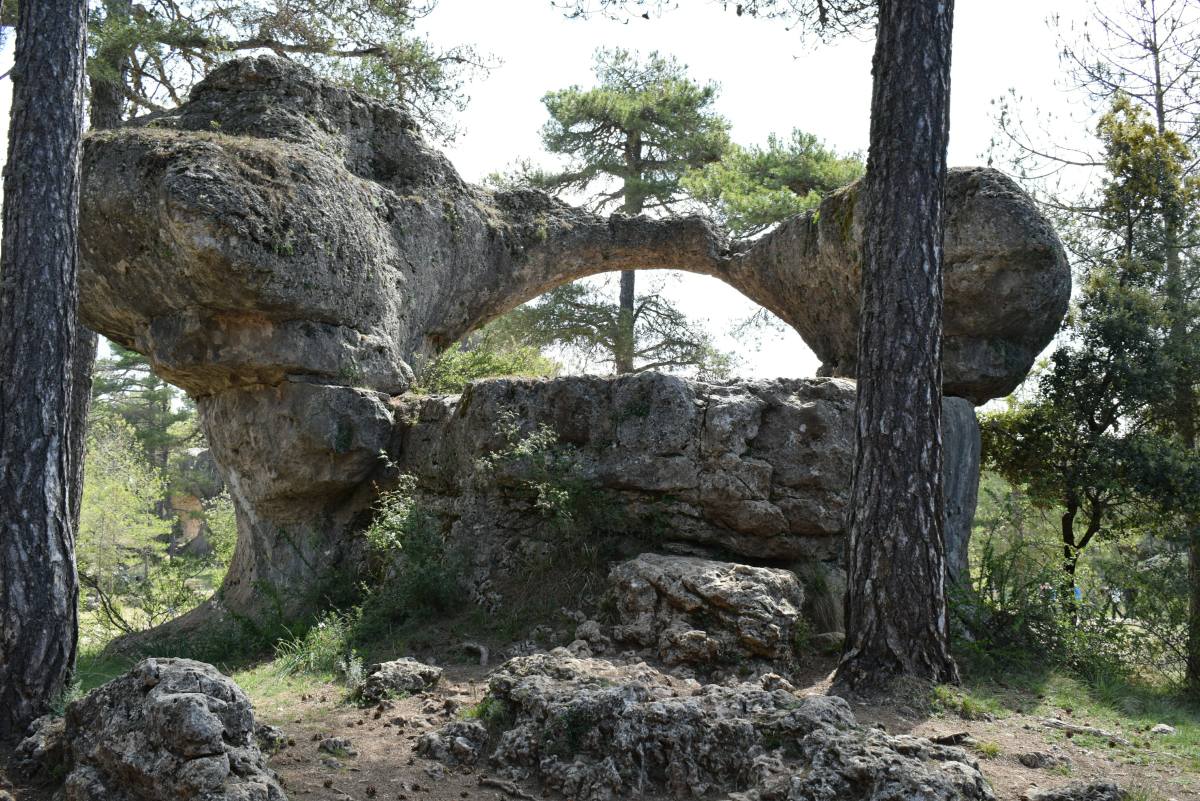


However, here’s a tree that is growing on bare rock. It is not be surprising to see rockery type small plants growing on the rocks, but this is a fir tree about 8 feet tall. An info board (in English) tells us that trees that take root on the rocks grow as dwarf or bonsai specimens due to the lack of normal nutrition.


This formation is called the convent door. Figures emerging are disappointingly not nuns but just visitors like ourselves. 


We are in this photo together, courtesy of one of a passing Spanish group. We have coats on because it’s cold, being in the central Spanish plain at about 4,000 feet.


Just one more rock image to stretch your imagination – the two bears. There are literally dozens of these rock shapes, but we’ll stop here before they become too repetitive. It’s quite different when you’re there and can appreciate the scale of the rock formations and look at them from different angles.


We returned to the campsite by a different route, and stopped at a car park of an indicated viewpoint. This is the view of the river gorge as we approached the viewing platform.


Here is he platform. It wouldn’t have looked out of place in rock city.


Can you spot the tiny climber on the left-hand cliff? 


But there’s more going on than is first apparent on the cliff face. We spotted a big bird on one of the ledges.


The camera lens shows it to be a parent and chick. The info board tells us that these are Griffon Vultures, one of the largest, with a wingspan of up to 9 feet!


The cliff face is full of them when you look through binoculars. This one is on the nest.


There are many more on the cliff face, but they are more impressive when flying, 


There were Egyptian vultures too, but they wisely stayed in the distance. Must make sure we don’t nod off sat outside in the chairs on campsite in the afternoon sun with these super scavengers about!


Thursday, 25 May 2023

Aguilas: April 2023


Aguilas is a coastal town about 30 miles from our base at Los Madriles. In common with most of the settlements around the Med., Aguilas has a long history. Starting with prehistoric remains, it was settled by the Romans, the Carthaginians and the Iberians. Then, in the 8th century, came the Arab occupation that lasted until the catholic reconquest in 1253 by Ferdinand and Isabella. 

There were further setbacks in the 18th century when a burst dam killed 600 residents, and then an earthquake. The main industry, mining, flourished until tourism started in the 1970’s. Today it’s patronised by largely Spanish tourists in the part of the town developed for that purpose.


The old town still looks very Arab in appearance although none of the buildings would date back to the Moorish occupation.

Although an interesting town to visit, our reason for coming was to spend the day with Ray and Diane, our next-door neighbours when we lived in Alconbury. They moved to Spain two years ago and have a house near Valencia and a park home a few miles inland from Aguilas.

Our friends suggested we visit the castle, an imposing fortress overlooking the town and the sea.


Unfortunately, the castle itself was closing as we reached the top but we had great views like this one of the harbour.


Ray pointed out some rock shapes that were supposed to have given the town its name: Aguilas means eagles. Couldn’t really make it out – maybe upside-down eagles?

 We climbed down from the castle to the main square, in a delightful setting with trees and shrubs, surrounded by old buildings. 


Plenty of café tables in the square, so we sat a while over café con leche, taking in the scenery and passers-by. This enormous ficus plant was worthy of a photo, with Jane and Diane in front for scale.


After lunch we followed Ray and Diane 5 miles back inland to their park home. The plot was large and well laid out, and the other dwellings were of different designs giving a pleasant appearance to the park.


Also, lovely mountain views from the garden.

A good day out: having visited a different town and a catch up with old friends at the same time!


Wednesday, 26 April 2023

A Testing Walk

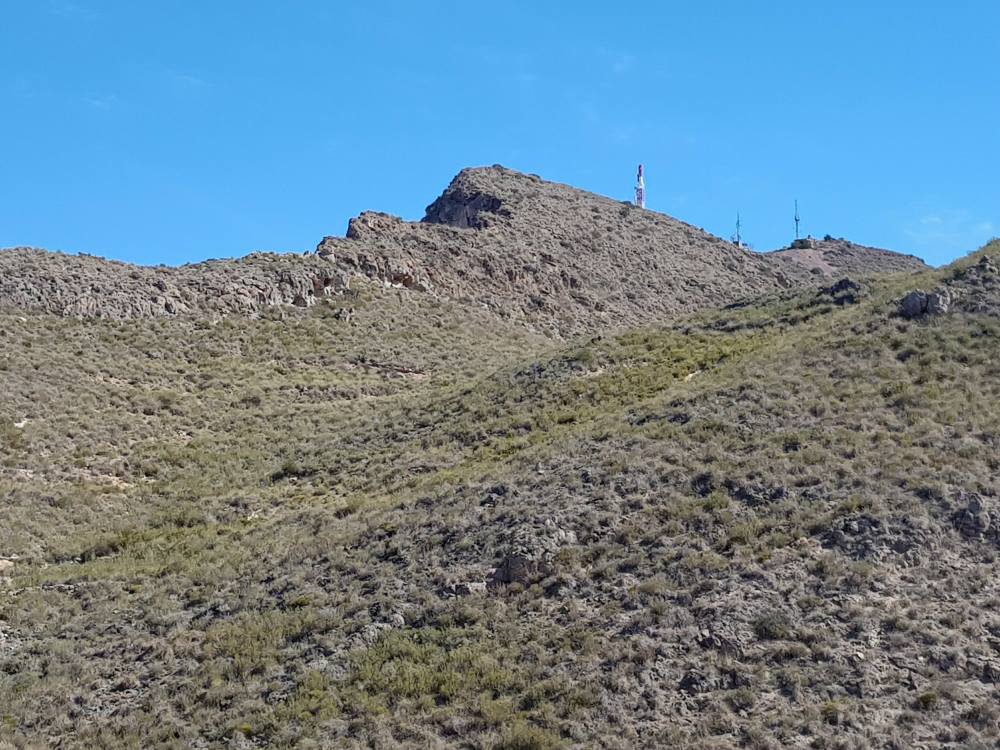
 This is a fine weather walk we have only carried out once before, many years ago. We started at Santa Elena tower on a headland three miles opposite the campsite, hopefully visible in the following longshot photo.

The tower was a watchtower to spot pirates that roamed the Med many years ago. It’s quite sturdy, with the entrance 20 feet off the ground for extra security. Not a popular chap if you forgot the ladder!


The tower soon disappears from view rounding the other side of the headland. The path is rough, with loose stones, and cuts across a steep slope.

This is where you’d end up if you slipped on the stringy grass, lethal in the wet but navigable with care today.

It’s barely a donkey track but is part of walking trail GR92. Usually these are well marked with paint stripes on adjacent rocks to confirm the path, but nothing much here. Some of the scrambles are becoming steeper and covered in looses scree so easy to skid on.

A surprise looking down at the next rocky bay: what appears to be the remains of a dwelling. A beautiful, quiet location – you could maybe live on fish, but what about the weekly bin collection.

The path then turned inland, away from the precipitous plummets to the sea, but time for a quick atmospheric seascape photo before we turn away.

The transmitter masts are at the highest point but we headed for the saddle to the left where the path drops back down to civilisation.

Here’s the view from the saddle before heading down. It was still careful going on the track, but gravity was helping now so we were back in time for lunch.


Friday, 31 March 2023

France & Spain Mar 2023

 Start: Thursday 9th March

The first blog is late this year, for no good reason! We’ll be staying at our usual campsite, Los Madriles, so blogs will be posted only for anything different that we do to avoid a repetition of previous years. 

A moderate covering of snow on the car and caravan starting from home, but the forecast says we will run out of it as we head south. By the Dartford Crossing it’s gone. 

Strong coastal winds are forecast for tomorrow, Friday, so we will take the inland motorway route through France. We arrive at a farm site near St Quentin, for two nights. The extra day is to shop for the fresh fruit, veg and meat we now can’t take from home because of Brexit. The latest forecast for wind gusts inland don’t sound too safe for towing anyway. 

The farmer was most helpful; because the ground was soggy he let us stay in the farmyard. Just an ordinary but peaceful farmyard, as the photo shows. Not a rooster in sight (or sound).

Our route continued past Dijon and Lyon to the French Med.. We rested for a couple of days near Montpellier. The site was on a large estate rather gone to seed as this photo of the big house shows.

However, the walking paths through the woods were excellent and well marked. We came across an aqueduct that was built in the 17th century to take water to the castle in the centre of the small town of Castries close by. It is stated to be the largest private water system constructed in France.

Next stop Cambrils, 80 miles south of Barcelona. The campsite led directly onto the beach and the weather had turned warm so we decided to stay for several days that turned into a week. The beach is a series of horse-shoe bays like the one in the photo.

Much in evidence were flocks of parakeets, escapees from captivity. They can overwhelm resident species, so it’s as well not to be too carried away by their cuteness. Just like the grey squirrels in the UK.

The town of Cambrils is unremarkable but pleasant, with few high-rise buildings . Walking from the campsite away from the town we were soon on dirt roads and scrubland. This is typical.

Coming across a disused railway bridge in the middle of nowhere we were amazed to find some exceptional quality artwork painted on the bridge concrete support pillars. The following two photos are examples.


Next stage on the journey is to Calpe, not far from our final destination. Calpe is famous for its rock, not as in the lettering thorough the middle like Blackpool rock, but for its imposing size and nature reserve status.

Nice beach, too, but it’s a mini Benidorm when you look the other way towards the high rise apartments and hotels. No “Tea Like Mother Makes” cafes though, just high class restaurants.

The old town, however, is charming, The first building in this colourful alley displays a classy mural.

The part of the mural just out of camera is worth a closer look because it’s a 3D galleon. High quality work.

This town square is typical old Spain, the blue and white colours harking back to the occupation by the Moors (Arabs).

We see more paintings on buildings as we walk around; this one covers the complete side of a large edifice and depicts a Moorish town floating on a magic carpet platform with a couple more buildings underneath. But no “Sinbad  woz ‘ere” signature.

Back in the new town, health and safety falls far short of UK standards. This guy is part of a team painting a tall block of flats, each painter being sat on a wooden seat like a child’s swing, suspended from ropes at the top that haul him up or down as required. 

Near the rock was a large, shallow lake used from Roman times until 1988 for extracting salt by evaporation. Now it serves to attract migratory birds. This flamingo was close enough to make a nice photo.

No mention yet of the campsite. Very well run and beautifully clean, with large but expensive pitches. Now spot the elephant in the room!

It’s a tower block under construction, appearing to grow out of our caravan roof. In reality it’s just beyond the camp boundary, and work proceeded all day, every day. A long-term Brit we talked to said that you just get used to it. Is that so? Time to move on!