Tuesday, 26 March 2024

Monday 18th March: Seville

 There is only one campsite convenient for Seville, in a suburb with a frequent and cheap bus service. Because of its monopoly, the campsite really packs ‘em in.

Campers use the site to visit Seville and the surrounding area then move on: no long-stay campers here. However, it’s quiet at night, and we got this reasonable end pitch:

So, having used the perfect bus service, here we are taking the short walk from the terminus to the historic centre of Seville. We come to the second largest building in Spain, after the Escorial Palace near Madrid. The enormous edifice  now houses the university, and is as long to the left of the entrance, which isn’t visible, as to the right that is shown on the photo:
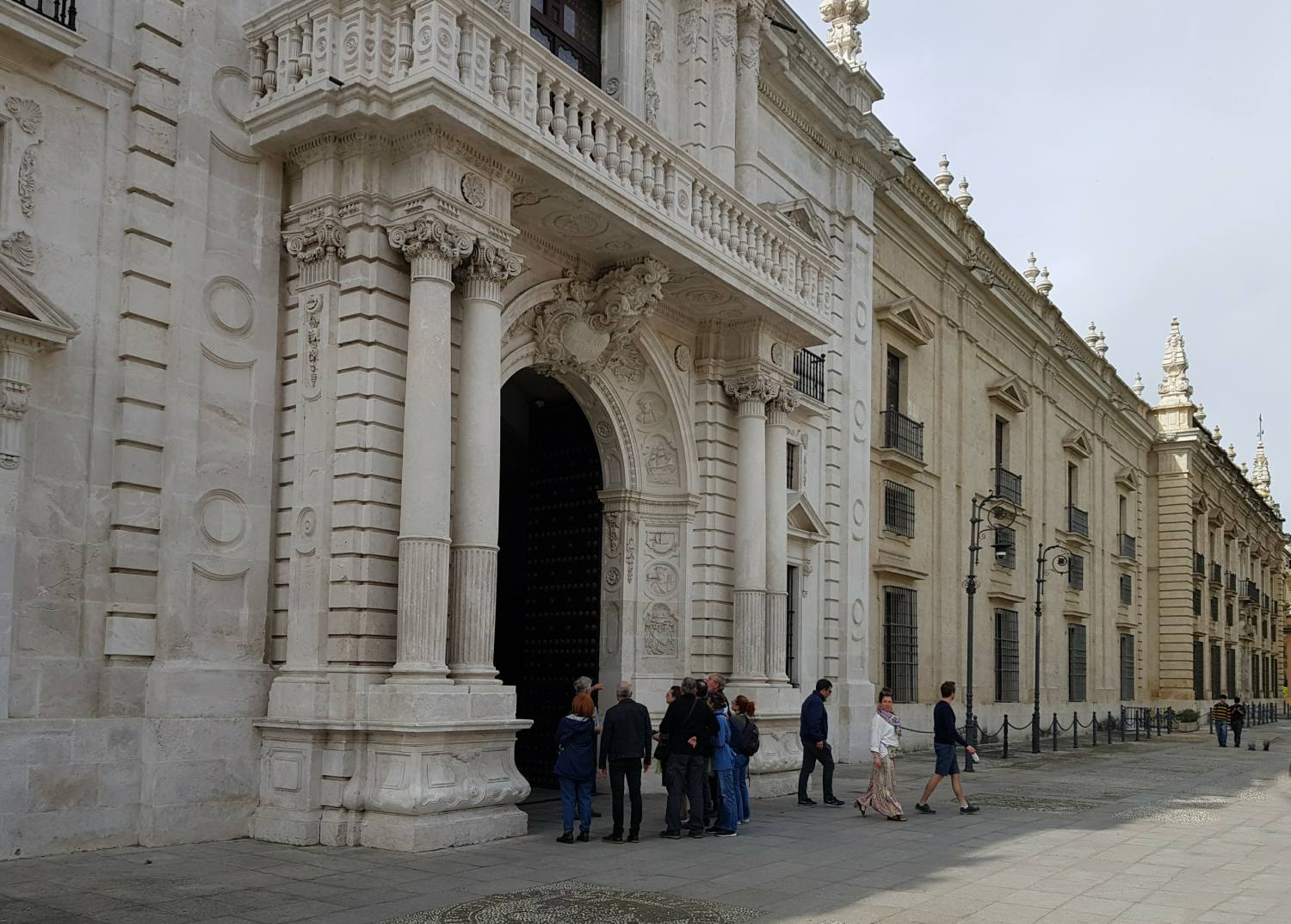
It seems anyone can wander in, which we did, where it’s much less austere, with pleasant courtyards
and patios:

It was formerly a cigar factory, and the building’s forever claim to fame is that it was Carmen’s place of work in Bizet’s opera of that name. You enter the building half expecting, to hear the stirring Toreador song, but I’m sure today’s  anti-smoking lobby would prefer Alan Smethurst’s  (the Singing Postman) “Have you got a loit boy”. The compromise is silence.


Next we pass the superluxury hotel Alfonso Xiii. The hotel was built to accommodate top visitors such as heads of state attending a grand exhibition planned for 1929. The exhibition never happened because of the Wall Street crash. King Alfonso Xiii was also a disaster and abdicated after a short reign.

Street performers start to appear in the square leading to the cathedral, some worth watching, some not. Here we have a flamenco dancer whose shawl is magically produced from the litter bin behind. Who says the camera never lies?

The huge cathedral is impressive from any angle, inside or out. It was blogged in detail in 2020, together with its integral Giralda tower, so we didn’t visit again, but the stunning architectural detail has to be worth another photo:

So what’s this shop all about? We never did find out. Cannabis is nominally illegal in Spain but apparently tolerated. Anyway, we couldn’t fit a plant that size into the caravan.

In another square there is a protest that became much noisier later. Nothing to do with big politics e.g. Ukraine or Gaza, but employees of the Public Buildings Authority who are objecting to plans to privatise the cleaning services. Just as in the UK, they can’t see any advantage.

Good Friday is next week and all towns are getting ready for big parades. In Seville, unsurprisingly, it’s big time. Religious banners are going up everywhere, routes being laid out and seating installed. Practically all shops have religious effigies reflecting their support for “Semana Santa”. Here’s an example, and we perhaps ought not to be too judgemental.

Just off the centre is the museum, by way of contrast a modern design but pleasing nonetheless. Its canopy spans the museum building itself and then the whole road.

We head for the Casa de Pilato, a grand mansion of the early 16th century. It is a mixture of Moorish and European styles. The front façade sums it up: 

The inner courtyard looks completely Moorish, like a Moroccan palace. The idea is to create a cool and shady atmosphere in the extreme summer temperatures, particularly as Seville is the warmest city in Europe.

Inside we observe restorers at work. It’s really painstaking – and look at that detailed ceiling! Stiff necks and a hot bath for the whole team after a day’s work, I’m sure.

And look at this for another ceiling! Why was so much effort and cost expended on these intricate ceilings – how much did these people drink?

Most of the walls are covered in small, highly patterned tiles. The cost, time and expertise must have been enormous.

Another intricate design, covering half a wall. Their patience and skill was unimaginable.

Now here’s an odd one to finish – a portrait in the classical style of a couple holding their child. It’s entitled  “The Bearded Lady”! So, we are to assume that dad is in the background and bearded mum is holding the child. It has to be said that, even clean shaven, mum would still look very masculine. They both look too old to have kids anyway. Why didn’t the artist go the whole hog and paint a bearded baby as well?

So goodbye to Don Pilato, and we head back to the bus terminus. Soon back to our sardine campsite and sit out for an hour – it’s plenty warm enough, 26 degrees C or so. Tomorrow we visit Cadiz.




Monday, 18 March 2024

Tuesday 12th March: Burgos then Monfrague

 Burgos is a one-nighter, and we’ve stayed here before. It’s pleasant enough, set in a park by a river, but the site is rather run-down. As we had arrived early, we were able to sit out for an hour in the warm sun and then walk by the river: a good wind-down after the drive. 

Burgos is 2,800 feet above sea level so, despite the warm sun on our arrival, there was an overnight frost. It soon warmed up as we got under way. Our destination is Monfrague. This isn’t a town, but a national park containing a peaceful campsite. We stayed here some 10 years ago and, by chance, bagged the very same pitch overlooking a sheep field.

It could almost pass for a piece of England, but many of the trees are cork oaks and there are some unusual birds like the azure winged magpie. These travel in large flocks and appear late afternoon. This is one close-up:

The park visitor centre next to the campsite, all free, provides information on the wildlife to be found in the park - some of it in English, even more helpfully. The extensive nature trail outside carries on with more info boards. The animals and birds don’t generally stay around to be ID’d  but we enjoyed some pretty flowers, for example this little orchid:

The  views are spectacular too, looking towards the still snow-capped mountains in the distance.

Walking back to our pitch, we spot another resident of the area – the stork. Their nests are found on pylons, poles and masts everywhere. They’re really numerous, and present all year round. Goodness knows what the birth rate is like in this area!

We shop in the nearest small town of Plasencia, and then go on to the focal point of the park – the Salto de Gitano, the Gypsy’s Leap. This is a rocky defile in the river Tajo, on its way to the sea at Lisbon, Portugal.

The far cliff is home to hundreds of vultures, more visible in the next photo:

Close-up, with a bigger lens, these are seen to be griffon vultures with a wingspan of around 10 feet. There’s also a  slightly larger resident in the park, the black vulture but we didn’t any today. 

Next stop a hermitage and 12th century castle ruins dating back to the Moorish occupation. Thankfully, as the day has turned warm, we can drive most of the way up. It’s not as amazingly impressive as we imagined, particularly with the modern chapel tacked on the end. 

However, the views are spectacular, looking down over the Tajo, and Jane with binoculars in hand:

To finish, a view towards the other direction, unfortunately blocked by two cheesy faces. We rarely allow ourselves the indulgence of a selfie – you can perhaps appreciate why!

We’ve had a really super relaxing time here at Monfrague and tomorrow it’s into the hectic tourist world of Seville.


Tuesday, 12 March 2024

France & Spain Mar 2024

 Start: Thursday 7th March 

We’re on the road at last: we had planned to leave two weeks ago but were waiting for the results of a medical examination that, fortunately, proved to be benign. 

Our route so far this year has taken us down the western side of France. Our first stop was Abbeville, where we stayed an extra day to stock up with goods we cannot take since Brexit. 

We also needed to settle a medical bill from last year. This was shown as payable via the internet, but wasn’t recognised. It was also shown as payable at any public finance office, so here we are at the public finance office in Abbeville. The cashier is shaking her head. “Non, monsieur, you must pay this at Tour where you received the treatment”. But, I point out, it says on the bill “any public finance office.” You must stand your ground with officialdom, politely of course. The cashier now needs to consult the next management level up, and after 10 minutes she returns with management level up who scrutinises us as to whether we are deemed worthy of squaring the account. She nods to the cashier, so we have passed muster. Payment is made, and we leave with a receipt as evidence against being criminally excluded from France in the future. 

However, the journey is going well and today, Monday, we are camped on the Spanish border. Don’t assume it’s now all shorts and sunshine weather because we’re in the rain shadow of the Pyrenees, but are happy campers nonetheless and heading to Burgos in Spain tomorrow.


Monday, 5 June 2023

Burgos: 22nd May 2023

 Burgos was one day’s drive from Cuenca, and the campsite within walking distance of the old city. The campsite is pleasantly set in a park and this was our pitch.


The photo is somewhat misleading because each night the site is filled to capacity before 6:00 pm because it serves as a convenient overnight stay for those catching the Bilbao or Santander sea crossings.

Burgos is quite high up, about 3,000 ft, so quite cool at night – but cold enough for snow?


Not quite! It’s the cotton-wool type seeds from the plane trees. So into Burgos without anymore ado. This is the magnificent 11th Century gateway that leads into the old town.


Straight into the cathedral square, dominated of course by the 13th century cathedral said to be one of the finest in Span.


Now cathedrals, however magnificent, tend to merge into one another in blog descriptions. But here’s something unique to Burgos – Papamosca’s clock. Papmosca’s job is to ring the hours by hitting the bell, a mechanical wonder in the 16th century when the clock was built and when awareness of precise time was only just beginning. It even has minutes on the dial.


Of course, the magnificence and detail of the various gold leaf alterpieces is astounding, and the effort to create them unbelievable.


In close-up, below, even more amazing.


The gold threadwork of the bishops robe is beautifully executed: that’s Jane’s judgement, which is far more relevant than mine.


This bishops tomb is a study in beautifully carved marble.


We noticed a large painting on the wall, in front of the carved bishop’s feet: Christ taken from the cross, lying in a heap on the bare earth wearing just a loincloth. It is difficult to reconcile the image in that painting with the opulence being displayed throughout the rest of the cathedral.

This is unusual, a twin staircase straight out of a Fred Astaire Hollywood movie. A bit older than Fred, though, built 1518 to 1523.


Now this is what you call a bike-lock, maybe even be heavier than the bike itself.

The ceiling here, of which this is just a small part, is absolutely teeming with angels, cherubim, seraphim etc. Looks like Heavenly League supporters pouring out of the stadium after a match.


The whole cathedral complex was decorated in great detail, certainly enhanced by restoration work. That is an unresolved debate – how much do you restore old buildings before they lose their authenticity. The entrance way shown below is a good example.


 last one of the enclosed quadrangle, with Jane. These always take atmospheric photos with sunlight streaming through.


Back out in the real world, we walked past this modest dwelling, totally transformed by flowerpots.


Quite a few pretty houses around the cathedral square, but nothing like the numbers, or even the feeling of antiquity as in the city of Cuenca.

 In summary, like the campsite, worth a stopover if it’s on your route but not as must-see as other places we’ve visited.


Tuesday, 30 May 2023

Cuenca City

Cuenca is really two cities. The lower town is the modern half; the old city is perched high up with precipices on two sides. It has Roman roots and was occupied by the Moors, but until the reconquest by the Christians in 1177, its history is vague. The castle dominates the highest part, and the city developed downwards from there into the layout we see today. The photo underneath was taken from the castle and shows the city’s dramatic position on the cliff edge.


We parked by the castle as it was free. Free, that is, apart from a scruffy man who claimed to be the attendant. Worth a couple of euros to make sure your tyres weren’t let down. So down we go through the town gate into old town.


Lots of medieval alleyways like this, generously adorned with religious images as befits a Catholic country.


We were following the path down, just alongside the cliff edge. The houses were very tall in some places, 5 or 6 storeys high. The flimsy wooden supports upholding this house are set in modern concrete, but how safe would you feel in past times?

We arrived at the footbridge that spans the gorge. The building on the opposite side was a Dominican convent, dating from the 16th century. It is now a Parador, one of a chain of hotels run by the Spanish government in old and historic premises. What a great way to preserve fine buildings that would otherwise go to rack and ruin.


We walked across the bridge and on the way back took in the fine view of some of Cuenca’s famous “hanging houses” (casas colgadas). The balconies look the most at risk. The nearer balconies belong to a restaurant, so you could experience a “death by chocolate” dessert in more ways than one!


We head for a lunch of tapas in the central square, sitting under one of the umbrella sunshades. The air temperature is cooler up here but the direct sun is powerfully intense.


Our last bit of sightseeing for the day is the cathedral, which is entered through the central square.


It was started in 1183, soon after the reconquest from the Moors, and was the first Gothic cathedral in Spain. It was constructed on the site of the great mosque, of which there is little remaining evidence. The central courtyard with its fountain is perhaps a connection with those times as Arab planners would always feature water in their important buildings.


Otherwise, the interior is relatively unremarkable compared to the great cathedrals of Spain. But here is a beautifully worked geometric ceiling worth showing. In many of the great medieval buildings of Europe, ceilings and upper parts contain the most intricate work of carvings, statues and paintings, which are difficult to view because of their high location. Maybe you got the best view after an over- generous helping of communion wine.


Now plod back up the hill to the castle car park. On the way, we noticed on a church wall, an example of these strange elongated figures that we have seen in many locations in Spain, religious and otherwise.


Nearly back at the car park we found a large gathering of bikers who clearly see the twisting roads in the vicinity as an interesting challenge ride and meet up here either during or afterwards. There was also a gay wedding celebration centred on the cafes near the castle, but we thought it too intrusive to take photos, so you’ll have to make do with the bikers.


Before getting back into the car (tyres all fully inflated!), we looked up the gorge away from the direction of the city, into the wild back countryside. It’s picturesque and inviting on a lovely spring day but in wintertime must have been a bitter, hash environment for the inhabitants in past times. 


So that’s Cuenca, most interesting, and highly recommended for a visit.