Tuesday, 31 March 2009

March 27th to 31st: Moulay Bousselham


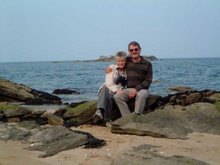
We moved today from Marrakech 300 miles north to our last port of call in Morocco. The campsite is by a lagoon that connects with the sea at the village of Moulay Bousselham, where there is a fine sandy beach. The village takes its’ name from a 10th century holy man and is a place of pilgrimage as well as being a weekend resort favoured by wealthier Moroccans.

We did, by the way, solve the mystery of the half-finished buildings, mostly dwellings. It seems that Moroccans typically build their own houses by saving up and doing it a bit at a time, and it might take 10 or 15 years to complete. They don’t have a mortgage system as borrowing and interest are frowned on for religious reasons.

Had to include this last shot of an unfinished house, only to show the scaffolding system generally used. They obviously need to get through this stage of construction fairly quickly, at least before woodworm sets in!

Thanks, Morocco, it was wonderful!

Sunday, 29 March 2009

26 March; Operation Overload

These photos show just some of the overloads and dangerous loads we saw, certainly not the most extreme examples, as you rarely have the camera ready at the right moment.


The most dangerous load that we saw was carried by a moped, weaving at high speed through the souks. The moped passenger was a youth holding a large sheet of glass (4ft by 3ft ish), flat face forward, with his bare hands. The most burdensome load was a woman carrying a 15kg gas bottle on her head.

24 March: Tourist Marrakech.


The large central square in the Medina (old town) comes alive after dusk with a host of performers: African bands, snake charmers, acrobats, storytellers, food stalls etc. They all collect money for watching the performance or taking photos and all ask for ridiculous amounts initially. The group here wanted the equivalent of £4 for a few snaps, but we only gave what we thought was reasonable, so they got £1 (10 dirhams).

The picture above is of the interior of a madersa, a Koran school. This one was refurbished in the 1560’s and is covered with intricate designs and, overall, gives the impression of great peace and harmony. Experts think that the same craftsmen worked on this building as worked on the Alhambra Palace in Granada, Spain.

The El Badi Palace (was there an el Goodi?) dates from the same period as the madersa, but is now a ruin. Above, Jane takes the part of the ghost doomed to perpetually wander the crumbling subterranean passages. The photo below is of the icon of Marrakech, the Koutoubia Minaret, completed in the 12th century, and visible for miles, given the absence of tall buildings here.

23 March: The High Atlas

These are the highest mountains in North Africa and rise steeply from the plain, 30 miles south of Marrakech. On this particular route into the High Atlas, the road runs out at the village of Imlil (alt. 5,700 ft.). It’s a trekking centre so you can continue on good tracks by mule, on foot, or 4X4.

We carried on walking a short way up the path toward Djebel Toubcal, the highest peak at 13,681 ft., avoiding the guides touting for hire and even guides who’ll find you guides!

21 March: Visitors

We picked up Ralph and Gemma this morning from the airport. They had booked accommodation in a small riad, a building constructed around a courtyard, usually an open courtyard. Charming and very Moroccan, as you can see.

Slight problem: the riad is somewhere in the souks. A souk is a market, and in Marrakech these are huge and located in labyrinthine streets and alleys that are largely un-signed. It takes us an hour to find it, asking directions many times and fending off numerous traders and peddlers. As the crow flies we have covered about 300 metres.

The souks are an almost overwhelming experience of shops and people, crammed in together, all busying themselves with hustling, selling, bargaining, browsing, passing through, or just waiting. It’s a hubbub of people, but when you look hard there are not many transactions being finalised: like Tangier port it’s superficial bustling about without much end product. What it does is give purpose to the trader’s day as he works persistently and at great length at prising money from passers-by, be it only occasionally successfully.

Sunday, 22 March 2009

19 March: Marrakech


We moved camp yesterday to Marrakech- this is us en route- and are staying 7 miles from the city centre. Marrakech is a hectic place to drive in with little lane discipline. Bikes, mopeds, donkey carts etc. weave in & out, and there’s double-parking everywhere. Traffic police with whistles stand at all major road junctions attempting a veneer of control. But against all expectations the vehicles keep moving.
It sounds like a nightmare, but actually isn’t, for one fundamental reason – very little aggression on the part of Moroccan road-users. Maybe we UK drivers could learn something here.

Today we visited the Jardin Majorelle, a garden named after its French designer Jacques Majorelle and now owned by fashion designer Yves Saint Laurent. It is beautifully elegant, like the haute couture of Yves Saint Laurent, but in practical enjoyment terms can’t compare to a lawn with a marigold border or a row of broad beans on the allotment.

16 March: to Tafraoute


Tafroute is a small town in the middle of the Anti-Atlas mountains. It is in a beautiful setting and a centre for walking tours. The scenery en route was spectacular and worth the 7 hour round trip. The town itself is very laid back, as the photo shows!

Tafraoute is surrounded by large rock formations: this one is called Napoleon’s Hat.