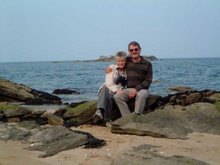
Wednesday, 31 March 2010

March 22nd: The Alhambra

The Alhambra Palace is part of a huge walled complex that was started in the 9th century with the building of a defensive fort, the Alcazaba, that occupies a commanding position on a rocky headland directly overlooking the city of Granada. Jane, on the bench, is playing the part of the weary and confused American tourist. "I'm real sure it's Edinburgh castle...."

The bell on the highest tower in the Alcazaba was used to signal the market gardens below when it was time to change the water flow in the irrigation channels. The Moors had sophisticated water management systems that continued after they were deposed, in some cases right up to modern times.

The Alhambra palace was built by the Nasrids, the ruling dynasty,in the 13th century as a massive castle, close to the Alcazaba fort but separated by a deep ravine that has now been filled in. The palace was repeatedly improved and refined right up to the end of the Moors’ occupation in 1492. The lion courtyard below shows the typical quality and harmony of the buildings.

A close-up of some carving demonstrates the overall superb workmanship.

Water was used extensively in Moorish design to promote peace and relaxation, and the photo below shows one of many examples of its’ use. The water was green and murky but did support goldfish so you would probably survive if you fell in.

As large as the palace is today, only a part of it is left. Carlos V, the grandson of Ferdinand and Isabella who ousted the Moors, demolished large areas of it to build his own palace. He no doubt felt that he needed to make his own statement. The photo shows the circular interior courtyard looking very much like a bullring. Actually for many years it was used as a bullring. Carlos’ palace is solid and imposing but looks crude in comparison with the design and decoration of the Alhambra.

The remaining area of the walled perimeter is now filled with gardens and a 5* hotel, but at its peak it housed a town of some 40,000 inhabitants. There are a few foundations left of the dwellings but it’s difficult to imagine where they would all have fitted in.

The Generalife
We’re not finished yet! The Nasrids also built a summer palace called the Generalife on an adjoining rocky outcrop. I can’t quite see why the Caliph built his summer palace just round the corner as the climate is hardly going to be any different, but maybe he liked to wave to the folks left behind. Anyway you didn’t question the Caliph’s decisions. The end result, though, is very beautiful, and the gardens and water features emanate peace and tranquillity.

Unfortunately, at the time we were there, the gardens were overrun by a party of unruly French school children and a large Japanese guided tour, so peace and tranquillity was not the association we were left with!

Saturday, 27 March 2010

March 22nd: Granada 2


Granada has a large Gitano, or gypsy, population many of whom still live in caves in the hillside on the eastern edge of town. It isn’t quite as Flintstone as you might imagine because the caves mostly have a house type frontage with rooms quarried out of the rock behind, as per the photo above. The Gitanos have a strong flamenco tradition and have produced some world-class performers in guitar and dance. Capitalising on their reputation, some of the caves have been converted into flamenco clubs but tourists are warned to beware of being fleeced for a second-rate performance at inflated prices.

There also appear to be a number of alternative lifestyle folks around so we were not surprised to see someone taking their pig for a walk. The pig was clearly keen for some petting and rolled over for a passer-by to scratch its’ head.

This attractive cobbled walk along the river leads out of town towards the Gypsies’ caves with the old Moorish quarter on the hill to the left and the steep crag of the Alhambra on the right. The Moorish quarter doesn’t contain many original arab-style buildings but is a maze of narrow alleys, and as it climbs up presents great views of the city, the Alhambra and the Sierra Nevada Mountains.

Friday, 26 March 2010

March 18th: Granada 1


Granada was the last stronghold of the Moors and held out until 1492 when King Fernando and Queen Isabella of Spain expelled them. Apparently Fernando was the handsome part of the duo and Isabella did the thinking. The picture shows the outside of their tomb: we went inside but there are no photos allowed. It is very grand and impressive with a massive carved marble tomb, intricate gilded altar and wrought iron altar screen, but lacks the beauty and harmony of similar tombs we saw in Italy last autumn.
Isabella died in 1505 and left instructions that a candle should be left burning for her in perpetuity. Being the acclaimed heroine of all Spain, this wish was followed to the letter- that is, until some time in the 1980s, when an electric light bulb replaced the candle! Despite numerous protests, it took 10 years before the candle was restored.

This is Convento de San Jeronimo, a beautiful building surrounded by orange trees. It was founded by Fernando and Isabella but not built until after their deaths. It is still an operating convent today. But hang on, I’m puzzled here, and I know the spelling is slightly different, but wasn’t Geronimo an Apache Indian chief?

This is one of the many guitar shops in Cuesta de Gomerez, or “Guitar Street” as it is known. They are not just shops but workshops and make the guitars on the premises. They have a reputation for high quality. The shops were closed as it was early afternoon (i.e. siesta) so I couldn’t go in for a closer look, but the lack of price tickets in any of the shop windows indicated premium prices.

March 16th: Arrival at Granada


The site is 10 miles from Granada and fairly new. It is terraced and has stunning views over the Sierra Nevada, Spain’s highest mainland mountain range. Although the camp is at an altitude of about 3,500 feet, as you can see it was warm enough to sit out in summer gear and admire the view. That’s a sapling, by the way, not a fishing rod at the side of Jane.

The site organises a free trip into the local Natural Park once a week in 4 X 4’s. This was the day after we arrived, so we went. The 4X4 took us along some dirt roads with sheer drops but lovely views over the mountains and ended at an abandoned quarry. The rock mined was stark white as the photo shows and was turned into gravel chips for a multitude of uses including road building. The whole area underfoot comprised these gravel chips making it look like a pure white beach.

Sunday, 21 March 2010

March 16th: Portugese Odds and Ends

Here are the few odd items that didn’t fit into the other blogs.

Chapel of Bones

In the town of Alcantarilha was a chapel with walls, floor and ceiling made of human bones. These were dug up from the church graveyard several hundred years ago when it became full. As far as I could discover there was no more to it than that. It made a gruesome sight, but the occupants all looked happy enough and I did check the photos afterwards for “red-eye” in case one of them gave me a cheeky wink.

Cork Harvesting

The last inland walk took us past lots of stripped cork oaks. The number 8 in white indicates that these trees were de-barked in 2008 so the grower knows they need doing again in 2017, i.e. every 9th year. It seems that, despite the plastic revolution, the market for cork is as strong as ever and we saw in the local shops cork wallets, shoes, handbags, skirts even. It’s obviously a more robust material than you think. The heap below is a typical pile of cork bark.


Ajulejos

This is an example of Portuguese blue tile panels found everywhere, azul being the Portuguese word for blue. You may recall the photo from the disused nunnery in an earlier blog. The tiles are still being produced in a great variety and most houses seem to have at least one feature block of them, usually quite a classy enhancement. They also appear in volume in souvenir shops where the artistic value is more questionable.

Portuguese Language
In written form the vocabulary is similar to Spanish so you can make a fair stab at the meaning if you know some Spanish. There, the similarity ends: the pronunciation is nothing like, and sounds more like Russian to me than Spanish. The main sound effect is caused by the letter “s” being mainly pronounced as “sh”, for example 6 coffees= seis galaus, pronounced “saysh galawsh”. Fit your teeth with anti-spray guards before attempting!

On the whole Portugal was very interesting, especially the walking where we were lucky enough to be included in an experienced group. Parts of the coast are like Spain, very touristy. We could have been luckier with the weather but I think that would have applied to most of Europe. And now back to España.

Friday, 19 March 2010

March 15th: The Last Walk

No, this isn’t a piece on capital punishment: we’re leaving Portugal tomorrow for Granada, and this is our final trek. The walk starts 40 miles inland and well away from the tourist coastal strip.

You see we’ve bonded into quite a team! We made stepping-stones four times to get across swollen rivers and on only one occasion did anyone get wet feet. The problem was that stones lying around on the riverbank are mostly irregular in shape, so the “stepping-stones” are really piles of wobbly small rocks.

This was a typical settlement, part of which has been modernised. The number of derelict buildings behind housed people who eked out a living on the land in former times. With a view like this I'm sure they will eventually be restored as second homes

At the highest point of the walk was a former windmill that is now a Buddhist monastery. The flags are prayer flags written in an indecipherable script – presumably Tibetan? There was also a shrine where fruit offerings are left each day. We didn’t however see any monks, only a digger making a bigger accessible area around the fruit shrine. From the monastery, the rough path ran straight down steeply to the road where we had parked the cars.

Sunday, 14 March 2010

March 12th: To the Top of the Algarve.

Foia, at 902 metres, is the highest mountain in southern Portugal and was our destination. The walk started from Monchique, a small spa town, and we sallied forth on a steep cobbled path leading past an abandoned nunnery.

Actually, the nunnery wasn’t abandoned at all because it was occupied by squatters: friendly squatters who invited us inside for a look. It was in a ruinous state, as were the squatters, but handsome in its’ proportions as the following photo shows.

One feature unexpectedly still nearly intact in the nunnery was this blue tiled panel. Blue tile scenes are found everywhere in the Algarve including churches, but ancient ones do have a second-hand value and it is surprising that the squatters hadn’t sold the panel on Monchique market. Still, it’ll be a nice feature for our bathroom.

We were treated to some wonderful views as we progressed upwards. Foia isn’t part of a mountain range, so the view is virtually 360 degrees from the top with both the south and west coasts of Portugal visible.

As a consequence of it being the highest summit, the top is crammed full of masts of every description and an area of military aerials that was off-limits. The big mast in the centre could almost be a rocket. Also at the top were a modern hotel, restaurant, café and gift shop and a big car park: not everybody is daft enough to walk to the top.

We went down a different way, through lots of brambles. The photo shows one of the easier sections and, as you can see, Jane and Derek are in good spirits. There were numerous wild flowers out, like irises and banks of primroses, so there were compensations for the scratches!

And bringing up the rear: a picturesque waterfall. When we arrived back in Monchique, Derek popped into an ironmongers to buy a mousetrap (not sure why he needed one). After paying for the mousetrap, the proprietor wouldn’t let him leave without taking a glass of the local jungle juice, a potent 90% proof spirit called medronho.Evidently this week’s special offer, with every mousetrap.