Monday, 11 March 2013

Monday 4th March: to Miami

It’s a 250 mile drive to our next campsite near Miami. The Miami area is a huge metropolis so we’re in dense traffic for the last 50 miles of the journey, even on the toll road.
The Florida toll road system is complicated. There are cash-only automatic booths that take only quarters (4 quarter coins in a dollar). So you need a load of these. Then you can pay a person at some booths: coins, notes, or plastic. But you can avoid this with a Sun-Pass. Here you set up an account, put credit in, and buy an electronic device that automatically identifies you at each toll stage and deducts the due amount from the credit in your account. That’s too complicated for short-term users like us, so we drive armed with quarters and notes. 
Never be too confident you’ve got it sussed! Motoring around Miami, an overhead road sign informs us that we are now being “billed by plate”. So they clock you between points by photographing your licence plate and then billing the registered owner. Which isn’t us as it’s a rented vehicle. However, a call to Cruise America confirms that they will pay the charges and we settle up at the end.  
We arrive in good time at the Miami-Dade County Larry and Penny Thompson Memorial Campground.  Plenty of room as you can see.
County and State sites are much cheaper than private sites but generally offer fewer facilities. This one’s pretty good and it’s got all the hook-ups, bathrooms and washing machines.
We did have a small problem at check-in. They had lost our booking so were given a temporary pitch the first night while they sorted it out. The campground is part of a pleasant County park next to the zoo, with walks set in lush foliage.
Florida is all about year round hot weather which in the Miami area, the southernmost tip, supports coconut palms. Falling coconuts are big enough to cause serious head injury, as demonstrated by Jane.

The coconut palms and posh marina in the background are on the edge of the Biscayne National Park that forms the upper part of the Florida Keys, a string of islands stretching for 80 miles, now connected by road.
The section of the park here consists of a set of mini islands joined by a path jutting 1½ miles out to sea. It’s lined by mangroves and small trees with numerous water birds like pelicans, herons, cormorants and even an osprey. Uncommon species, too, like the great crested flycatcher, anhinga, and yellow crowned night heron. It was a beautiful walk and nicely shaded from the hot sun.
Next, just some of the wildlife that was good enough to pose. Most creatures were too fleeting for the camera.
Alligator, Great blue heron, coot. Next a brown pelican.
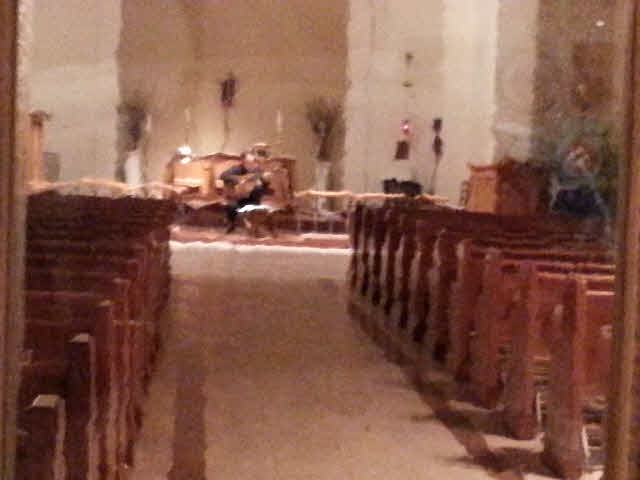
On our first day here we were fortunate in meeting a couple from Illinois who overwinter here. We hit it off right away with Lou and Machiko and passed some pleasant hours chatting in their motorhome. They also took us to a guitar concert held in a Spanish-style church near Miami. The soloist was classical guitarist Adam Holzman, someone I was not familiar with, but who turned out to be probably the best player I’ve heard. Naturally, photos were banned during the performance, but here’s a shot of him practicing beforehand taken through a stained glass panel that gives an unintended surreal effect.
We did discover that it would take four bus changes and 3 hours to get to Miami centre, so we didn’t. Not sensible to take the rv there either due to lack of suitable parking and dense traffic. Tomorrow we head for the Everglades National Park.


Sunday, 3 March 2013

Friday 1st March: Rocket Launch


There seems to be about one rocket launch a month from the Kennedy Space Complex. The one scheduled today at 10:10am is an unmanned Falcon 9 supply rocket. It is destined for the International Space Station which orbits at 370 km (230 miles) above the Earth. The capsule in the nose of the rocket contains the supplies, and when these have been unloaded (Big Macs, popcorn, Cokes etc.?) the nose cone will then return to Earth having been loaded with completed experiments and samples from the space station. And empty cans and packets.
We watched the launch from the Kennedy Space Centre Visitor Center and were patched in to launch control. We’ve all heard it before, but it’s more exciting because you’re actually there: “Three minutes and counting.” Then, “… 3…2…1…zero. We have liftoff!”
 
A confession to make here- this isn’t one of my photos. From where we watched we couldn’t quite see the launchpad itself, and also my camera recorded only the extreme brightness of the rocket motor, and nothing else. This had all the drama of a photo of a 60 watt light bulb.
The Visitor Center has numerous exhibits, for example the rocket garden. Each rocket has an information plaque detailing its contribution to the space story.
Space travel isn’t for the claustrophobic. This Gemini nose cone sat on top of the rocket and contained two astronauts, side by side. They stayed in this cramped space for up to 2 weeks, in their seats the whole time. The Gemini project ran as part of the Apollo moon landing programme, to test the capsule’s capabilities, and also man’s durability, in space. It’s about 12 feet long (4 metres).
We also attended a talk given by a real astronaut. He had piloted the Space Shuttle in 1984, being previously a test pilot as many astronauts were. We learned some fascinating insights into personal aspects of space travel and weightlessness, as well as the broad brush of the overall Shuttle Programme.
You say you won’t fall for that gimmicky photo-shoot- but here we are with astronaut Jon McBride. Actually, one of his aides used our camera and there wasn’t a charge.
The two separate days we spent at the Kennedy Space Complex were truly eye-opening. The whole experience was well organised and presented, and excellent value for money. Of course, there’s a lot of hype and flag waving, but the Americans have achievements to be proud of.
You pick up the mood and even the schmaltzy JFK fountain gives you a warm-hearted feeling as you leave, though you can’t be sure whether Jack is looking with visionary eyes at the heavens or imagining another sort of star!


Thursday, 28 February 2013

Sat 23rd Feb: Kennedy Space Centre

The National Aeronautics and Space Administration (NASA) was created in 1958 to carry out the “peaceful exploration and use of space”. Presumably the word “peaceful” was inserted to remind the Russians that the word “military” could be substituted if necessary. 
The sharp end of the NASA space programme is the Kennedy Space Centre on the east coast of Florida, about 40 miles from our campsite. It is the rocket final assembly and launching complex, and is named after JFK whose enthusiastic support moved the programme forward dramatically in the 60’s, resulting in a moon landing in July 1969. Following on came the space shuttle programme, International Space Lab, Hubble Telescope and numerous satellite launches. There is now a huge commercial aspect to NASA’s operations. 
This is Guiness Book of Records country, so let’s start with one of the World’s largest buildings, the Vehicle Assembly Building. Every name here is reduced to an acronym, so it’s the VAB from now on, and here it is, as we saw it from the tour bus:
 
All the space vehicles are assembled and maintained inside this building and from here they are taken by crawler, a giant caterpillar tractor, to their designated launch pad. The VAB structure is 525 feet tall with an interior volume equal to nearly 4 times that of the Empire State Building in New York.  
The tour bus proceeds to the observation gantry, and we get off. This is the closest location allowed for launch viewing, and on those days it is closed to tourists. The main launch pad is LC39A, as seen from the observation gantry. The white dome on the left is for liquid oxygen storage, the one on the right for liquid nitrogen. These are rocket fuels.
We get off the bus again at the Apollo/Saturn V Center. The Apollo missions were the manned moon landings and Saturn V the rocket that propelled them there.
As a technical description of a fully loaded, 363 feet high, 2,750 tonne Saturn V rocket, I can do no better than copy this Google entry:  
The Saturn V (pronounced "Saturn Five") was an American rocket used by NASA's Apollo and Skylab programs from 1967 until 1973. A multistage liquid-fuelled launch vehicle, NASA launched 13 Saturn V’s from the Kennedy Space Centre, Florida with no loss of crew or payload. It remains the tallest, heaviest, and most powerful rocket ever brought to operational status and still holds the record for the heaviest launch vehicle payload.
 And here it is, the mighty Saturn V, totally impressive. Before being directed to the rocket itself, we were given a simulated countdown and launch in the very control room used for the Apollo moon missions. Very realistic and atmospheric.
The exhibits give some idea of the high risks and cramped conditions the astronauts endured. The re-entry capsule’s exterior shows burn marks from the extreme heat on re-entering the earth’s atmosphere. But you do have to stop yourself imagining a probe on the front and a shrill metallic voice screeching “exterminate!”
Equally prone to flights of imagination are some of the early space suits. Did space knights wear these for jousting?
This one must be for a fancy dress party, right down to the goldfish bowl helmet and bike reflectors!
Even the lunar landing model can’t escape an alternative interpretation. A DIY job for the local carnival. Ran out of nice strong cardboard, so finished off the base with gold foil Christmas wrapping paper. Design based roughly on Kellogs Corn Flakes toy.
These light-hearted asides aren’t meant to trivialise the awe-inspiring achievements of the space programme visionaries. We gained some understanding of the hazards, and of the courage of the men and women who made these journeys, and of the huge commitment in manpower and resources that made it possible. 
The bus took us back to the Visitor Center where there are many more exhibits and facilities to explore, a few of which we did. But that’s another story. We are returning for a further visit which will hopefully include a rocket launch. 


Monday, 25 February 2013

Wednesday 20th Feb: Airboat Ride

The first question many people would ask is, “what’s an airboat?” A photo of the smallest type, parked on land, best illustrates the basic design.
It’s a flat bottom boat driven from behind by an aircraft propeller encased in a frame for safety, like a fan. It has no keel, rudder or engine screw protruding in the water to get tangled in weeds or debris, so it can negotiate open water, swamp or waterlogged ground without breaking its stride.

Technical Notes
The tourist boats offered by all the airboat ride outfits seem to come in two sizes: 6 or 17 seats, both powered by the same beefy Continental 520 aircraft engine producing some 300 hp and capable of 45 plus mph. Racing airboats can reach 135 mph. Engine noise is high enough for the operators to provide us with ear defenders. Nobody used them.
Steering is based on aircraft principles with two rudders placed directly behind the propeller, swivelling the engine thrust to one side or other in order to make a turn. This can be a rapid skid turn, as our airboat pilot demonstrated.
 
 
We went with Boggy Creek Airboat Rides based at Lake Toho. This is one of their 17-seaters leaving the docking area for the swamps.
 We opt for a 6-seater excursion which is claimed to get  into more inaccessible parts of the swamp with close-up views of the wildlife. Whilst waiting for our departure slot, we get the baby alligator treatment. The object is, of course, to have your photo taken holding the alligator, which is quite docile and appealing.
We learn that the alligator’s 64 teeth replace themselves throughout its life and that it has little strength in the muscles used to open its jaws. The piece of tape holding the baby’s mouth shut is quite sufficient. However, once its jaws are open, the alligator can then exert a huge bite pressure. So keep that tape on!
Now we are in the swamp. In the airboat you sit almost on the surface of the swamp as the boat is so shallow, so it gives an impression of great speed when travelling flat out, much in excess of its true 45 mph. It’s too bumpy to take photos. This is us stopped to look at an alligator.
This is the alligator, an 8-footer according to the pilot/guide. He is very knowledgeable and points out osprey, bald eagle, wood stork, and ibis, just to mention a few. There are around 3,000 alligators on the lake and 1.5 million in Florida.
The swamp and lake water levels are now managed by dams and sluices within a range of 3 feet a year where previously it was some 10 feet. The vast lakes and swamps of central and southern Florida all eventually drain down into the biggest swamp of all, the Everglades, at the southern end of the State.
The guide’s eagle eyes spy a three banded watersnake partly out of the water on a lily pad. We half expect these dangerous creatures to suddenly launch themselves at us, but practically all wildlife will leave you alone as long as they don’t see you as a threat or dinner.
Speaking of dinner, a well-camouflaged limpkin has found a huge fresh water snail which he then vigorously repeatedly stabbbed with his long beak. A limpkin is a long-legged water bird with a metre wingspan, so we can guess the snail’s size at a huge 4 to 5 inches in diameter! Later, a Google search reveals that it is a Florida apple snail, the wold’s largest fresh water snail. Anyone for escargot and fries? Everything comes with fries in America.
The airboats might seem a tourist gimmick, but we got an inside look at a Florida swamp ecosystem in a most accessible way, and it made a very enjoyable and different day out.