Wednesday, 20 September 2017

Cedar City, Utah

Utah’s earliest white settlers were a group of Mormons who travelled into the uncharted West to avoid persecution. Led by Brigham Young, they settled in what is now Salt Lake City in 1847.

Young sought self sufficiency, which needed iron. Ore was discovered 250 miles south, and volunteers were enlisted to develop the area for an iron works. In 1851 the new settlers arrived where Cedar City now stands. But they needed an expert, and fortunately had one in Richard Harrison who was previously been superintendent of the world’s largest iron foundry in Liverpool. He came with the initial wave of settlers, and designed and built the first iron works. It produced its first iron from local ore on Sept 30th 1852. Some achievement, from a standing start!

The local Frontier Homestead Museum celebrates those early days with interesting memorabilia, if presented somewhat haphazardly.


Out the front is an 1920’s excavator used for scooping iron ore. I guess it could scoop almost anything. The machines were never used in the locality as the iron works unfortunately didn’t thrive, and closed in 1858.
Here’s a rickety wild west stagecoach demonstrating, if nothing else, how uncomfortable the ride must have been. Dangerous, too, as the stage has a bullet hole in the side.
And now a reconstructed settlers cabin from the late 19th Century. Jane thinks she could live in this just fine as it’s about the same size as our caravan back home. Also it’s more arrow-proof than our caravan, but no cassette loo. You don’t ask.

Because of the elevation here, over 5,000 feet, winters can be cold and snowy. A local inventor came up with a snowmobile in the 1940’s. Although it looks more like a midget submarine, apparently it did work and was a great success leading to the much more sophisticated machines of today.
Probably the most interesting exhibits were the dwellings of the Southern Native Americans. These are called wickiups, made from woven rushes, or bark, or branches in a variety of designs and sizes. These were used until  about a century ago. The museum examples don’t look as if they would offer much shelter in bad weather- or even good weather, come to that.
The pit houses of the Fremont peoples who lived in the area until the 13th century seem much more substantial. They were farmers and possessed sophisticated artifacts like pots and ornaments that have been found, but little is known about their culture, and we don’t know why they suddenly disappeared.
Cedar City is now pleasant smalltown America, complete with national fast food chains, shops and garages. However, the “Historic Center” has been preserved which contains its core of individuality.
Nearby is Kolob canyon. It’s rather overshadowed by its near neighbour Zion that we visited a few days ago,but it’s quite spectacular in its own right. There are some excellent walks within, as can be seen from this trailhead.
Moving up into the canyon itself, the 1000 foot red rock walls are very impressive.
Driving and climbing all the way to the end of the scenic 6 mile paved road is an overlook that puts you nearly level with the top of the walls. Description boards point out hidden valleys where streams feed dense stands of firs. Cougars have been spotted but no chance for casual visitors. It fact there wasn’t much wildlife beyond the occasional bird, rabbit, lizard and squirrel.
Unlike Zion, there were only a handful of cars, so we had a leisurely morning in yet another magnificent American scenic park. 


Monday, 18 September 2017

Zion Canyon National Park

Zion is a deadend canyon about 8 miles long. It has been occupied for thousands of years by man. First evidence is of primitive hunters, then from about 2,300 years ago came the farmers, the Ancestral Puebloan Indians. These disappeared around 1200 AD to be followed by the Southern Paiute Indians, and lastly Mormon settlers from the 1850’s. It is a harsh climate of great heat in the summer and cold winters but the canyon has a key feature in a desert area- water. The Virgin river runs along its whole length.

The Paiutes still claim affiliation with the Canyon based upon their occupation of the land for many centuries. This early photo shows a tribal member in traditional clothes and with hunting gear. He looks more at home in this environment than his descendants today who own and run (inefficiently) the Indian Peaks campsite where we’re staying.
 We visited Zion on a Sunday: it was packed. We queued to pay per car at the entry where the rangers directed us to the only car park, which was full. Thanks. A second consultation with the rangers revealed that there was plenty of parking in the small town adjacent and a free shuttle bus.
Back at the Visitor Centre some time later, courtesy of the free shuttle, we get a nice view of the entrance to the canyon.
Now we board another free shuttle bus to see the canyon itself. Private vehicles are prohibited because the single narrow access road would be totally clogged with visitors’ cars. The shuttle stops frequently at designated locations where you can alight and walk and sightsee.
At this stop we admired the peaks called the Three Patriarchs. Many of the names, including Zion itself, were given by the Mormons, so are Biblical.
Now we reach the canyon end, and get off again. It isn’t quite a dead-end as the Virgin river flows through a narrows in the rocks called a slot canyon.
Despite its constraints, a concrete path runs alongside the river for about a mile into the narrows. It’s even wheelchair friendly, the surface is so good. Note two things: Jane striding out along the path, and the green canyon wall. This is created by water seeping continuously out of fissures in the rock thereby creating a microclimate for plants and creatures. So it’s much more than just a slimy surface.
When the made-up path runs out it’s just the river. Hardy explorers can carry on walking up the river for another 12 miles, if you don’t mind wet feet. As you can see, some are doing so. However, the Park Authorities sternly warn that you need specialist footwear (can’t see any in the photo!) and check the weather forecast as flash floods can be lethal.
We make one more stop-off on the way back to see the view of the canyon featured in most brochures. It was a bit misty from the heat haze by this time of the afternoon but maybe that adds to the drama.
 Despite the crowds, Zion was beautiful and the weather perfect, if a little hot. We drove out easily with no queues and were back at the campsite within an hour. 


Saturday, 16 September 2017

Heading West: 4th Sept

The Washington to Las Vegas flight left at 6:30pm, so we chased the setting sun, landing at 8:30 local time. 5 hours flying in 4 time zones. On the plane it was noticeable how few lights indicated towns of any size until we were lining up for touch-down. Then suddenly, an explosion of light from The Strip made it seem we were landing in the middle of a giant funfair. In a way, I suppose we were.


We came to Vegas to pick up the camper, staying a few days to provision it and get used to the tail end of summer temperatures. Still too hot at max 115F (45C). Here’s our camper, all set to leave for the cooler mountains of Utah.
There is one main road from Vegas to Utah, so it’s busy. The speed limit is 80 mph, the highest we’ve so far seen in America, and the lorries mostly all travel at that speed. This kind of rig would often zoom past intimidatingly. The phrase, “not taking any prisoners”, comes to mind.
 It’s scrub desert with a background of stark mountains most of the way. Mile after mile.
The route cuts across the top corner of Arizona and then through the mountains into Utah. Literally, carved through the mountains.
Into Utah, the other side, the scenery is more dramatic still with the different colour rock formations.
Another hour now to Cedar City, our destination. The campsite is a few miles outside in an Indian reservation. However, we don’t see any Indians as the campsite is run by a few of the residents. They tell us that the Indians don’t take much interest in the campsite, which was built for them by the Government. There’s a lot of guilt about how the Indians were treated and dispossessed, so maybe sometimes they get given things they don’t really want. The site is in a pleasant location, but somewhat run-down. We’re the camper on the front left.
The walking is good at the back of the site. The tarmac road peters out into a dirt track which carries on indefinitely. The hills show tinges of red from iron ore deposits.
We walked for a long time this day and reached the edge of the reservation. We knew that from the sign below. We expected, at the very least, for an arrow or tomahawk to embed itself in a nearby tree whilst we were quickly surrounded by Paiute tribesmen wearing feather plumes. Disappointingly, nothing. Just as well, perhaps, as my knowledge of Indians is limited to John Wayne films, and the Lone Ranger and Tonto.


Tuesday, 12 September 2017

Virginia’s Southern History

We are visiting in Virginia, one of the southern states where the economy developed from colonial times into agriculture using slave labour. Produce might be tobacco, cotton or general farming, or a mixture.


Several historic buildings remain in Virginia as testimony to the institution of slavery. Chatham Manor is one such, close at hand in Fredericksburg. We paid a visit. Built in 1771 for a William Fitzhugh, who was both a farmer and statesman, the estate employed some 100 slaves at peak.
Here it is today, and directly underneath as it originally was. You can see the marks on the modern building where the proticos used to be.
Little is known of the day to day running of the estate but in 1805 the slaves rose up against their overseer and whipped him. Several slaves were killed and some sold off as a result. The slave cabins did not survive, but the brick-built laundry still stands where the slaves employed within also slept on the premises.
By the time of the Civil War in 1861 the estate had changed hands several times and was now owned by the Lacy family. The Manor had a problem: it was beautifully located, overlooking the wide Rappahannock river, and that river became the front line.
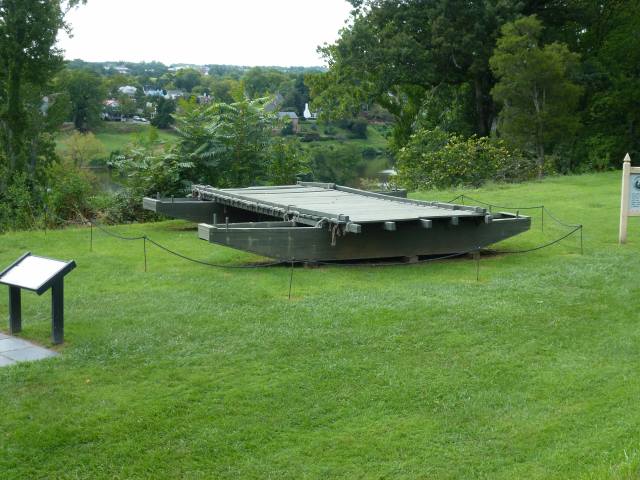
In April 1862 the house was requisitioned by the northern army and the Lacys were expelled. In November 1862 the northern commander General Burnside set up headquarters in Chatham. He planned a major assault on Fredericksburg with 120,000 troops. But first he had to bridge the river, which he intended to do using pontoons, a section of which has been preserved in Chatham gardens.
On December 11th 1862, dozens of guns, ranged along the Chatham heights, pounded Fredericksburg on the other side of the river. This remaining gun in Chatham garden points directly to the town, an easy target. The river is invisible down the slope in front.
Directly after the bombardment the army engineers set about creating three crossing points by lashing together the pontoons. The opposing fire was murderous and only one pontoon bridge was effective. However, the town of Fredericksburg was eventually taken at great cost and Burnside’s soldiers pressed on to challenge the southern forces’ defensive line just beyond the town.  

Now Burnside had a problem. Robert E. Lee, commanding the south,was perhaps the best general on either side, and he had prepared a perfect defence. His men waited in a sunken road behind this actual stone wall..
Behind, up the slope, were Lee’s cannon. Burnside’s forces charged seven times and each time were repulsed. Such were their losses that they retreated back across the river, which then became the dividing line for the next three years.The white cottage in the photo above was there in the thick of battle and bullet holes remain in the walls visible through the windows (door locked).
This was Civil War’s biggest battle, involving nearly 200,000 men. It was savagely fought, creating some 20,000 casualties. However, there were some incredible acts of compassion like the southern trooper Richard Kirkland who repeatedly ran into no-man’s land to give water to the wounded of both sides. Firing stopped when they realised his mission and a bronze statue was struck after the war to commemorate his bravery.
Many of the northern wounded were brought back to Chatham Manor, which was used as a hospital. It became so cold during that winter that the military staff ripped off the wooden wall cladding to burn for heat. The refurbished interior shows how much wood would have been available!
Slaves obtained their freedom in areas occupied by the north. Chatham’s slaves all made off using any transport they could find, as this example shows.
And what of General Burnside, having lost such an important battle? He was replaced soon after, but his name lives on in the word for side whiskers: Burnside became sideburns. You can see why from his photo.


Saturday, 9 September 2017

America’s Love Affairs

For the vast majority of Americans, shooting and gun ownership is a hobby like football or stamp collecting. Europeans might say that you can’t kill or injure anyone with stamps, but then it’s the American heritage to own and carry firearms. Son-in-law Scott supports responsible gun use and suggested we all went to the firing range to see for ourselves how enjoyable shooting real guns can be. We take him up on the offer. At the range, there is a wide variety of weapons for hire, or purchase, as well as ammunition.


Safety rules are paramount, and here are Claire and Jane are all ready to go with the necessary ear defenders and waiting for shooting instruction.
Jane is firing at the target of a male head and shoulders outline. The targets can be made more distant or closer on a pulley.
Notice that the villain is neutralised by dead-eye Jane’s accurate volleys.
We’re mostly using .22 guns. This is the smallest diameter ammunition, so the gun doesn’t jerk much when fired. This is more accurate for beginners and occasional users. I was persuaded to fire a .45 revolver, much favoured by the gunslingers of the Wild West. A .45 slug has great stopping power but also a violent kick when fired. In untrained hands (i.e. mine) I would consider a .45 pistol as much a danger to the user as to the target. 
In fact, a tiny piece of blowback caught me in the eye so I was seeing double for a while: I had become yet another American firearm statistic….
However, we all agreed that the shooting range was great fun, having set aside for the moment the complex arguments of the Great Firearms Debate.

In parallel with gun culture, America’s other romance is with the motor car. Scott is well represented here with a big pickup truck, a sports car and a mini. Also- and this is the unusual one- a Polaris Slingshot. It looks like a batmobile. Here’s a photo of Scott arriving at Colonial Beach.
The Stars and Stripes flag is a Scott’s embellishment and flaps about as you drive. Driver and passenger wear crash hats. It’s a hairy ride, as I can testify to, but a more sedate run around the block was offered to Jane from Scott & Claire’s house. Jane’s being strapped in: it’s now too late to change your mind!
But all’s well. Jane is smiling and raising celebratory arms. She has survived.


Wednesday, 6 September 2017

A Local Lad’s Roots

We managed to fit in a few leisure activities around the wedding. The first was a visit to George Washington’s birthplace, located a few miles from Colonial Beach. This was his parents’ tobacco plantation on a picturesque inlet off the Potomac river called Popes Creek.
It was of course worked by slaves as the year of his birth was 1732, over 100 years before the Civil War and the abolition of slavery. River access was important because the tobacco was exported by ship to Europe packed in barrels such as these.
The next photo is of the reconstructed house where George came into the world. It was built in 1931 by the Wakefield National Memorial Association- the estate was originally called Wakefield.
The house is suitably furnished from that era, but only a very few items have any direct association with George or his family. This room is an example.
This is where we start to run into difficulty. The contents of the house isn’t connected with the Washingtons, also the guide told us that, actually, the reconstructed house is much grander than the original would have been. Again, it wasn’t  built in the right place. “But”, the guide said, “it’s really to represent the value we place on Washington’s birthplace. What he was worth to the nation.” In any event, the Washingtons moved when George was three so he would have retained little memory of any past of the property.

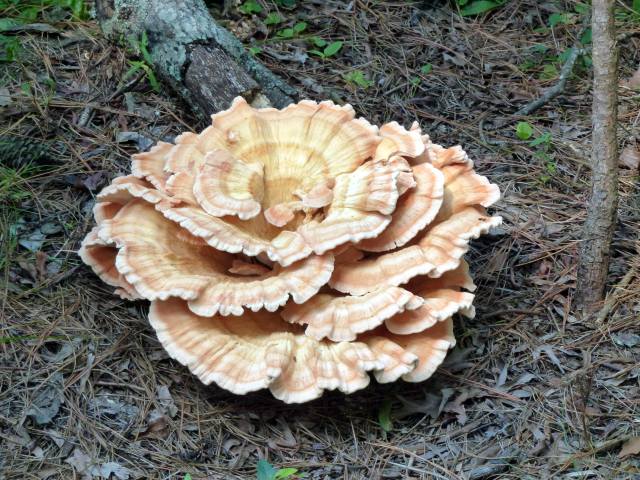
We had an enjoyable walk on wooded and shoreline tracks through the estate. I wasn’t quick enough with the camera to catch the eastern rat snake that crossed our path, but did snap this amazing fungus about a foot across. Despite the historical manipulation, it was a most pleasant place to visit.


Monday, 4 September 2017

Saturday 26th August: The Wedding

Steven is Jane’s grandson and is marrying Lauren today at the New Life Church of which they are both members. Weddings photos are of most interest to family members, so general Blog readers’ indulgence is requested for this entry. Presentation is everything, so here is Adam and Jane nearly ready to leave for the church. Mustn’t forget the hat, Jane!
Steven and Lauren are now man and wife. They are standing on a raised area like a stage, so we all get a good view of the ceremony.
Claire, Jane’s daughter is with her husband Scott and their son Mathew and daughter Katy. The bits on the floor are rose petals that have started to become scattered.
There has to be a close-up of the bride. Lauren is with Jane, now with hat. It should be noted that part of Lauren’s bouquet was a beaded flower posy made by Jane.
Jane is modest about her beading skills but I’ll take this opportunity to showcase the posy as it is really a work of art and much admired.
Ceremony over, we head outside to the church lawn for the reception. It’s open-air with tables as can be seen.
Our grandchildren have a wide age-spread. Steven, the groom, is 27 and Ginny has just turned 2. She’s here with son Ralph and his wife Kelly. Ginny’s been so good in the church and continues to be delightful.
Ginny is very photogenic (it’s the best age) so it was impossible not to take cute photos of her the whole time they stayed with us. Her she is playing peek-a-boo under a cane sunchair.
We all felt that the day had gone perfectly, and Steven and Lauren left at dusk to the guests best wishes for a happy and successful future.