Thursday, 12 May 2022

Cartagena

 The city was founded in the 3rd century BC by a Carthaginian general who named the city after his home town of Carthage in north Africa. It flourished as the main city in a mining area, which was further expanded under the Romans. It was conquered by the Moors and then retaken in the 13th century. It became a great naval port under King Phiip II (ye king of Spanish Armada fame), and still remains so today.

We started our visit with a boat trip to look at this great harbour, and here’s the boat, run by the local authority, hourly, at very reasonable rates.


We spotted a small naval vessel straight away. The photo shows how effective the grey camouflage is compared to the red ship which really stands out..

Now we’re passing a submarine under repair, or maybe scrapping: I don’t think Putin has anything to fear from this one.

Chugging round the harbour, next up is a fort. This protected the harbour entrance and dates from the 19th century. It’s called Fuerte Navidad: Fort Christmas.


Passengers can alight at the fort and be picked up by the next boat, but we stayed aboard. After pulling away from the small jetty, the boat ran alongside a mole. At the end of which is a lighthouse – Christmas lighthouse, as it happens. Now from the mole came a strange wailing sound, difficult to place in sunny Spain, but lo and behold, it’s the bagpipes. A piper was playing on the mole, oddly dressed in a rugby shirt and shorts. Maybe Father Christmas would have been a more appropriate costume given the names of the fort and lighthouse.


 We passed by the Christmas lighthouse that marks the harbour entrance, and make a slow turn round the headland which is still studded with old fortifications, part of which seems to have fallen into the sea.

Cruising back down the other side of the harbour a strange floating contraption came into view. It’s a dredger, or at least we thought so.

Yet more fortifications, and then a cruise ship. Cartagena is a popular call-point because of its deep water harbour, and also it’s straight off the ship and into the town centre that is right by the port. The size of many cruise ships however means that they block off the view of the harbour as if a high rise block of flats had suddenly appeared.

It’s a favourite with pleasure craft too as the coast is very scenic and the whole Med available if you’re a proper sailor.

So we’re on dry land again and headed for the town, a most attractive approach featuring the domed town hall.

The shopping streets are pedestrianised and marble tiled – very up market.

And time for lunch. Despite being a popular tourist destination the prices are still reasonable so we sat down to a leisurely pizza. The leisurely bit is built-in as the service was slow but pleasant enough.

A quick look around the shops – but one high street is much like any other – and then to the Roman theatre. This one dates from the 1st century BC and is very well preserved. It has a capacity of 7,000 people. It was only “rediscovered” in 1988 having been covered by housing and rubble. This is what you see from the entrance portal’

The pillars around the stage are quite dramatic. Unfortunately, the washing hanging on the balconies of the flats behind rather takes away from its dignity.


But let’s do it justice by taking the shot from a different angle. Much more majestic!

The next photo shows most of the theatre, the stage, and the entrance arch high up. Our three performers, Jane, Natalie and Adam, are due to start - but where’s the audience? The play’s obviously been getting bad reviews.


So that’s Cartagena. Even the car parking was convenient: a huge underground park under the harbour promenade.

That visit was just over a week ago and sadly tomorrow, Thursday May 12th, we leave Los Madriles for a leisurely amble towards home. More reports to follow!


Wednesday, 4 May 2022

Bol Nuevo

Bol Nuevo is a seaside village 12 miles from our campsite. It means new bowl or pool, but that isn’t anything visible today. What we can see to start with is an unusual rock formation: wind-carved sandstone. The camper in the huge car park gives a good idea of scale.

The huge car park services a huge beach opposite, of fine sand.

But we’ve come for a walk, and head off along the cost using a dirt road. This is the view along the coast before we drop down to sea level. Notice the wooden gazebo indicating one of the few, exclusive homes before we reach the wilderness.

The sea path is backed by multi coloured rocks indicating various minerals of which iron ore was mined in the 18th and 19th century. 

No motor vehicles are now allowed on the road but even in our time in previous years it was used by cars. There are several cuttings like the one below that show it was once an important highway for it to have been worth  blasting away the rock. Adam and Natalie, who have joined us for a week, give an idea of how much was removed.

There are some pretty bays along the way, but beware – some are dedicated nudist beaches. It is an interesting speculation, when Spain had very strict  requirements to wear Covid masks at all times, to imagine the nudists all wearing masks and nothing else!

We reach the small dilapidated jetty from which the iron ore was shipped and return along a smaller coastal path. The iron ore colour in the rocks behind Adam is really strong in this next photo.

We backtrack along the dirt road we started along, passing pretty deserted bays and inlets. Some 20 years ago a Disney World was proposed along this part of the coast, and a motorway built in anticipation (now hardly used), but the plan never progressed. Thank goodness, we say, as the area would have been changed out of all recognition, but perhaps businesses and local employment would have a welcomed it.


Wednesday, 27 April 2022

The Broken Rocks

 Sounds like a forbidding place created by convicts’ hard labour. We’ll keep you in suspense!

We drive up into the hills and park at the start of an originally well made dirt road, now rough and rutted where erosion would prevent the passage of even a land rover. But it’s fine for walking.

We’re heading towards the sea, and catch glimpses of it as the dirt road twists and turns. Lucky we’re not in a vehicle as we’d probably be car sick!

Turn the next corner and a huge seascape spreads out in front of us. We’re looking towards Cartagena harbour in the distance. This is a major port with deep water berths for cruise ships, a large oil refinery, and the main base for the Spanish Mediterranean fleet.

Plodding on, keeping the same sea panorama in view, we arrive at the broken rocks. It’s just a natural jagged rock formation, so no sinister overtones.

We are returning to the car by another route, and I take one last photo before the sea disappears altogether. The one building visible, overlooking the sea, is known locally as the Custom House, now empty. This area was  known for smugglers in the past: ideal, given its remote and difficult terrain, so it would seem a good place for the Customs to have an outpost.

The return path is nowhere near as wide or well specified as the dirt road to the broken rocks. However, it has been deliberately hacked out with any steep sides shored up for safe use by humans or donkey.

The question, of course, is why. The path threads through complete and total wilderness, much greener than usual because of this year’s abnormal rainfall. Perhaps a clue is to be found in this long abandoned sheepfold.

Or even more probably, in this dry stone wall next. There are many of these walls above the track creating terraces back up the hillsides. We realise that we are looking at the remains of subsistence farming  of the past and the track their access road. The locals must have lived an unimaginably hard and frugal life. Ministering to the tourists today is a more attractive option.

The track eventually joins the dirt road from the Custom House, and thence back to the car. A walk with incredible views, and a peek into Spain’s rural past.


Tuesday, 19 April 2022

Wet,Wet

 Until a week ago the weather was unsettled: the area received more than its annual rainfall in the preceding three weeks. One of our favourite walks is along a rambla that runs near the campsite. A rambla is a dry river bed, which this one always has been in the previous 15 years we’ve been coming here. This year is different.

There are at least 20 dwellings sparsely dotted along the 5 mile long rambla that use it as a road. The water in some places has eroded the surface to form small waterfalls. This waterfall covers the width of the rambla, about 7 or 8 metres across.

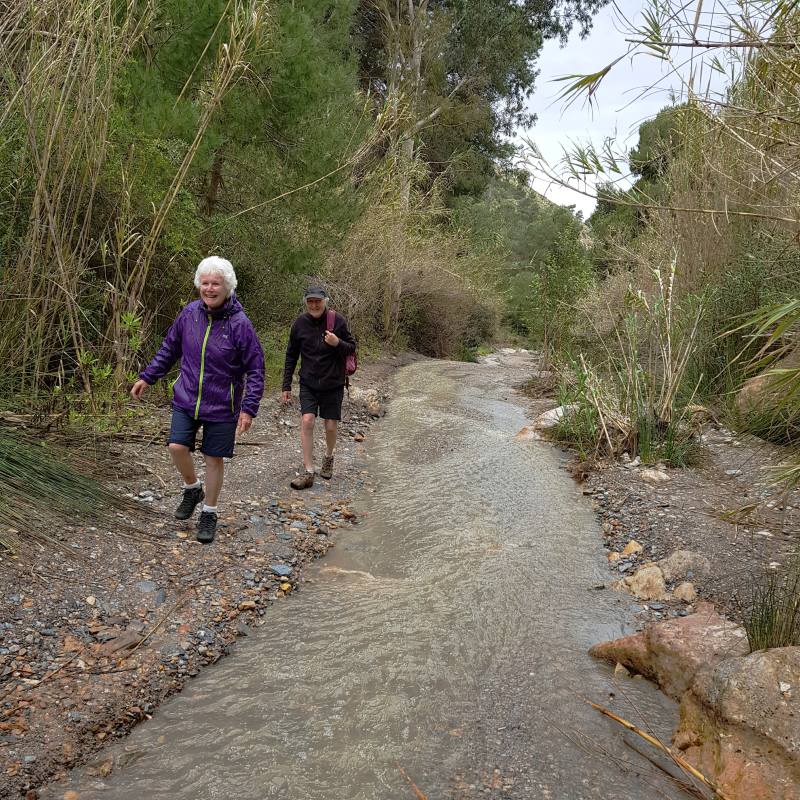
And a little further along, where our two friends are walking, it’s a full-blown river.

The residents generally drive 4X4s and we saw them tackling water depths and boulders that would strip the exhaust off most normal cars. But the scenery remains beautiful: the cliffs in the next photo reach nearly 2000 feet.

An info board tell us that the cave of the horseman, coming up next, contains evidence of human occupants 12.000 years ago, so we’re in Flintstone country. Fred’s cavemobile was hopefully a 4X4.

Towards the top of the rambla is a chapel, dated 1971, looking and feeling much older than it is. It is nicely maintained and, most times we see it, someone is cleaning or tidying in it.

The old farmhouse, or finca, below gets more dilapidated each time but was once a substantial prestigious dwelling set in lovely surroundings. Even now, it is possible to see the areas of cultivation running towards the cliffs. The Parks Department have recently installed some picnic tables so folks can enjoy the ambience – folks, that is, with 4X4 vehicles. 


Wednesday, 13 April 2022

Las Coleras Mines: 7th April

 On a hillside behind the campsite are some abandoned mines. We decided to take a look. A climb of about an hour to reach the first reminded us that the miners had this trek to make and then do a day’s work. We’re getting close to the first mine here:

There are several mines, some interconnected below ground, stretching right up the hillside:

These are iron ore mines, first started in 1884 by a French company, initially using mules to bring the ore out and cart it down to the coast. This archive photo gives an idea of the work:

There was a full complex of administrative buildings as well as the mines themselves, including essential water storage in this odd shaped structure:

In 1912 the owners suspended mining temporarily. They reopened in 1915  having  modernised operations with pneumatic machinery and an aerial cableway to move the ore to the coast. A few of the pylons are still standing indicating the route to the coast:

Having conveyed the ore to the coast, a new jetty was built allowing easier loading of the barges that ferried the ore to the ships waiting in the bay. Clearly they weren’t able to take the jetty into deep water for loading directly onto the ships. The archive photo next gives an idea of the system, with the jetty on the left and the barges stringing out from it. Nothing now remains of the jetty.

We didn’t venture into the mines themselves as we weren’t equipped but there are no barriers preventing access. They are a firm favourite venue for caving groups that do have the equipment - and the training.

The mines closed in 1931 when Franco came to power (I can’t see any connection ) and reopened in 1951, with final closure in 1961 due to cheaper competition. The ore was in fact high grade and had been exported to the UK and Switzerland.

A hard life for the locals, but who said dealing with us holidaymakers was easy!


Thursday, 7 April 2022

Wednesday 5th April

Considering that we have been here for over two weeks we don’t seem to have done much: it’s been forced relaxation caused by poor weather. Let’s be honest – very bad weather! This region is normally one of the driest and sunniest in Spain, with only 8 inches of rain per year. That amount has already been exceeded in the time we have been here. There are some compensations, but the pot of gold could not be traced:

Unsurprisingly, it’s greener than usual. The small reservoir outflow is much more vigorous this year. It’s about a 30 foot cascade.

Occasionally the hills at the back of the campsite display a strange phenomenon, captured by my phone camera so it’s not really clear:

Guesses? Dashing in to get the better camera, the result is now obvious:

It’s a huge flock of sheep, with the shepherd lower down just visible carrying a red backpack. Some years ago we encountered a similar shepherd while walking in the hills and he indicated that he and his dog were out with the sheep 24/7. He must have a very understanding wife (Barbara?)!

Next shot is us out in the hills, a dry day at last. This carpet of plastic is but a small proportion of the tomato greenhouses all along this coast. Perhaps this is what we will all be eating when meat is banned for eco reasons.

A short walk to the local village on another day -  a lovely little chapel by the sea. Looks like it’s been there for centuries but it was actually completed in the 1960’s.


 Finally, we put some excess couscous in the bird feeder. To our amazement, a minute late, there’s a feeding frenzy! The bird feeder is Jane’s own design using two 5 or 6 litre water bottles. Perch points are cut in the one bottle and gravel put in the bottom for stability. The base only of bottle two is cut off and wedged over the gravel in bottle one. That’s the feeding tray, which also keeps the gravel in place.