Wednesday, 26 April 2023

A Testing Walk

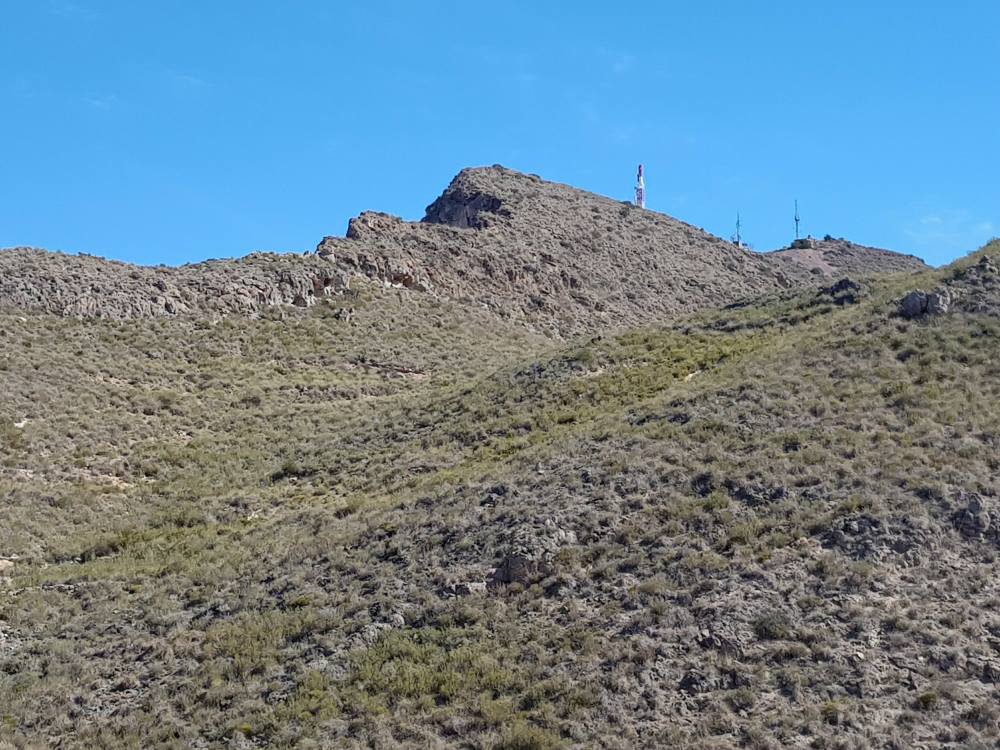
 This is a fine weather walk we have only carried out once before, many years ago. We started at Santa Elena tower on a headland three miles opposite the campsite, hopefully visible in the following longshot photo.

The tower was a watchtower to spot pirates that roamed the Med many years ago. It’s quite sturdy, with the entrance 20 feet off the ground for extra security. Not a popular chap if you forgot the ladder!


The tower soon disappears from view rounding the other side of the headland. The path is rough, with loose stones, and cuts across a steep slope.

This is where you’d end up if you slipped on the stringy grass, lethal in the wet but navigable with care today.

It’s barely a donkey track but is part of walking trail GR92. Usually these are well marked with paint stripes on adjacent rocks to confirm the path, but nothing much here. Some of the scrambles are becoming steeper and covered in looses scree so easy to skid on.

A surprise looking down at the next rocky bay: what appears to be the remains of a dwelling. A beautiful, quiet location – you could maybe live on fish, but what about the weekly bin collection.

The path then turned inland, away from the precipitous plummets to the sea, but time for a quick atmospheric seascape photo before we turn away.

The transmitter masts are at the highest point but we headed for the saddle to the left where the path drops back down to civilisation.

Here’s the view from the saddle before heading down. It was still careful going on the track, but gravity was helping now so we were back in time for lunch.


Friday, 31 March 2023

France & Spain Mar 2023

 Start: Thursday 9th March

The first blog is late this year, for no good reason! We’ll be staying at our usual campsite, Los Madriles, so blogs will be posted only for anything different that we do to avoid a repetition of previous years. 

A moderate covering of snow on the car and caravan starting from home, but the forecast says we will run out of it as we head south. By the Dartford Crossing it’s gone. 

Strong coastal winds are forecast for tomorrow, Friday, so we will take the inland motorway route through France. We arrive at a farm site near St Quentin, for two nights. The extra day is to shop for the fresh fruit, veg and meat we now can’t take from home because of Brexit. The latest forecast for wind gusts inland don’t sound too safe for towing anyway. 

The farmer was most helpful; because the ground was soggy he let us stay in the farmyard. Just an ordinary but peaceful farmyard, as the photo shows. Not a rooster in sight (or sound).

Our route continued past Dijon and Lyon to the French Med.. We rested for a couple of days near Montpellier. The site was on a large estate rather gone to seed as this photo of the big house shows.

However, the walking paths through the woods were excellent and well marked. We came across an aqueduct that was built in the 17th century to take water to the castle in the centre of the small town of Castries close by. It is stated to be the largest private water system constructed in France.

Next stop Cambrils, 80 miles south of Barcelona. The campsite led directly onto the beach and the weather had turned warm so we decided to stay for several days that turned into a week. The beach is a series of horse-shoe bays like the one in the photo.

Much in evidence were flocks of parakeets, escapees from captivity. They can overwhelm resident species, so it’s as well not to be too carried away by their cuteness. Just like the grey squirrels in the UK.

The town of Cambrils is unremarkable but pleasant, with few high-rise buildings . Walking from the campsite away from the town we were soon on dirt roads and scrubland. This is typical.

Coming across a disused railway bridge in the middle of nowhere we were amazed to find some exceptional quality artwork painted on the bridge concrete support pillars. The following two photos are examples.


Next stage on the journey is to Calpe, not far from our final destination. Calpe is famous for its rock, not as in the lettering thorough the middle like Blackpool rock, but for its imposing size and nature reserve status.

Nice beach, too, but it’s a mini Benidorm when you look the other way towards the high rise apartments and hotels. No “Tea Like Mother Makes” cafes though, just high class restaurants.

The old town, however, is charming, The first building in this colourful alley displays a classy mural.

The part of the mural just out of camera is worth a closer look because it’s a 3D galleon. High quality work.

This town square is typical old Spain, the blue and white colours harking back to the occupation by the Moors (Arabs).

We see more paintings on buildings as we walk around; this one covers the complete side of a large edifice and depicts a Moorish town floating on a magic carpet platform with a couple more buildings underneath. But no “Sinbad  woz ‘ere” signature.

Back in the new town, health and safety falls far short of UK standards. This guy is part of a team painting a tall block of flats, each painter being sat on a wooden seat like a child’s swing, suspended from ropes at the top that haul him up or down as required. 

Near the rock was a large, shallow lake used from Roman times until 1988 for extracting salt by evaporation. Now it serves to attract migratory birds. This flamingo was close enough to make a nice photo.

No mention yet of the campsite. Very well run and beautifully clean, with large but expensive pitches. Now spot the elephant in the room!

It’s a tower block under construction, appearing to grow out of our caravan roof. In reality it’s just beyond the camp boundary, and work proceeded all day, every day. A long-term Brit we talked to said that you just get used to it. Is that so? Time to move on!


Wednesday, 8 June 2022

Briare

 The last blog wrongly stated Briare was 10 miles down the Loire. It’s 10 miles up the Loire, where our campsite takes your canoe so you can float down to Gien. It’s not as photogenic as Gien but it does have the longest canal aqueduct in Europe, built by M. Eiffel of Tower fame. It’s not as impressive as our Llangollen canal aqueduct but here it is, as it crosses the Loire, looking much like a sewerage pipeline.

Looking round from the aqueduct, we spotted a familiar contraption on the opposite bank. It’s the gypsy caravan with the young lad apparently sat on a chair in the river.

There are several canal systems meeting here. They are clearly much more reliable than the Loire for both leisure and transport, and are quite scenic.


Now back into town for a coffee in the church square. At the risk of  describing yet another cathedral or church, this one earns its place by being unusual, although it doesn’t look it from the outside, apart from the green mould.

It was built between 1890 and 1895, financed by the local enamel factory magnate. It was designed in the Byzantine style, like eastern European or Russian churches, because they are decorated in a way that the benefactor could display lots of enamel work. A closer look at part of the façade shows this treatment on the patterning over the doors and in the arches on the next level up.

Inside, the floors show eastern pattern design but not sure if it’s enamelwork?

The whole effect is of another time and place, but it is a regular Catholic church.

No more churches for a while, at least until the next blog! We headed then back to the campsite to prepare for moving off tomorrow for Abbeville, our last stop before home.


Monday, 6 June 2022

Gien

 Our campsite is opposite this picturesque small town on the banks of the river Loire. It was from here that we visited Bourges, blogged previously.

The Loire is the longest river in France at 630+ miles. However, it is the least navigable of France’s large rivers because for much of the year it is shallow with constantly changing sandbars. In the past, when rivers were an important highway, it was more used and better managed with debris cleared and navigable channels maintained. Today its main use is for leisure, so this is the kind of craft we saw using the river, nothing more substantial than this paddleboarder. It makes the pleasure cruisers and narrowboats on our river Ouse seem like ocean liners.

The Loire in flood is another matter, and we saw flood marks that stretch the imagination. This one indicates a level of 7.3 metres (24 feet 3 inches) on a house on the main road, far above the current river level.

There were a couple of house boats tied up along the bank, again, very small and of garden shed design.

We climbed up a steep staircase to the castle and church occupying the top level of the town. The castle is now a museum, the museum of hunting, which didn’t inspire us to enter.


We did get a nice view of our campsite from the top and of the river.

So down we go, a different way, and come across a statue that seems to be bent on stopping the traffic. The plaque says it’s Vercingetorix - so who’s he? Well, oddly, he popped up way back in school. Vercingetorix was the chief of the Arverni tribe that united much of Gaul (mostly today’s France) in a revolt against Roman rule. He is still seen today as a symbol of French unity although he came up against Julius Caesar and lost. He’s not having much success with the traffic either.

The banks of the Loire contain many footpaths and cycle tracks. The campsite offers bike and canoe hire for those interested. We stuck to walking and came across lots of interesting things, this gypsy caravan for instance. It was trundling along the meadow path next to the river and then stopped for the horses to feed. We caught up with it, and from a halting conversation with the young guy on his own, it was clear he was a real Romany and this was his home.

We have another little trip out before we leave Gien, 10 miles down the Loire to Briare.


Saturday, 4 June 2022

Bourges: 1st June

 Bourges is Peterborough’s twin town, so we thought we’d drop in to see how it compared as we were staying in the area. We parked in a modern multistorey on the Avenue de Peterborough at the edge of the old town and walked into this delightful old squares. Bourges Boulevard in Peterborough also contains car parks and direct access to the city centre.

The old town streets are almost all original medieval buildings, for example this road leading to the cathedral.

We are reminded that Bourges is on one of the great pilgrimage routes by the cockleshell symbols inlaid into the paving.

The cockleshells inevitably lead to the large cathedral of 13th century construction.

Inside, it’s amazingly tall. They used cutting edge building techniques for its day.
The really stunning feature is the original stained glass. They clearly had no local Cromwell to wreck what he considered unnecessary ornamentation. The photo is but a small sample of the stained glass, each piece of which tells a biblical story.

There’s also an intricate clock made for the wedding of Charles VII to Marie d’Anjou here in 1422. It looks like it’s portable, like a carriage clock, but it’s 15 feet tall and Charles VII is not described as a giant. 

Outside, some of the carvings are amazingly detailed, scenes of Judgement Day that can’t be fully appreciated from the photo. Thankfully, it’s scary stuff!

There are some fine touches on individual buildings in the streets, like this lion face that looks like he’s burst into song.

The palace of Jacques Coeur is the largest and most ornate in the city. He was a shipping merchant, moneylender and arms dealer: a Mr Big, and also Charles VII’s finance minister.

We do the tourist info map circuit and end up back at the car park.

Peterborough has a long history, but nothing like the number of old buildings surviving as in Bourges. The cathedrals stand comparison: Peterborough’s is slightly older and each are of great historical significance. The outskirts of the cities are, superficially, similar with unremarkable suburbs.

It’s an hour’s drive back to the campsite when we later had this lovely sunset.