Sunday, 2 June 2024

The Camargue

 The Rhone delta is called the Camargue, a huge area of marshland and water channels. It is an hour by car from St Remy. As with the fenland in East Anglia, a large part has been adapted for agricultural use and also to reduce mosquitos, but I assure you that there are still plenty left! The photo is of a typical crop, one that wouldn’t be possible in the fens – rice. The water levels are controlled by the dyke on the right.

There are still plenty of original wetlands remaining, mostly the sections nearer the sea, where exotic species like flamingos are to be found.

The Camargue is also famous for its wild white horses, but it’s debatable as to how many are really wild. The numerous horse trekking centres here all use white horses that are have clearly been tamed, but let’s pretend that the herd in the next photo are the real thing.

This is where black fighting bulls are bred to be used in bullfights in this part of Provence. The spectacle takes place in such historic places as the Roman arena at Arles. Unlike Spanish bullfighting, the bull is not killed and the bullfight amounts to a contest between the agility of the matador and the bull. Here they are looking deceptively docile.

There is just one town in the Camargue, on the Mediterranean, Les-Saintes-Maries-de-la-Mer. It is  named after St Mary Jacobe and St. Mary Salome. One of the Marys (no agreement on which one) had a daughter Sara who is the patron saint of gypsies. At the end of May each year thousands of gypsies travel here from all parts of Europe to celebrate their Saint Sara in a week-long festival. 

By chance, we happened to visit the town on the Saturday of the festival week. We managed to park with great difficulty as the town was thronged by thousands of gypsies with their caravans, and multitudes of sightseers like ourselves. 

The festival is focused on the church where the effigy of Sara lies. The church was fortified to provide protection for the residents in case of attack by pirates. We’re not too sure that the pirates have gone away.

Sara’s effigy is taken from the church towards the sea in a slow procession several times during the week, but unfortunately not when we were there. Sara must be kept somewhere near the altar end in the photo but I thought it best not go for a close-up.

Most of the gypsy caravans were modern but there were a few traditional ones that must be stored locally: can’t imagine this one trundling all the way from, say, Romania!

We saw off-the-cuff gypsy guitar music and dancing, very much like flamenco. 

Some gypsies had dressed up for the occasion, as in the two following photos. The lady looks very elegant but the man seems to be stuck in the 1960’s – look at those winkle pickers, no wonder he’s sitting down!.


We managed to bat off the charmless charm sellers which was only a minor irritation in a pleasant and unique day out. The town itself, because of its isolation, has its own identity and even its own cross which is a crucifix with an anchor. This symbol appears everywhere, for example even on this (decaying) front gate.


Wednesday, 29 May 2024

Homeward Bound

 We left our base camp at Los Madriles in Murcia, Spain, on Sunday 19th May and travelled for three consecutive days up the Mediterranean coast into the south of France. We headed for St-Remy-de-Provence, where we plan to stay for a week. We are again now seeing new and interesting places, so the blog can continue. 

As background, St Remy was our first caravan holiday destination back in 1989 when we borrowed Mum & Dad’s caravan. We’re not at the same site but in the same area on the edge of town, with a spacious and pleasant pitch.

The lush vegetation is partly kept under control by these chaps. Hopefully, they won’t need to stand on the caravan roof to reach the highest branches.

The town of St Remy was founded as Glanum on the Roman via Domitia, built in the 2nd Century BC as the first road to link Rome and Spain, crossing Provence to do so. At the edge of town is a triumphal arch from 20 AD celebrating Caesar’s conquests in Gaul and a mausoleum from the same era. These formed a gateway into the town of Glanum whose excavated remains can be visited (we didn’t). Now- is the arch extra small or Jane extra large?

Right across the road from the Arch is the mental sanctuary, the monastery of Saint-Paul de Mausole, where Van Gogh spent a year trying to recover his sanity after cutting off his own ear. I suppose that's better than cutting of someone else’s ear. This is the entrance now, followed by Van Gogh’s 1889 painting of it. 

Surrounding the monastery are walkways with Van Gogh’s paintings at the very spot where he painted, e.g. the one above. This is another example, where the shape of the hill is clearly recognisable.

We remember the town of St Remy as elegant and up-market, and set off to see if it’s changed. We arrive at the edge of town to see diversions and streets closed: we have stumbled on the festival of St Eloi who turns out to be the patron saint of farmers, horses and farriers. Here are all the cart horses lined up waiting to start the parade.

Off they go, and last in line is the float dedicated to St. Eloi. It appears that several plane trees are growing out of the float but be assured that they are firmly anchored to the pavement behind.

The parade is accompanied by folks in traditional dress, like the lady in the next photo. 

Into the shopping area now,  and the town is just as swish as we recalled. This is one of the pretty streets: just as well you can’t read the price tickets!

But it’s a most pleasant atmosphere, for example this corner with a small fountain.

Plenty of restaurants, too, in picturesque squares - and not a McDonald’s in sight!. This one could almost be a Renoir painting

There’s more to explore around this area so please hang on in for the blogs to follow.


Saturday, 6 April 2024

Carmona

 Carmona, less than 30 minutes drive from Seville, is a beautiful, historic, small town. It is the Spanish home of Michael Portillo, the TV rail traveller and ex-MP. His connection with Spain is a father who lectured at Salamanca university and fled to England at the time of the Spanish civil war. Disappointingly, Michael did not put in an appearance to show us round. 

We parked outside the old town in an  underground pay car park. Although there are several free parks, these are patrolled by self appointed parking attendants wearing official-looking high-viz jackets who demand money for parking, so you either pay up or risk damage to your vehicle. We’ve come across this at other places in Spain. 

Emerging from the car park, we see a lovely view of San Pedro church with its tower modelled on the Giralda tower in Seville.

Just beyond the church is the Puerta de Sevilla, the entrance to the old town. The gate is mainly original Roman structure through which the main road, the via Augusta, passed on its way to Cordoba.

It’s a double gate, and the next photo shows how massive and well fortified it was. Nothing, of course, is completely original as is see from the Moorish arches added later.

Just inside the gate, the old town is pleasantly laid out mainly in this style of building.

It’s a short walk to the central square, the Plaza de San Fernando. Folks from my generation will understand when I say that the last train is still expected here. The square contains some splendid Moorish style buildings  like the Casa de Cabildo, the old town hall.

Just beyond the square is the 14th century church of Santa Maria la Mayor built over a mosque. The tower is thought to be adapted from the mosque’s minaret.

Inside, the church is beautifully proportioned, with marble tiled floors and sweeping arches.

he guide book tells us that the ornate panel over the alter is called a retablo, and can be illuminated by inserting a coin. We see that it’s already lit up so someone’s already activated the lights.

Leaving the church, we walked to the Cordoba Gate at the other end of the old town, from where the road sped on to Cordoba. It’s a fine old edifice, originally Roman but modified many times since. The latest modification appears to be stopping it from crumbling.

Onwards and upwards to Pedro’s Alcazar, a massive fortress that dominates the eastern side of the town. The fortress walls were badly damaged by an earthquake in 1504, but apparently never fully repaired.

Part of the decaying structure was saved by being converting into a parador. These are state-run hotels usually in ancient buildings that would otherwise have been lost to the ravages of time. So, we go  through this gate…

…and into the parador grounds.

Paradors operate at the higher end of the hotel market, but perhaps not luxury category. This one costs around £200 per night for a double room - well over a week’s campsite fees! 

One reputed gem we didn’t have time to visit was the Roman necropolis, half a mile out of town. We’ll look forward to seeing it another time, and  the town merits another visit.


Saturday, 30 March 2024

Cadiz

Cadiz has a long history as a seaport.  It was founded in about 1100 BC by the Phoenicians. Inhabitants of Cadiz are known as Gaditanos after the original Phoenician name Gadir. 

England in its various wars with Spain has bombarded Cadiz several times,  for example by Drake who claimed to have “Singed the King of Spain’s beard” and Nelson at the time of Trafalgar. However, we didn’t see any evidence of these attacks. 

The guidebook says the wealthiest period for Cadiz was from the 17th century after the river port of Seville silted up and that trade then went through Cadiz, particularly the gold and silver plundered from the New World. The cathedral owes its redevelopment to that wealth, originally a mosque, then a 13th century church before being reconstructed lavishly as a cathedral.


We pay at the door and are shown towards a sloping passageway. We quickly realise that we are ascending one of the bell towers not entering the cathedral itself. 

It’s a stiff climb but we get to the top just as one of the seven bells is striking. The photo is a non-striking bell:

As you would expect, the views are panoramic and the good news is that there’s no sign on the horizon of English galleons bent on revenge.

After descending (more easily!) to the base of the bell tower we now enter the cathedral itself. It’s full of the usual images, gold alterpieces and marble pillars, but magnificent nonetheless.

Once out of the cathedral, we walked through the fishermen’s district to one of the city gates set in the old city walls.

The gate led to a causeway linking with a fort that would have dominated the seaways into the city but now looks unimpressive. Nice beach though.

This is part of the old jail. From the outside, it could be modern day apartments, so not looking too austere. I’m sure the reality was very different.

So what’s this, a pile of junk fly-tipped over the breakwater wall? Looking closely, they are rough and ready cat boxes. There are several large colonies on the sea side of the breakwater with notices to say that the cats are neutered and aren’t doing any harm there. Presumably, the cats’ guardians are a charity with official permission for the moggytown. It’s an interesting way to deal with Spain’s feral cat population.

These are the gates to the old town, set in the old walls, now claimed totally by the heavy traffic entering and leaving the city.

The convent of Santo Domingo was finished in 1650 and the tower is made out of Cadiz oyster stone. Here’s a photo of the tower – very nice- but we couldn’t see how oyster stone was anything special.. 

The last photo is a good example of too much information! The stone wall along the front is part of the Roman theatre. The tower on the right is the cathedral tower that we climbed. There’s another one to the left, and then the cathedral dome that’s supposed to shimmer like gold except looks like a cold fried egg. Research revealed no info on the multi-coloured pyramid. 

There were other  significant buildings and museums in Cadiz that we couldn’t fit in on a day trip. In just over an hour we arrive back in Sardine City Campsite, Seville, an easy 65 miles on good motorways. 


Tuesday, 26 March 2024

Monday 18th March: Seville

 There is only one campsite convenient for Seville, in a suburb with a frequent and cheap bus service. Because of its monopoly, the campsite really packs ‘em in.

Campers use the site to visit Seville and the surrounding area then move on: no long-stay campers here. However, it’s quiet at night, and we got this reasonable end pitch:

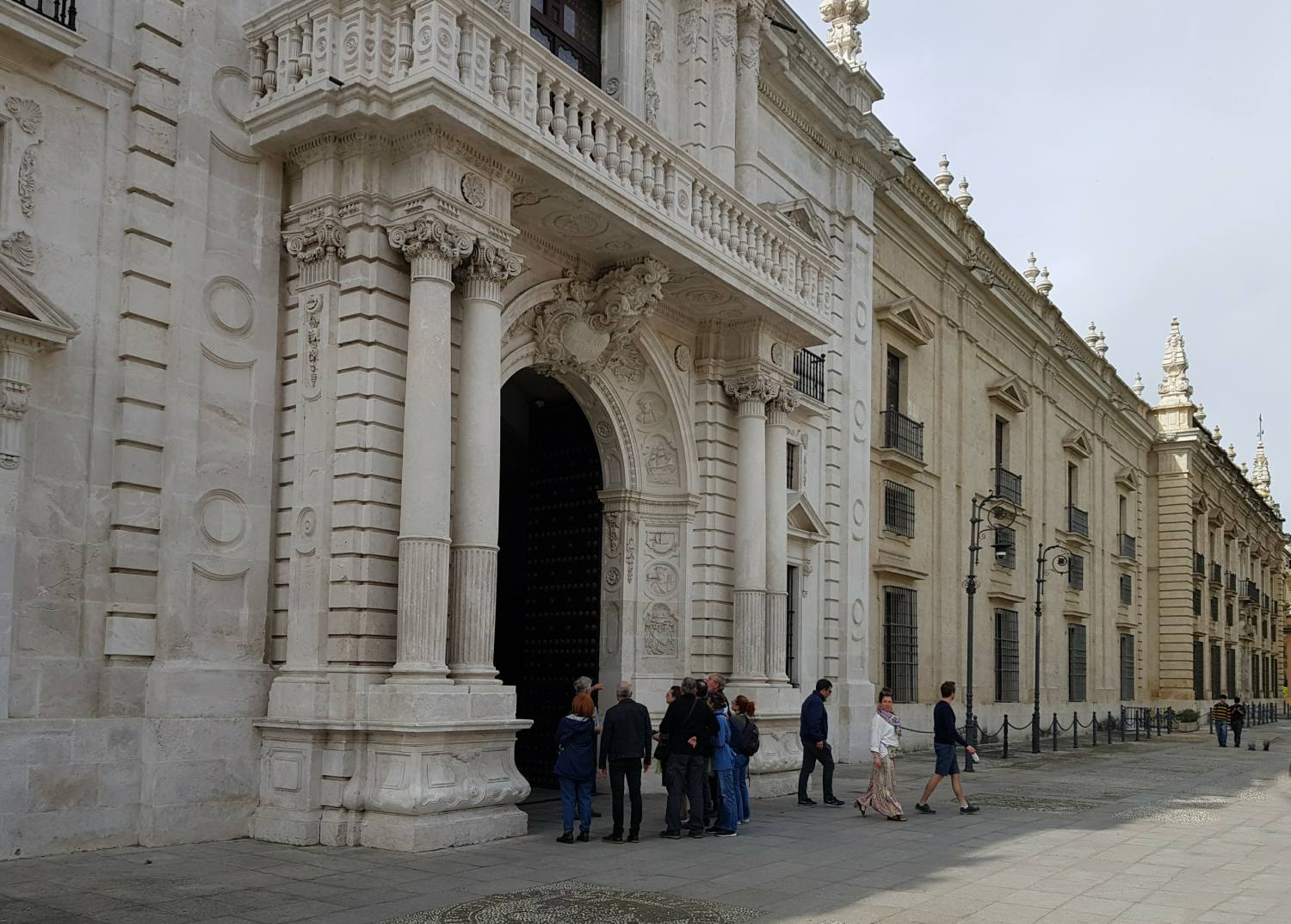
So, having used the perfect bus service, here we are taking the short walk from the terminus to the historic centre of Seville. We come to the second largest building in Spain, after the Escorial Palace near Madrid. The enormous edifice  now houses the university, and is as long to the left of the entrance, which isn’t visible, as to the right that is shown on the photo:

It seems anyone can wander in, which we did, where it’s much less austere, with pleasant courtyards
and patios:

It was formerly a cigar factory, and the building’s forever claim to fame is that it was Carmen’s place of work in Bizet’s opera of that name. You enter the building half expecting, to hear the stirring Toreador song, but I’m sure today’s  anti-smoking lobby would prefer Alan Smethurst’s  (the Singing Postman) “Have you got a loit boy”. The compromise is silence.


Next we pass the superluxury hotel Alfonso Xiii. The hotel was built to accommodate top visitors such as heads of state attending a grand exhibition planned for 1929. The exhibition never happened because of the Wall Street crash. King Alfonso Xiii was also a disaster and abdicated after a short reign.

Street performers start to appear in the square leading to the cathedral, some worth watching, some not. Here we have a flamenco dancer whose shawl is magically produced from the litter bin behind. Who says the camera never lies?

The huge cathedral is impressive from any angle, inside or out. It was blogged in detail in 2020, together with its integral Giralda tower, so we didn’t visit again, but the stunning architectural detail has to be worth another photo:

So what’s this shop all about? We never did find out. Cannabis is nominally illegal in Spain but apparently tolerated. Anyway, we couldn’t fit a plant that size into the caravan.

In another square there is a protest that became much noisier later. Nothing to do with big politics e.g. Ukraine or Gaza, but employees of the Public Buildings Authority who are objecting to plans to privatise the cleaning services. Just as in the UK, they can’t see any advantage.

Good Friday is next week and all towns are getting ready for big parades. In Seville, unsurprisingly, it’s big time. Religious banners are going up everywhere, routes being laid out and seating installed. Practically all shops have religious effigies reflecting their support for “Semana Santa”. Here’s an example, and we perhaps ought not to be too judgemental.

Just off the centre is the museum, by way of contrast a modern design but pleasing nonetheless. Its canopy spans the museum building itself and then the whole road.

We head for the Casa de Pilato, a grand mansion of the early 16th century. It is a mixture of Moorish and European styles. The front façade sums it up: 

The inner courtyard looks completely Moorish, like a Moroccan palace. The idea is to create a cool and shady atmosphere in the extreme summer temperatures, particularly as Seville is the warmest city in Europe.

Inside we observe restorers at work. It’s really painstaking – and look at that detailed ceiling! Stiff necks and a hot bath for the whole team after a day’s work, I’m sure.

And look at this for another ceiling! Why was so much effort and cost expended on these intricate ceilings – how much did these people drink?

Most of the walls are covered in small, highly patterned tiles. The cost, time and expertise must have been enormous.

Another intricate design, covering half a wall. Their patience and skill was unimaginable.

Now here’s an odd one to finish – a portrait in the classical style of a couple holding their child. It’s entitled  “The Bearded Lady”! So, we are to assume that dad is in the background and bearded mum is holding the child. It has to be said that, even clean shaven, mum would still look very masculine. They both look too old to have kids anyway. Why didn’t the artist go the whole hog and paint a bearded baby as well?

So goodbye to Don Pilato, and we head back to the bus terminus. Soon back to our sardine campsite and sit out for an hour – it’s plenty warm enough, 26 degrees C or so. Tomorrow we visit Cadiz.