Friday, 17 September 2010

Tuesday 14th: Trip to Murren

The first leg of the journey is by train to Lauterbrunnen, just outside which is located the Steubbach Falls, Switzerland’s tallest, 300 metres high. It was first measured in the 18th century by dangling a rope from the top and adding lengths until it reached the bottom. It is impressive, and especially so in springtime from the volume of melting snow. The picture shows the waterfall apparently showering onto a house roof, but it’s actually well behind the town.

The ingenious Swiss have created a tunnel and walkway behind the waterfall’s base, so you can look through it to the beautiful Lauterbrunnen valley. Unfortunately, the water has fallen such a long way that it has atomised and just creates a mist that prevents you from clearly seeing the valley. The mist also blows back through the observation holes and soaks you, or to be more precise in the photo below, soaks Jane. Now was all that engineering effort worth it?

So on from Lauterbrunnen, up on the cable car to connect with the cliff-edge railway that runs to Murren. Wonderful views of the valley and mountains from the cable car and railway.

Murren itself is a walking resort in summer and a skiing haven in winter, discovered by the English as long ago as 1840. “No motor vehicles”, the guidebook said, but on arrival we were nearly bowled over by a Land Rover. Were we really expecting only milk floats in the 21st century? It was in fact a real town, as opposed to a purely tourist creation, with a number of old wooden buildings, although the example below has been dressed up a bit.

What Murren has got is unparalleled views. It’s on this clifftop 5,300 feet up, with vistas into the valley below and the snow-clad Alps above. You can’t reproduce this panorama with a camera (well, I can’t!), but this is the best I can do, looking towards the Eiger. Question of the day – is that the Swiss national flag in the photo, or the flag on the 18th green? Bear in mind that any balls landing in the rough would need to be chipped back from the valley 2,500 feet below.

Thursday, 16 September 2010

Switzerland September 2010

Friday 11th: Arrival at Interlaken

We left Alconbury last Thursday, and nearly made Switzerland in one day! Not by design I should add, but we just couldn’t find a motorway services in France to park up for the night: they were totally full with lorries. We often do an overnight stop in services when we plan to cover a big mileage on the first day because you just pull into the next services when you’ve had enough, with no campsite to find or time constraints.

But why the problem this time? Then the penny drops: we’re near the German border, and what’s changed in the last few years is the mass of extra lorries coming from the new EU countries like the Baltic States, the Czech Republic and particularly Poland. We head down towards the Swiss border where these lorries don’t go- and suddenly there’s plenty of room. We eat dinner at 10.30pm, but who cares, and after nibble on a few savoury sticks (Paluski Polish sticks, 99p from Tesco- so it’s no good us complaining about all these extra lorries!)


So now we’ve arrived at Interlaken. The site has the unlikely name of “The Lazy Rancho”, shades of Texas rather than Switzerland, but very friendly & helpful proprietors who speak fluent English.


From our pitch we have a 5* view of the Eiger, Mönch and part of the Jungfrau. It’s interesting how their appearance changes depending on the time of day and weather. The following two photos give some idea of this. The first is taken at sundown and the second in near darkness, both with some cloud.


Tuesday, 22 June 2010

June 21st: The Suisse Normande


I suppose any comparison with Switzerland raises high hopes- impossibly high hopes. However, the scenery was impressive, with more rocky crags and steep valleys than in other parts of Normandy. The Suisse Normande area mainly follows the river Orne and the photo below gives a typical lovely view, with the Orne centrestage.

Strolling around in Clecy, near where the above photo was taken, we came across an unusual use for ex-WW2 ordnance- as electric fence supports (the rings welded on the side hold the wire). That’s me looking shell-shocked. The battle swung inland after D-Day and the whole of Normandy saw fierce fighting: it’s heartening to know that some expended armaments were put to good use!

It was good to see lots of outdoor recreational activities provided, particularly for youngsters. We saw several parties of young canoeists on the Orne, and these below were having great fun playing a kind of canoe basketball that seemed to exercise their skills at manoeuvring the craft as well as all getting soaked.

Saturday, 19 June 2010

June 19th: Alençon Lace


Alençon is a pleasant town with a long history associated with lace making. A typical street near the old town centre is shown above.
In contrast to most towns who go all out to capitalise on their past, there was no evidence visible of their former lace industry at all, nothing in the shops, no café/hotel/restaurant names associated with it etc. This was in complete contrast to Mère Poulard of Mont St Michel, a solitary figure from the past done to death by the trinket industry, and surely a missed opportunity for Alençon with a genuine heritage stretching back centuries.
But there was a local museum with a large lace section, and it was fascinating.

This example is about 4 inches across, and look at the incredible detail! Even the background mesh is created by the lacemaker and there are 9 stages in producing the finished product. It took an astounding approx 1,000 hours to make this 4-inch circle. We saw much bigger works of immense intricacy and skill, representing eras when all nobility, men and women, and high-ranking churchmen were generously adorned with lace. There were about a dozen other lace making centres in France, but Alençon was top rank. The industry started to shrink in the early 19th century and today survives in one small local sponsored workshop.
The museum also contained many works of art, a few with an unusual label alongside. See underneath, where the text of the notice is magnified.

What it says is:
PLACEMENT BY THE STATE
WORK RECOVERED
BY THE ALLIES IN 1945
A further panel elsewhere explains that when the French works of art pirated by the Nazis were reclaimed in 1945, there were some that could not be reunited with their original owners. The state then stepped in and allocated these works to an appropriate museum. So there's a lottery-style win waiting for some worthy relation who can prove his rights of inheritance, but presumably you're disqualified if you have a German name!

Thursday, 17 June 2010

June 15th Bagnoles


Bagnoles is a spa town, which have as common features: elegant (= expensive) shops, smart restaurants and well-groomed parks. Adjacent to the town centre is an ornamental lake that Jane is looking into trying to spot the large fish. All very pleasant, if unspectacular.

The chateau here is the council offices, set in a landscaped park with specimen trees and views over the town. It is noticeable how many doddery old folk there are both in the parks and in the town, which is to be expected as Bagnoles is a working spa town, and they are here for the cure. A curious side effect is that it’s difficult to park in town- there are loads of spaces, but they are practically all reserved for disabled badge holders.

This above is the sharp end: the treatment complex. The warehouse type building on the right is the spa hotel and the building backing onto the woods is the treatment centre. The treatment, the cure as they refer to it here, consists of bathing in or drinking the mineral water that is also slightly radioactive. The claims for its range of effectiveness unsurprisingly seem too good to be true. But you do see a lot of sprightly old folk around who, incidentally, also glow in the dark- so keep an open mind!

Monday, 14 June 2010

June 9th to 12th: Now Normandy

On Wednesday June 9th we drove from Dinan to Bagnoles de l’Orne in Normandy, a journey of just over 2 hours. The weather’s been changeable since we arrived, with heavy showers, but today was fine so we went to the nearby town of Domfront about 10 miles away. Bagnoles itself can wait ‘til we’ve explored it in better weather.
Domfront
This is a really pleasant fortified historic town, built on a hill. As expected, the old town is full of picture-postcard half-timbered buildings. It’s not always obvious which houses are the genuinely old ones and which are recent imitations, but one did have a date of 1515 carved on a lintel in the street running from the square in the photo.

Leading off the main street are many ancient courtyards into which you expect a party of knights on horseback to clatter at any moment. That is, if you ignore the satellite dishes and the lady wearing jeans.

The castle grounds are the town park and are delightful, with splendid views in all directions from its’ commanding position. The flowerbeds merit a special mention as they are composed of a mixture of red lettuce, blue/grey cabbage and pepper plants, as well as flowers. I hope the photo gives some idea of this strange but effective mixture.

A high, hedged fence runs alongside one steep elevation of the park, and halfway along it is the plaque shown below, referring to a nearby wartime safe house. It’s easy to think that, because France was quickly overpowered in the last war, all French people gave up and waited passively for the UK/USA to defeat Germany. Maybe some did, but there is ample testimony all over France to the huge risks that many inhabitants took to do their best to contribute to victory. (You might remember us describing the memorial near Brantôme to the 26 locals executed there.)

Ok, but where’s the house? It is actually behind the memorial, on the other side of the hedge, built against the precipitous rock wall. We couldn’t find it for ages, and only by leaning out over one of the battlements was the picture possible.

Now for some older history: we are in Normandy after all and we have here the ruins of a Norman castle. The only two walls standing are those of the keep, or donjon as they call them here (were the original builders Don and Jon, do you suppose, sort of like Ant & Dec?)

The castle was built in 1092 by Henry Beauclerk, one of William the Conqueror’s sons. He became Henry 1st of England in 1100, at which point Domfront became an English possession. It was also much frequented by his successor Henry 2nd and his queen Eleanor of Aquitaine with the royal court.
It was here in 1170 that a final attempt was made, unsuccessfully, to resolve the quarrel between Henry and his archbishop Thomas à Becket. He was murdered at Canterbury later in the same year.
Becket spent some years in exile in France previous to that and celebrated Christmas mass in 1166 in Notre Dame sur l’Eau, a church by the river in Domfront lower town. It still survives, much restored as a result of roadbuilding in 19th century and WW2. You really do feel in touch with the past in these old buildings, in this instance standing just where Becket stood.

Friday, 11 June 2010

June7th: Last Days at Dinan


There seems to be lovely scenery wherever you look in France. I know that’s because on holiday you’ve got the time and inclination to search it out. The abbey by the river was only a few miles from the campsite, an evening walk. The abbey fits in so well with the setting that it could have grown there with the trees.

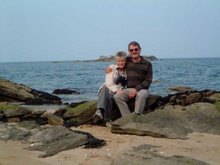
Last day, and a picnic by the sea. That’s us, on a stunning headland overlooking several inlets and bays with islands. Lots of boats of all sizes and types were visible, from a canoe and sailing boats up to cargo ships heading for St Malo, and also a naval vessel, so plenty to look at through the binoculars. No picnic by the sea is complete without a seagull, and this one here had a great weakness for Pringles.