Tuesday, 12 April 2016

Cartagena: The Roman Theatre

Cartagena is a pleasant city that’s been around for over 2000 years, so there’s plenty of history and archaeology to see. This is the central square, with the elegant Town Hall on the left.
After a few hours on the main shopping street, we head for the Roman Theatre. The site was rediscovered in 1988 and slowly excavated, resulting in the current museum and theatre restoration. It’s an impressive size, the second largest in Spain, right in the city centre- so how do you manage to “lose” something that big for so many centuries?
It was a top theatre in its day with high grade workmanship, as shown by this headless statue. The folds in the marble look so realistic. 
A real oddity is the cathedral that was constructed on the top level of the theatre in the 13th century. It was modified several times over the years but was destroyed by aerial bombing during the Spanish Civil War (1936 to 1939). The ruins are visible under the crane in the photo.
A closer look shows it to have been a splendid building; it’s still used as a venue during the annual Cartagena Music Festival. 
Roman theatres in general presented a range of plays, comedies and tragedies, as well as variety acts like juggling. Here there was also an orchestra area, so lots more possibilities although there was no specific information on actual performances; it’s all been lost in the mists of time.
The orchestra occupied the semi-circle in front of the stage and I’ve greyed out the blocks of flats in the background to make the outline of the theatre ruins clearer.
The museum, housed in a separate building, also summarised the history of Cartagena up to current times, with exhibits bearing descriptions in English and Spanish. All very interesting and well displayed.


Thursday, 7 April 2016

The Mines of Mazarron

There is evidence of mining here as far back as the 3rd century BC, but the first identifiable mine is Roman. Here we are hovering above the entrance to the Roman mine, trying to imagine the awful working conditions of gruelling manual work in the baking summer heat.  
The mines worked until 1966, so most of the remains are of much more recent times. This is the dirt road leading into the mining complex with some picturesque spoil heaps. 
Peak production was during the period 1860 to 1940, so most of the dilapidated buildings and machinery date from that era. At this time around 2,000 people were employed. An idea of the scale can be gauged from the number and size of the decaying structures.
The main deposit was lead-zinc-silver ore, and it was the declining price of these metals and the deteriorating condition of the mine workings that caused mining to cease. The winding gear is still in place, be it falling apart and in no way usable.
Many parts are quite dangerous although some token safety barriers have been erected. These you could easily hop over or duck under, like this mine shaft where I could photograph right down to the water level several hundred metres below. I was expecting to see it full of mother-in-laws.
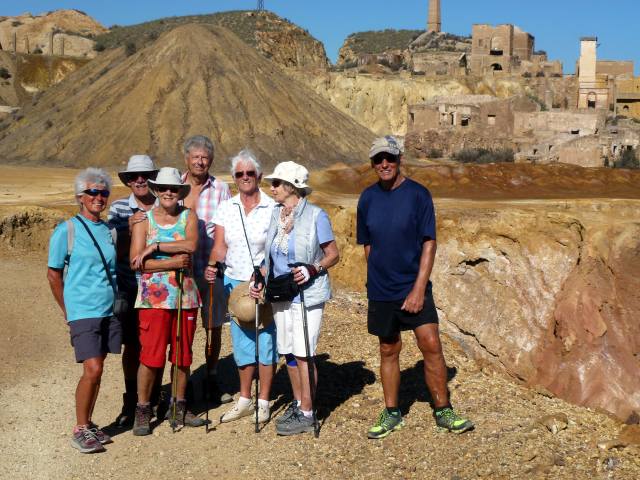
Our group photo is even poised on the edge of a steep open pit. You get used to these hazards after a while.
There are some strange structures like this tunnel running up a hill. We ask, why do you need a tunnel above ground when surely they’re all underground? Jan, our walk leader, had the answer: for ventilation.
There was a chimney at the top of the hill connected to the tunnel in which a fire was lit, drawing air up the tunnel. The tunnel was connected to the mine workings underground drawing stale air out of the mine and pulling fresh air in from a vent open elsewhere.
Elsewhere, there are some surreal colours in the pools where the minerals have mixed with water, like this one.
It’s quite sad to see it in a tumbledown, abandonned state but the advantage is that there is unrestricted access. The worst hazards are partially protected but it is up to the individual to watch out for their own safety. So take care, but it’s fun exploring in a potentially risky but authentic environment. We’ve maybe lost something in being too health and safety cautious in the UK. 


Monday, 4 April 2016

The Walks

The walking group is organised by Jan and Marjon who live on site all year. These are extremely well researched, and varied. The following scenes are from a selection of these walks that lay practically all within a 10 mile radius of the campsite.

The next photo is us on a typical donkey track in the hills. We’re the only asses using the paths these days. 
Some of the views are quite spectacular; this one for example, as we head towards the broken rocks.
Now we are at the broken rocks, so called because of their sharp, jagged edges. We note some new ones have split from the cliff. 
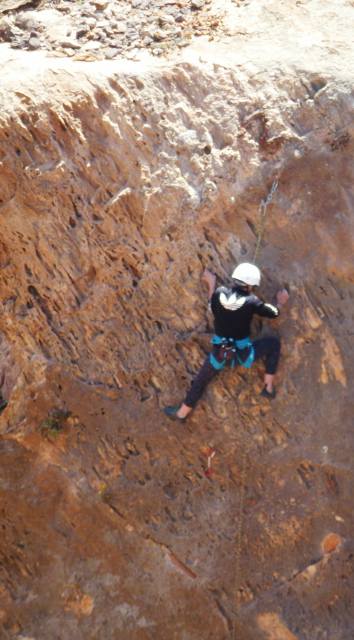
Where there are dangerous rocks there are climbers. It’s comforting to know rescue is at hand should any of us lean over too far!
We sometimes unexpectedly stumble across wildlife (we do a lot of stumbling), like this tiny tortoise. I took the photo with someone’s boot to show how small it was. It didn’t move, apart from a wiggling hind leg: Jan wondered if the solar panels in its shell were down as it was a dull day. 
We see flowers, too, especially at this time of the year, of the scrub land variety but pretty nonetheless.
We often look down on villages we recognise from the hilltops, and even spot a cantina or two that we’ve used for refreshments after a walk.
Our descent may take us through a small gorge, testing our legs and lungs, but not requiring any mountaineering skills other than the ability not to fall over loose rubble on the path or trip over another rambler.
And a drink at a local cantina after the walk really goes down well!


Friday, 1 April 2016

Los Madriles

We nearly didn’t bother coming here, and yet it’s certainly our best site in Spain and probably anywhere else. Here’s a quick rundown on why we think it’s so good.

We’ll start with “Main Street”. It’s on a slope with access roads to terraced pitches running off from each side, so most campers have a sea view.
Following Main Street in the other direction, upwards, the views are of the mountains. An empty pitch in the photo shows they’re of good size and gravelled: good for levelling and drainage. The only pitch you don’t want is next to the toilet emptying point!
The pitches are separated by conifer hedges and bougainvillea fences facing forward, with our pitch that looks seawards as an example.
At the bottom of the site are the swimming pools. One’s enclosed; the other is open-air and large. Both use thermal spring water and are always at 80+ degrees. This is the open air pool, with a spectacular mountain backdrop.
Climbing the mountain behind the pool, as we did a few days ago, gives a panorama of the whole site and its setting. A stiff hour’s ascent starting from the campsite brings you to the top, and this view. The white areas are plastic greenhouses producing plastic tomatoes for the supermarkets. These are nowhere near so dominating at ground level. 
Whilst we’re up here, 1,000 feet above the campsite, let’s look inland to the mountains that are full of old tracks and trails making it wonderful walking country. More about that in following blogs.
We’ve also got a shop on site, table tennis, boules, tennis, library, cafĂ© and a social programme in peak season (wintertime). Reasonable rates, too. And still I feel that I’ve not done it justice!


Sunday, 27 March 2016

Motril

Our campsite’s address is Salobrena, although it’s much nearer to Motril. Motril is a working city that gets short shrift in the guidebooks, but it’s not without its charms. Here’s part of the city centre with an apartment block as well designed as in any posh city.
On the edge of the centre is a church and public park. The church is set in landscape gardens and very pleasant, but unlikely to rival the Alhambra Palace.
The church interior doesn’t disappoint. It’s very ornate and beautifully maintained. The chapel behind the altar is the centrepiece, an area of total magnificence. I’m not sure of the significance of the pair of horns that could have come off either a Viking helmet or Desperate Dan’s cow pie.
The park is below the church, which we can frame between the two sculpted figures that represent the discovery of the New World. The Europeans (nude man on right) are meeting the Native Americans (nude man on left). You may note that the tableau has been ‘enhanced’ by graffiti and also purple paint on the European’s private parts, fortunately not luminous.
Back at the campsite, we set off for a walk along the side roads behind the site. These are always interesting; usually we spot many birds and creatures.
This time it’s the humans’ turn. Around the corner of the narrow, pot-holed road there comes a lightweight motorbike bearing two men and a dog. Sequence of events: bike stops at a field gate, man gets off and hastily picks up large armful of wood; bike makes off, now with wood, two men and a dog, weaving between deep ruts. ‘Good luck’, is all you can say!
Our time in Salobrena is coming to a close. The question is, ‘where to next?’ We considered the Cabo de Gata National Park, but decide to take the easy option and return to a site we have enjoyed staying at many time before: Los Madriles.


Thursday, 24 March 2016

Salobrena Town

Salobrena is an Andalusian white town near our campsite. This is a typical steep street that we ascended on our way to the castle.
The houses show a simple elegance in spite of the angle of the street.
The beautiful shrine at the top of the street looks like a dead end, but steps carry on upwards from both the left and right of the Virgin Mary. It looks like she might be there to point out the paths for those confused.
We pass through delightful little squares like this one at the top of the long flight of steps from the shrine. 
Onwards and upwards! But very picturesque, with ornamented cobbled paving, so well worth the effort.
Now we have arrived at the castle, the highest point in Salobrena. It was built by the Moors (the Arabs) in the 10th century and has only just opened to the public after major restoration that is still not complete.
It’s a traditional looking castle for those days with big, strong walls set on a good defensible position like a mound, or hill, or rocky outcrop.
The view over the battlements is extensive although a little too misty to see the distant mountains. However, I did zoom in on the last sugar cane processing factory in Europe, which closed in 2006. The Moors brought the sugar cane crop with them in the 10th century when they settled on this coast, and found the climate around Salobrena to be ideal for it to flourish. The area became a major sugar producer until the plant was introduced to the West Indies by Spanish explorers where it thrived even better. Thereafter, the home industry went into a slow decline. 
The fort’s practical purpose didn’t prevent the builders from including artistic design features, like the circular patterns in the brickwork on the top of the water cistern.
Leaving the castle, we descended the steep streets back to the car and drove a few miles to the coast. A glance back shows the rock on which the castle is built; you can see what a good defensive position it occupies.
We end on a sad note, from the Spanish Civil War. Its tragedies are overshadowed by the Second World War that started soon after, so are not much reported outside of Spain.
This monument below describes the flight of thousands of refugees heading east from Malaga to escape Franco’s advancing troops. The fleeing refugees, mainly women, children and old folks, were bombed and shelled by Franco’s forces as they retreated. At the Guadalfeo River near Salobrena, swollen by winter rains, many drowned as they tried to cross in panic to escape. In that complete journey between 3,000 and 5,000 refugees perished.
We enjoyed an interesting day out, rounded off with a very enjoyable Chinese meal at €5.95 (£4.60) for the 3 course set menu.


Sunday, 20 March 2016

Fish Market of the Future

Stan has an unusual local visit lined up: the fish auction at Motril. It’s just a couple of miles and located, unsurprisingly, at the fish dock. We see a traditional fishing boat on blocks presumably for maintenance. It makes a fine sight in the evening sun.
But these aren't the usual boats anymore; it's now the world of the deep sea trawler, and these are the boats tied up at the quay unloading their catches for the auction.
Close up, these boats look as if they mean business with those metal plates hanging off the back. You wouldn’t want to tangle with the trawlerman in the yellow leggings either.
It’s not all mechanised though, and we surprised this chap mending nets in the traditional way. 
Now we come to the futuristic bit. The fish come off the boats, all sorted into different types, in these blue boxes.
Nothing unusual about that, but then each box gets put on a slowly moving conveyor belt that passes in front of rows of seats where the buyers sit. Notice that there are several TV screens facing the buyers.
The conveyor belt stops at each blue box under a downward pointing camera so a picture of the fish in that box is shown on the TV screen. The bidding for that box now starts, in complete silence! This is how it works.
You can perhaps see that each buyer is holding something: it’s an electronic pad that he presses to make a bid. The highest bidder’s device also identifies the bidder, and a ticket is printed out that falls into the box so the purchaser can find what he’s bought at the end of the auction. The conveyor belt then moves on to the next box.
Stan’s comment, on looking at the TV screen images of the various fish types going past, was, “It’s very sad, this is their last family photograph!” 
So it’s goodbye from the fish auction, and from the big fella in a box all to himself.