Wednesday, 14 June 2017

June 7th: Bayeux and the Tapestry

Bayeux was the first city to be liberated after D Day and suffered little war damage so the town still retains many medieval features. This is a typical example from the central area.
Here is a picturesque old mill on the river Aure that runs through the old part.
The outstanding building in the old town is the cathedral. It was built by order of Bishop Odo, William the Conqueror’s half brother and dedicated in 1077. It has been altered since, as practically all cathedrals have, but nonetheless retains a beautiful harmonious image.
The crypt, part of the original  structure, is highly atmospheric with illustrations of angels playing trumpets and what my guide book tells me are bagpipes. Anyone, angels included,  playing ‘Scotland The Brave’ for all eternity might just shorten the queue for Heaven a little.
The cathedral contains some colourful friezes, one showing the murder of Thomas a Becket in Canterbury cathedral in 1170. He was more Norman than English, with connections to Bayeux, hence meriting the illustration here. We forget that religious buildings were often decorated in bright colours that have faded over the centuries. This restored small alcove suggests how parts of the cathedral may have looked in its heyday.
I do like a nice gargoyle. This one is a carving rather than a gargoyle but look like he’s just bitten on a sour lemon.
Above all it’s the sheer elegance of the building that is so impressive. Look at the vaulting bathed in the gentle light through the east end stained glass windows.
The Bayeux Tapestry used to be shown annually in the Cathedral but is now on permanent  exhibition at a dedicated museum a few hundred metres away where it is stored under optimum conditions to preserve it for posterity.

This is where we’re now heading , to the Tapestry Museum. Long queues, so we buy the tickets and come back after lunch. Now slightly shorter queues.
No photos of the tapestry, understandably, so what follows are photos of photos that may not be best quality. 
The tapestry is 230 feet long, 20 inches high and contains 58 numbered scenes. Scolars say there was originally one further scene, now missing, at the end. 
Each visitor is issued with an audio guide describing the events in sequence in the tapestry. The audio commentary starts automatically and cannot be paused: you have to keep moving so the description synchronises with where you’re looking.   
The story starts with ageing English king Edward The Confessor sending Harold to tell William Duke of Normandy that  he, William, is to be the successor to the English throne. Harold pledges allegiance to William and they are the best of chums.  Shortly after, King Edward dies and Harold grabs the throne of England for himself. William feels both incensed and betrayed so decides to invade England to reclaim what he sees as his right. Here’s the invasion fleet on the way.
It seems to be quite a jolly affair, indeed, the commentary pointed out that some of the horses on board are smiling. Then, when they land at Pevensey beach, they have a barbie! Chicken and various meats are identified and a good time is had by all. Bishop Odo is seen seated at the circular table on the extreme right.
Now comes the serious bit. William moves inland a few miles to join battle with Harold who has appeared  with his troops that have forced marched from Stamford Bridge in Yorkshire. Notice how the tapestry manages to impart movement to the mounted horsemen by the use of different colours. Bishop Odo- that man again- is seen in one of the frames carrying a mace into the battle. Being in holy orders, he was not allowed to draw blood but it was ok to brain the enemy with his mace. Must keep to the rules.
Sad end- and we all know this bit- Harold perishes with an arrow in his eye. He’s difficult to spot, but Harold is holding the almond shaped burgundy shield with the white cross. He’s also the one with the arrow in his eye. Should have worn safety goggles.
 The final outcome was that William won and was crowned King of England in Westminster Abbey on Christmas Day 1066.

The Tapestry was commissioned soon after 1066 by none other than Bishop Odo. As expected, the story is told from the Norman perspective, but that is the winner’s prerogative. Its account is pretty even-handed, to be fair.
It is generally thought to have been embroidered in England, probably Winchester or Canterbury; perhaps both.
The Tapestry’s own history is quite diverse, and it is first recorded in 1476 as part of the Bayeux Cathedral inventory. It disappears and pops up again regularly, for instance in the French Revolution when it was used for covering military wagons until rescued by a local lawyer. Now it’s safe in its climate controlled environment.
The Tapestry is a unique historical document, particularly in furnishing us with military and civilian details of that era. We certainly felt it a privilege to be able to look back through its window on events nearly 1000 years ago. 


Saturday, 10 June 2017

Around D Day: The Longest Blog

There were lots of festivities associated with the D Day landings, so we visited several of the nearest towns to sample some. First up: Courseuilles, in the Canadian sector of the landings. Here we saw a highland pipe band; in fact, a French pipe band, but they looked the part and played all the expected Scottish airs.
In every event there were numerous enthusiasts dressed in WW2 uniforms with period vehicles, mainly jeeps, some motorbikes,lorries and a few ambulances. Here’s a selection.

I guess this next tiny motorbike was used by the infantry!
An information board proclaimed that a staggering  639,245 jeeps were produced during WW2. It seems that a good number have survived and are this week driving around Normandy.

It was also great to see several proud veterans wearing their medals. 
There aren’t many left, and fewer still who are fit enough to make the anniversary journey; some, too, for whom revisiting the battle site is too painful. This memorial, one of many, brings home the scale of the losses. The names of the fallen are written on all sides, several to each line. There are many more pillars out of camera shot. And these are just the Canadians. 
The memorial in the town centre announces that General De Gaulle came ashore here on 14th June and declared the liberation of France. It reads like he’d seen the Germans off single-handed.
!30,000 men landed on these beaches on the first day, and a further 29,000 paratroops inland. But it was no push-over. The Allies faced well armed Germans in well prepared defences. This gun battery at Longues is the best preserved, and was able to pepper the landing armadas of both the British and Canadian sectors.
It was claimed that the battery was put out of action by the Royal Navy early on D Day, but three of the four gun emplacements are intact. The remaining damaged gun looks like it took a direct hit, but the true story is perhaps more interesting. All four guns were captured by the Devonshire Regiment on 7th June and passed to the RAF who set up a temporary airfield on the flat ground adjacent. The RAF sited an anti-aircraft gun on the roof of one gun emplacement, storing the ammunition in the area provided within the emplacement. Somehow the ammunition exploded, wrecking the massive concrete structure and the gun- presumably destroying the RAF’s own gun as well. So RAF 1, Royal Navy 0.
No port was planned for capture on D Day or immediately after so  the British had pre-constructed a temporary floating harbour system called Mulberry. They started towing parts across on the afternoon of D Day itself. There were two separate harbours: one for the Americans and the other for UK/Canadian use, and both were fully operational by 19th June.
At this point, the worst storm for 40 years struck and the American harbour was destroyed. Fortunately the British/Canadian one was more protected and survived to provide port facilities for a further 8 months, landing 2½ million men, 500,000 vehicles and 4 million tonnes of supplies.
The harbour used 10 miles of floating roadways anchored by sunken concrete caissons and jetties. The remains are still much in evidence at the town of Arromanches. This just a small part of it.
A better idea of the scale of the harbour system can be appreciated from a long shot. The dots are all the size of the picture above and would have been joined by the 10 miles of floating road.
There are many museums along the whole coast but the biggest, the Overlord Museum,  is in the American sector. This contains a narrative of the invasion and many items of equipment and vehicles. Some look so innocent like this dust-bin lid which is actually a German pancake mine. 5 million mines of various types were in place along Hitler’s Atlantic Wall coastline together with tank and vehicle obstacles.
Of course the tanks were the most impressive. This American Sherman tank was being driven into the museum from outside. Glad it had good brakes or my writing might be falling a little flat!
 You wouldn’t guess that this lightweight German transport was in fact a modified VW Beetle.
The D Day anniversary celebrations are certainly about having a good time, but the serious side is keeping alive the memory of all those young men who sacrificed their lives. We have all benefited from the defeat of Hitler’s tyranny and should take a moment sometimes- and why not on D Day?- to be grateful to those who died so that we might now have such comfortable lives. 


Thursday, 8 June 2017

France Spring 2017

Start: Wednesday 31st May

Instead of our usual start in the gridlock of the A14 morning rush hour, we decided to leave after lunch. Now it’s the gridlock of the A14 early afternoon. However, at Cambridge it cleared and we beat our booked 6:20 pm tunnel slot by an hour and were offered an earlier crossing that we were pleased to accept. Europe is + one hour, so at 8:00 pm we arrived at the overnight campsite near Boulogne.

It’s not too far to our destination in Normandy the following day, a campsite in the village of Creully near Bayeux. The village, a small town really, is built in creamy/grey limestone typical of the area around Caen that the Normans also imported into England to build some of their finest castles and cathedrals. More to the point, Creully has two bakeries, so we’re looking forward to some delicious croissants and baguettes.

The campsite is green and spacious, but it does rather look like we’ve camped on someone’s front lawn.
Walking from the campsite into Creully is through a pretty wooded glade, which is also a fitness course. This accounts for the structures in the photo.
Some of the fitness equipment bears closer scrutiny as it is top of the range kit of high quality. And not even slightly vandalised.
Creully has a castle, as well as the two bakeries. The village was liberated on D Day itself, 6th June 1944, and that same day the BBC set up a radio station in the castle to report  on-the-spot  progress of the Allied advance. The castle dates from the 12th century and looks in keeping with the BBC’s status.
Unwittingly, we’ve arrived only a few days before the D Day anniversary. It’s the 73rd anniversary, not a milestone one, so we weren’t expecting much in the way of commemoration events. Wrong! It seems the anniversary is big-time every year and is well supported by re-enactment groups. We’ve a chap driving around the campsite in a WW2 jeep for instance.
All the towns and villages along the D Day landing coast seem to have a programme of festivities- swing dances, parades, memorabilia events, fireworks, parachute drops etc. These last for about 3 weeks spanning 6th June, the actual invasion day.  But more about that in the next time. 


Tuesday, 17 May 2016

Rouen

We’ve often driven through Rouen, but this time decided to visit as the campsite on the Seine was convenient for both Monet’s garden and Rouen.

It’s an old city dating from pre-Roman times with much history and many old buildings. As we’re unfamiliar with the city we navigated towards the cathedral’s easily visible spire that from 1876 to 1880 was the tallest structure in the world. It’s like a slim Eiffel Tower.
The cathedral front is predictably magnificent, set in a large, open square.
The carvings are unusually intricate as can be seen from close-up detail. These two could almost be weather men; if so then they’re telling us it’s overcast with spots of rain.
There’s been a church on this site since the 4th century, and the current building was started in the 12th century. It has been repaired and amended many times for various reasons such as lightning strikes, fires, wars, and improvements. The interior, although fairly bare, retains a pleasant appearance in spite of the many different repairs and upgrades it’s had. This stone staircase looks particularly elegant.
Religious statues are generally carved in solemn, grave style, but occasionally the sculptor sneaks a bit of humanity into his work. Has the guy on his right told St Peter a naughty joke (“Have you heard the one about the actress and the bishop?”), and he’s trying hard not to laugh. Despite what he’s holding, he definitely not keyed up.
Rouen Cathedral is famous for its bells, the heaviest peal in France; one is greeted face-to-face with several of these monsters on entering the nave. They’ve been refurbished, and will be rehung shortly, but in the meantime visitors can see and touch these huge bells that will soon be chiming out hundreds of feet above us. It was a striking encounter, you might say.
We came unexpectedly upon the next building around a quadrangle, called the Atrium of Saint Maclou. 
It is. or rather was, an ossuary, a place to store the bones of the dead. It came about as a result of the plague outbreak in 1348 when a large proportion of Rouen’s population was wiped out. A huge pit was dug, where the central courtyard is, into which all the bodies were placed regardless of status.
The bones remained in the pit until a second outbreak of plague in the 16th century that also devastated the inhabitants. The original pit was full, and now they needed space for more bodies, so in 1526 the cloisters that now surround this courtyard were built to house the old bones; the pit would then be available for the recent victims. Wouldn’t it have been easier to dig a new pit? Anyway, this is part of the wonderful medieval structure they raised.
There are many different carvings in the woodwork right around the rectangle appropriate to its purpose: skulls, bones, gravediggers tools etc.
This unique set of buildings is showing signs of decay although was occupied by the Fine Arts School until recent years, the bones having been removed and buried several centuries previously, as were the bones in the central pit. However, any modern excavations immediately uncover bones so the removal wasn’t very thorough. It must be a popular spot of dog-walkers. 
Wandering off, we strolled through many medieval streets like the one below.
We stopped to look at the Law Courts. The building dates back to 1499 and has been used as a royal palace, the exchequer and the Normandy Houses of Parliament. It was badly damaged in the last war but has been expertly restored.
We were making for the Joan of Arc memorial church, but first had to pass under the Gros Horloge arch, that’s the Big Clock. It’s one of the oldest in France and has a movement dating from 1389. It’s a beautiful old timepiece, difficult to read the time; but does it matter.
Joan of Arc is associated with Rouen because she was burnt at the stake here. In this square. She is one of the few foreign heroes we know in the UK perhaps because we, the English, captured her and condemned her to that terrible fate.
The Church of St Joan was built in this square in 1979 amid much controversy. It does look unconventional, but seems to work both inside and out. This is the interior with stained glass windows telling the story of the life of Saint Joan.
Rouen had more to see than we could fit in during one day, although it is largely an industrial city and the area of interest is confined to what is left of the old city. Maybe an overcast day didn’t help, but the old town seemed somewhat run-down and, although interesting, could be presented as an historic gem given some investment and tlc.

Tomorrow: the tunnel, and home.


Friday, 13 May 2016

Monet’s Garden

We’re now at a campsite by the Seine, 30 minutes from Giverny where the impressionist painter Monet lived from 1883 until his death in 1926. Throughout the time he lived there, Monet developed his garden into a showpiece of colour, with features such as a lake and a Japanese bridge, which he used as the subject of many of his paintings.
Monet’s son inherited the property and left it to the French Academy of Fine Arts on his death in 1966. The house and gardens were restored as they were in Monet’s day and were first opened to the public in 1980.

We are visiting in early May, the best time to experience the vibrant spring colours. Many others thought so too, so the entrance queue was a long one but it was well worth the wait. This is a general overview.
The arch running through the centre is particularly attractive.
The beds are themed around groups of colours; in front of the house are red and pink tulips with blue forget-me-nots.
There is a huge number of tulip varieties; here are a few in this collage.
Monet painted in the impressionist style, and it was interesting to see how well my photo shop programme converted a few of my photos into this genre. Instant Monet?
We enter the house now; the rooms are furnished in late 19th/ early 20th century style with Monet’s collection of Japanese prints on the walls of many of the rooms. This is Monet’s studio which had copies of his paintings hanging on the walls.
The kitchen’s a cheerful yellow and can be compared with an old photo of Monet himself in the same room. I’m not sure what he would have made of all the tourists.

It’s the garden that really holds our attention, probably because it was the subject of so many of his paintings. We make for lake and the Japanese bridge; it’s beautifully laid out like the rest of the gardens, and the bridge is instantly recognisable especially if given the Monet photo shop treatment.
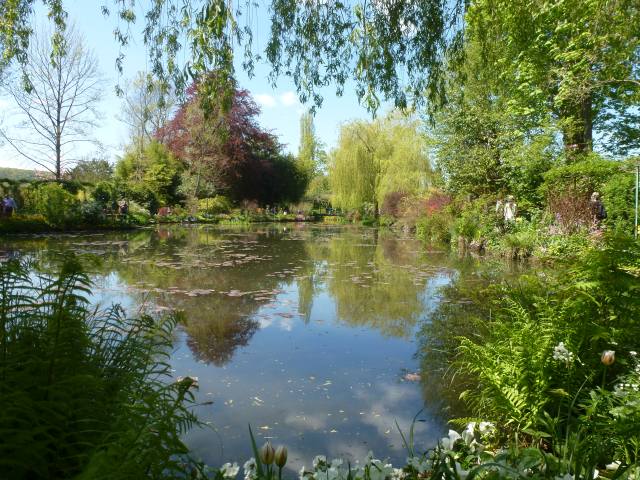
An overall view of the lake is also worth taking in; he often painted the water lilies here.
Monet’s garden was a stunning experience and so evocative of his paintings. However, he wasn’t the only artist in Giverny in that era: there was a thriving colony of mainly American artists, and these are presented in the Giverny Museum of Impressionism just up the road. Here again there are beautiful gardens, so Monet hasn’t got it all his own way.

Inside was an exhibition of works by Gustave Caillebotte. We’d never heard of him, either. He was apparently a close friend of Monet’s, and a few of his paintings seemed familiar, for example this one. I reckon he’s just dumped the girlfriend over the side and is rowing off for dear life.
Giverny village is pretty but obviously touristy given the numbers of visitors, but it avoids being too tacky and commercialised. This is one of the many cafes and looks very much in keeping with the village setting.
We were lucky, of course, with the time of year and warm sunny weather, but what a delightful day out. It certainly left a lasting impression!