Thursday, 22 June 2017

Sunday 18th June: The Fastnet Race

This is a big race in the calendar, although you wouldn’t guess so from the makeshift banner on the quay strung between two rubbish skips,
It’s an ocean race around the Fastnet lighthouse at the tip of Southern Ireland. I thought originally that the  description “Mini” meant that the  race would be around a tiny Fastnet lighthouse, as opposed to the full size one. However, it refers to the restriction on the length of the competitors sailboats: no more than 6.5 metres; that’s apparently small by ocean racing standards. There are 56 craft with two crew to each.
This is the forest of masts the day before the race.
This is what 6.5 metre yachts look like close up.There’s a crew member on board the middle one for scale. No restriction on width, though, so my competition yacht would need to be 6.5 metres long by 15 metres wide. 
There is frantic activity. Items being stowed, sails being checked and running repairs. This guy’s in a frogman suit fixing the rudder. Can’t have the boat going round in circles.
Another boat is on it’s side for repair- but still in the water! The craft look like small lifeboats, so I guess there’s no danger of them sinking.
We’re down at the pleasure port, Treboul, the next day, to see the start of the race. There’s hardly any wind in the port so each boat is towed out to the starting point a mile or so off shore. Here they go past the harbour entrance.
Meantime, we’ve found a little bay round the corner from the breakwater where we can eat our picnic and watch the competitors emerging under tow into the open sea.
 It takes a couple of hours to tow out all 56 boats, so we have plenty of time to eat and get up to our viewpoint on the top of the cliff to watch the 3:00 pm start. They stream out steadily and mill around over a wide area in the bay. Some other yachts sail out too, for instance this handsome older vessel with the brown sails. You can see the race competitors in the background.
A schooner on the far side carries the race officials and the starter. It’s getting towards 3:00 pm and you wonder how they’ll manage to assemble the participants into some sort of starting line; they are all over the place. Miraculously, as it approaches 3:00, they all seem to bunch together, as this long distance shot shows. That’s seamanship!
In most races, when the gun goes off, the competitors zoom away from the start line and jostle for position. In sailing, the gun (hooter, actually) goes off- and nothing happens. Then, ever so gradually and gracefully, the yachts form a line and head for the open sea in a most orderly fashion.
I’m sure it can’t be this gentlemanly all the way, and there has to be a drive to win as in all top level sports. Presumably, they’re monitored by satellite so that one doesn’t cut a corner by not rounding the lighthouse, or another rendezvous with a pal who gives a tow in his high powered speedboat.
But seriously, these are highly professional sailors, and whereas today the sea is a millpond, it can quickly change into a raging storm which they will need to sail through. I’ll stick to a punt on the river Cam, thanks.


Tuesday, 20 June 2017

Brittany: Some Local Towns

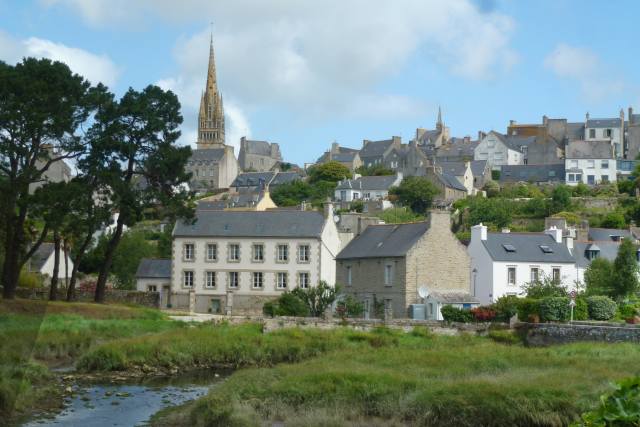
The first impression is of solidly built houses with slate roofs, able to cope with any weather. This photo of Pont-Croix, the small town nearest the campsite, is typical.
It might look rather dour and somewhat English, compared to the vibrant colours of the Mediterranean, but there is plenty of charm and interest here. Take for instance this intricate 14th century porch on the main church.
There is also a tide mill in the estuary, not in working order, but well preserved none the less. You can see the water entry points at the bottom of the building. The estuary looks like it could do with a good clean out for the mill to be working efficiently.
The old town centre is at the top of the hill around the church where there are cobbled streets and old buildings. In this picture we are looking towards a 17th century Ursuline convent church that is oddly marked on my tourist information brochure as the “ancient clothes drying shed”! This shed was clearly of some historical importance-  perhaps the equivalent of the school bike sheds, tucked round the back, where the nuns went for a quiet ciggy.
On to Douarnenez, a larger town and an important fishing port, even today. It could be described as “shabby chic” as demonstrated by the peeling paintwork on this row of (originally) smart buildings overlooking the pleasure port.

This is the pleasure port that the buildings face. The white buildings on the left in the photo are part of the modern fishing port complex, landing mackerel, sardines, tuna and lobster. The town also produces the greatest amount of canned fish in Europe.
 Along the prom is a building housing a fishing magazine. It was built in 1914 as a seaman’s mission to look after those who had fallen on hard times or difficulties It was founded by a wealthy  American who was moved by the plight of the unemployed fishermen when he visited the area before the First Word War.
You pass many individual cottages around the town, like this pair, the one on the right looking at you with astonished top window eyes.
It has to be said, they do make an effort with flowers in all the towns and villages. This restaurant is a bit OTT, but quite striking. Don’t think there’s a risk of anyone nicking the bike.
It’s an area that we have warmed to- “warm” being the operative word as it’s been over 30 degrees these last few days. That’s not typical for Brittany; it’s usually like west coast UK but slightly warmer.


Saturday, 17 June 2017

June 8th: to Brittany

A full day’s drive takes us to Pors Peron in Brittany. Pors Peron is a hamlet with a campsite of the same name. This is where we are staying. It’s 300 metres down a steep road to the beach, a pretty cove with fine sand.
It’s a rugged coastline very much like Cornwall; in fact, this area is called La Cornouaille. There is a splendid path following the whole coast along the clifftops from where walkers can get great views. Even on a fairly calm day there is some surf, especially around the exposed rocks.
The path itself is well maintained and mostly quite manageable but there are some scrambles that come close to the cliff edge and even closer to threatening one’s comfort zone. The photo below is of an easy bit.
Passing through one of the many small bays joined by the coast path, we noticed this monument. It commemorates the 23/24th August 1943 when a crew of 8, with 14 passengers, set sail for England to join the Free French forces. There are many other such  instances from all along the coast according to the guide book; it doesn’t say if any sailed back again in disillusion.
 We return to the campsite via an inland route, passing this farm building on the way. Notice anything unusual? A brand new roof with a huge dent in it: could the cows be trampolining nearby?
This is home for the time being, a large, quiet, level pitch. The climate here is mild due to the proximity of the sea, which accounts for the palm tree. The site is owned and run by Brits with a high proportion of Brit campers. It’s very ship-shape with a swimming pool and full facilities- but, disappointingly, no cricket pitch.


Wednesday, 14 June 2017

June 7th: Bayeux and the Tapestry

Bayeux was the first city to be liberated after D Day and suffered little war damage so the town still retains many medieval features. This is a typical example from the central area.
Here is a picturesque old mill on the river Aure that runs through the old part.
The outstanding building in the old town is the cathedral. It was built by order of Bishop Odo, William the Conqueror’s half brother and dedicated in 1077. It has been altered since, as practically all cathedrals have, but nonetheless retains a beautiful harmonious image.
The crypt, part of the original  structure, is highly atmospheric with illustrations of angels playing trumpets and what my guide book tells me are bagpipes. Anyone, angels included,  playing ‘Scotland The Brave’ for all eternity might just shorten the queue for Heaven a little.
The cathedral contains some colourful friezes, one showing the murder of Thomas a Becket in Canterbury cathedral in 1170. He was more Norman than English, with connections to Bayeux, hence meriting the illustration here. We forget that religious buildings were often decorated in bright colours that have faded over the centuries. This restored small alcove suggests how parts of the cathedral may have looked in its heyday.
I do like a nice gargoyle. This one is a carving rather than a gargoyle but look like he’s just bitten on a sour lemon.
Above all it’s the sheer elegance of the building that is so impressive. Look at the vaulting bathed in the gentle light through the east end stained glass windows.
The Bayeux Tapestry used to be shown annually in the Cathedral but is now on permanent  exhibition at a dedicated museum a few hundred metres away where it is stored under optimum conditions to preserve it for posterity.

This is where we’re now heading , to the Tapestry Museum. Long queues, so we buy the tickets and come back after lunch. Now slightly shorter queues.
No photos of the tapestry, understandably, so what follows are photos of photos that may not be best quality. 
The tapestry is 230 feet long, 20 inches high and contains 58 numbered scenes. Scolars say there was originally one further scene, now missing, at the end. 
Each visitor is issued with an audio guide describing the events in sequence in the tapestry. The audio commentary starts automatically and cannot be paused: you have to keep moving so the description synchronises with where you’re looking.   
The story starts with ageing English king Edward The Confessor sending Harold to tell William Duke of Normandy that  he, William, is to be the successor to the English throne. Harold pledges allegiance to William and they are the best of chums.  Shortly after, King Edward dies and Harold grabs the throne of England for himself. William feels both incensed and betrayed so decides to invade England to reclaim what he sees as his right. Here’s the invasion fleet on the way.
It seems to be quite a jolly affair, indeed, the commentary pointed out that some of the horses on board are smiling. Then, when they land at Pevensey beach, they have a barbie! Chicken and various meats are identified and a good time is had by all. Bishop Odo is seen seated at the circular table on the extreme right.
Now comes the serious bit. William moves inland a few miles to join battle with Harold who has appeared  with his troops that have forced marched from Stamford Bridge in Yorkshire. Notice how the tapestry manages to impart movement to the mounted horsemen by the use of different colours. Bishop Odo- that man again- is seen in one of the frames carrying a mace into the battle. Being in holy orders, he was not allowed to draw blood but it was ok to brain the enemy with his mace. Must keep to the rules.
Sad end- and we all know this bit- Harold perishes with an arrow in his eye. He’s difficult to spot, but Harold is holding the almond shaped burgundy shield with the white cross. He’s also the one with the arrow in his eye. Should have worn safety goggles.
 The final outcome was that William won and was crowned King of England in Westminster Abbey on Christmas Day 1066.

The Tapestry was commissioned soon after 1066 by none other than Bishop Odo. As expected, the story is told from the Norman perspective, but that is the winner’s prerogative. Its account is pretty even-handed, to be fair.
It is generally thought to have been embroidered in England, probably Winchester or Canterbury; perhaps both.
The Tapestry’s own history is quite diverse, and it is first recorded in 1476 as part of the Bayeux Cathedral inventory. It disappears and pops up again regularly, for instance in the French Revolution when it was used for covering military wagons until rescued by a local lawyer. Now it’s safe in its climate controlled environment.
The Tapestry is a unique historical document, particularly in furnishing us with military and civilian details of that era. We certainly felt it a privilege to be able to look back through its window on events nearly 1000 years ago. 


Saturday, 10 June 2017

Around D Day: The Longest Blog

There were lots of festivities associated with the D Day landings, so we visited several of the nearest towns to sample some. First up: Courseuilles, in the Canadian sector of the landings. Here we saw a highland pipe band; in fact, a French pipe band, but they looked the part and played all the expected Scottish airs.
In every event there were numerous enthusiasts dressed in WW2 uniforms with period vehicles, mainly jeeps, some motorbikes,lorries and a few ambulances. Here’s a selection.

I guess this next tiny motorbike was used by the infantry!
An information board proclaimed that a staggering  639,245 jeeps were produced during WW2. It seems that a good number have survived and are this week driving around Normandy.

It was also great to see several proud veterans wearing their medals. 
There aren’t many left, and fewer still who are fit enough to make the anniversary journey; some, too, for whom revisiting the battle site is too painful. This memorial, one of many, brings home the scale of the losses. The names of the fallen are written on all sides, several to each line. There are many more pillars out of camera shot. And these are just the Canadians. 
The memorial in the town centre announces that General De Gaulle came ashore here on 14th June and declared the liberation of France. It reads like he’d seen the Germans off single-handed.
!30,000 men landed on these beaches on the first day, and a further 29,000 paratroops inland. But it was no push-over. The Allies faced well armed Germans in well prepared defences. This gun battery at Longues is the best preserved, and was able to pepper the landing armadas of both the British and Canadian sectors.
It was claimed that the battery was put out of action by the Royal Navy early on D Day, but three of the four gun emplacements are intact. The remaining damaged gun looks like it took a direct hit, but the true story is perhaps more interesting. All four guns were captured by the Devonshire Regiment on 7th June and passed to the RAF who set up a temporary airfield on the flat ground adjacent. The RAF sited an anti-aircraft gun on the roof of one gun emplacement, storing the ammunition in the area provided within the emplacement. Somehow the ammunition exploded, wrecking the massive concrete structure and the gun- presumably destroying the RAF’s own gun as well. So RAF 1, Royal Navy 0.
No port was planned for capture on D Day or immediately after so  the British had pre-constructed a temporary floating harbour system called Mulberry. They started towing parts across on the afternoon of D Day itself. There were two separate harbours: one for the Americans and the other for UK/Canadian use, and both were fully operational by 19th June.
At this point, the worst storm for 40 years struck and the American harbour was destroyed. Fortunately the British/Canadian one was more protected and survived to provide port facilities for a further 8 months, landing 2½ million men, 500,000 vehicles and 4 million tonnes of supplies.
The harbour used 10 miles of floating roadways anchored by sunken concrete caissons and jetties. The remains are still much in evidence at the town of Arromanches. This just a small part of it.
A better idea of the scale of the harbour system can be appreciated from a long shot. The dots are all the size of the picture above and would have been joined by the 10 miles of floating road.
There are many museums along the whole coast but the biggest, the Overlord Museum,  is in the American sector. This contains a narrative of the invasion and many items of equipment and vehicles. Some look so innocent like this dust-bin lid which is actually a German pancake mine. 5 million mines of various types were in place along Hitler’s Atlantic Wall coastline together with tank and vehicle obstacles.
Of course the tanks were the most impressive. This American Sherman tank was being driven into the museum from outside. Glad it had good brakes or my writing might be falling a little flat!
 You wouldn’t guess that this lightweight German transport was in fact a modified VW Beetle.
The D Day anniversary celebrations are certainly about having a good time, but the serious side is keeping alive the memory of all those young men who sacrificed their lives. We have all benefited from the defeat of Hitler’s tyranny and should take a moment sometimes- and why not on D Day?- to be grateful to those who died so that we might now have such comfortable lives.